

Should AI Lawsuits and Mailchimp Woes Require Action From Intuit (INTU) Investors?
Intuit Inc. INTU | 0.00 |
- In August 2026, Grant & Eisenhofer P.A. filed a securities class action in the Northern District of California alleging Intuit and senior executives misled investors about generative AI competition facing TurboTax and the weakening performance of its roughly US$12.00 billion Mailchimp acquisition.
- The lawsuit, alongside related actions, spotlights a growing tension between Intuit’s public messaging on AI as a competitive edge and investor claims that new GenAI tax tools and Mailchimp headwinds were more problematic than disclosed.
- Against this backdrop of AI-related legal challenges and Mailchimp underperformance, we’ll examine how these developments may reshape Intuit’s investment narrative.
The latest GPUs need a type of rare earth metal called Dysprosium and there are only 28 companies in the world exploring or producing it. Find the list for free.
Intuit Investment Narrative Recap
To own Intuit today, you need to believe its AI powered ecosystem across TurboTax, QuickBooks and Credit Karma can keep earning power resilient despite competition and Mailchimp drag. The immediate catalyst is whether upcoming results and guidance reassure the market on tax and Mailchimp trends; the securities class actions around AI disclosures and the May 2026 reset make legal and execution risk around TurboTax competition and Mailchimp performance the central near term overhang.
The August 2026 class actions directly challenge Intuit’s claims that generative AI is a tailwind rather than a threat, putting extra weight on how convincingly management can prove its AI story. Against that backdrop, the August 12 rollout of Intuit Intelligence Chat across QuickBooks Online Advanced and Intuit Enterprise Suite is especially relevant, because it is a live example of the company using AI to deepen its foothold in mid market finance workflows, a key growth catalyst.
Yet behind the AI opportunity, investors should also weigh the risk that generative AI tools narrow Intuit’s pricing power and margin potential over time...
Intuit’s narrative projects $29.1 billion revenue and $6.8 billion earnings by 2029. This requires 11.6% yearly revenue growth and an earnings increase of about $2.2 billion from $4.6 billion today.
Uncover how Intuit's forecasts yield a $449.20 fair value, a 24% upside to its current price.
Exploring Other Perspectives
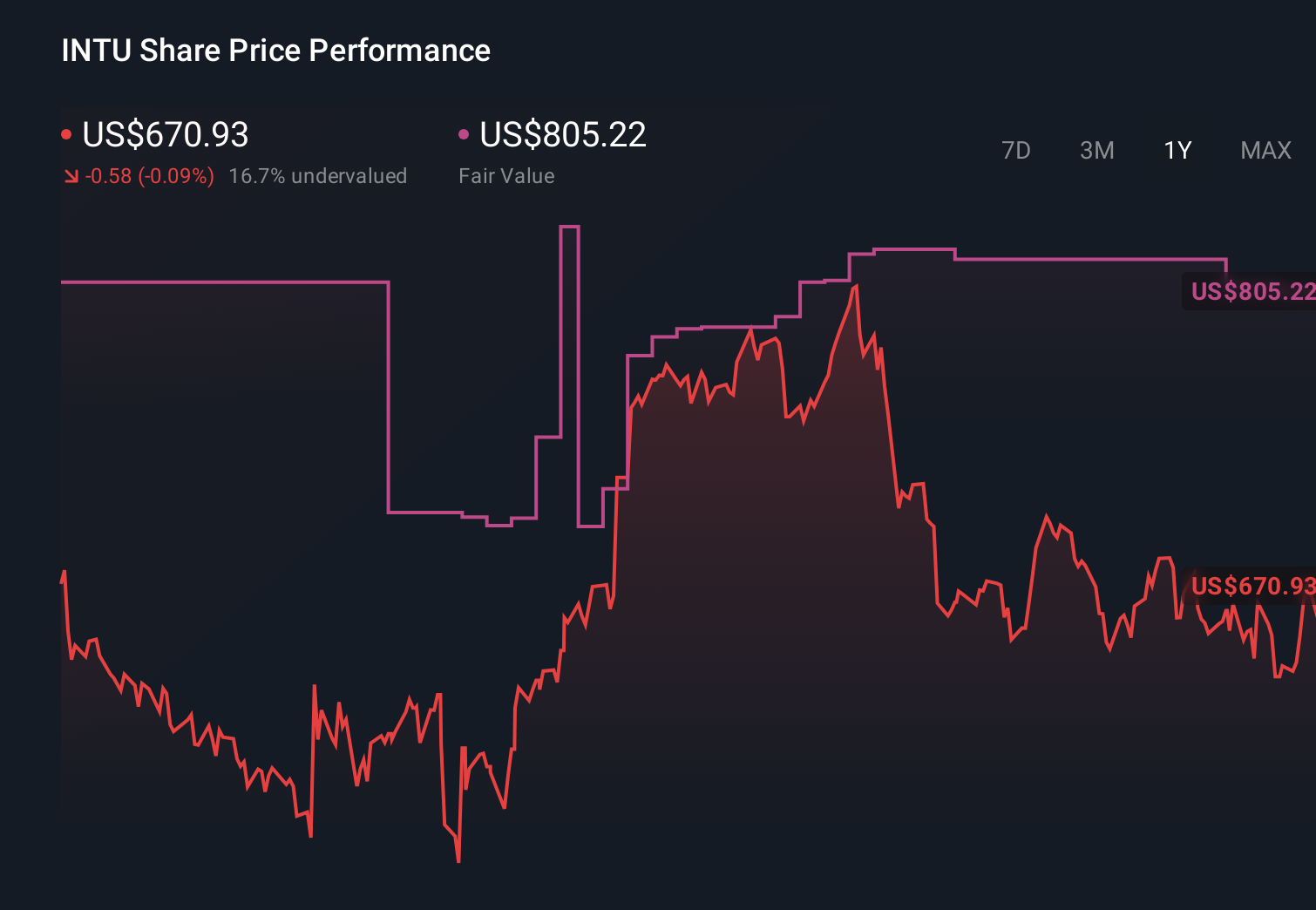
Some analysts were highly optimistic before this news, assuming revenue could reach about US$32.0 billion and earnings US$8.4 billion by 2029, but if cheaper AI only tax tools gain traction instead of Intuit’s AI plus human model, that more bullish path could look very different and it is worth considering how far apart these views really are.
Explore 20 other fair value estimates on Intuit - why the stock might be worth just $390.00!
The Verdict Is Yours
Don't just follow the ticker - dig into the data and build a conviction that's truly your own.
- A great starting point for your Intuit research is our analysis highlighting 4 key rewards that could impact your investment decision.
- Our free Intuit research report provides a comprehensive fundamental analysis summarized in a single visual - the Snowflake - making it easy to evaluate Intuit's overall financial health at a glance.
Ready To Venture Into Other Investment Styles?
Our top stock finds are flying under the radar-for now. Get in early:
- This technology could replace computers: discover 24 stocks that are working to make quantum computing a reality.
- Outshine the giants: these 16 early-stage AI stocks could fund your retirement.
- The future of work is here. Discover the 37 top robotics and automation stocks leading the charge in AI-driven automation and industrial transformation.
This article by Simply Wall St is general in nature. We provide commentary based on historical data and analyst forecasts only using an unbiased methodology and our articles are not intended to be financial advice. It does not constitute a recommendation to buy or sell any stock, and does not take account of your objectives, or your financial situation. We aim to bring you long-term focused analysis driven by fundamental data. Note that our analysis may not factor in the latest price-sensitive company announcements or qualitative material. Simply Wall St has no position in any stocks mentioned.