

Should Baidu’s New Dividend And US$5 Billion Buyback Plan Require Action From BIDU Investors?
Baidu, Inc. Sponsored ADR Class A BIDU | 118.23 116.75 | +5.55% -1.25% Pre |
- Baidu’s board has approved its first-ever dividend policy and a new share repurchase program of up to US$5.00 billion, effective through December 31, 2028, marking a shift toward recurring capital returns funded by operating profits, potential non-core asset disposals and other investment income.
- This move brings Baidu’s capital allocation closer to peers such as Alibaba and Tencent while the company continues to invest heavily in AI, including its Ernie assistant and the planned Hong Kong IPO of chip unit Kunlunxin.
- We’ll now examine how Baidu’s newly introduced dividend policy shapes its investment narrative, particularly given the scale of the US$5.00 billion buyback.
Invest in the nuclear renaissance through our list of 87 elite nuclear energy infrastructure plays powering the global AI revolution.
What Is Baidu's Investment Narrative?
To own Baidu today, you have to believe its AI ecosystem, search and cloud assets can justify a premium valuation even as growth expectations remain modest and profitability has been bumpy. The new dividend policy and US$5.00 billion buyback push the story further toward “show me the cash” rather than just “trust the AI optionality,” especially after years where total returns have swung sharply and net margins were hit by a large one off loss. In the near term, key catalysts still sit around AI monetization, Ernie adoption, Kunlunxin’s planned Hong Kong IPO and any signs that core advertising can support higher, cleaner earnings. The capital return plan itself may not change those fundamentals, but it can influence sentiment if earnings disappoint or if heavy AI spending continues to pressure free cash flow.
However, investors should also weigh how AI spend and low returns on equity could limit flexibility. Baidu's share price has been on the slide but might be dropping deeper into value territory. Find out whether it's a bargain at this price.Exploring Other Perspectives
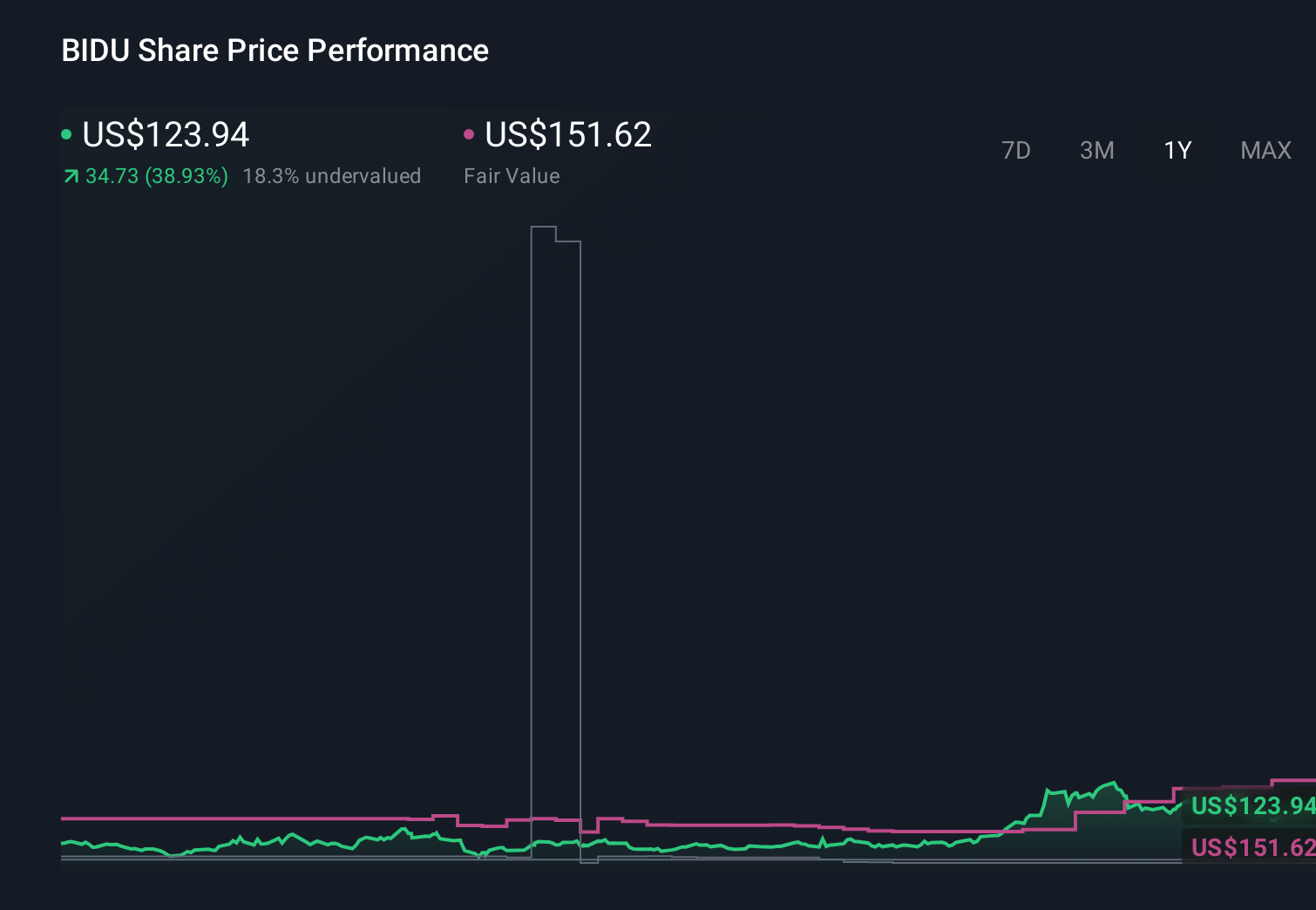
Explore 13 other fair value estimates on Baidu - why the stock might be worth as much as 50% more than the current price!
Build Your Own Baidu Narrative
Disagree with this assessment? Create your own narrative in under 3 minutes - extraordinary investment returns rarely come from following the herd.
- A great starting point for your Baidu research is our analysis highlighting 1 key reward and 2 important warning signs that could impact your investment decision.
- Our free Baidu research report provides a comprehensive fundamental analysis summarized in a single visual - the Snowflake - making it easy to evaluate Baidu's overall financial health at a glance.
Searching For A Fresh Perspective?
Markets shift fast. These stocks won't stay hidden for long. Get the list while it matters:
- We've uncovered the 14 dividend fortresses yielding 5%+ that don't just survive market storms, but thrive in them.
- Uncover the next big thing with 25 elite penny stocks that balance risk and reward.
- Outshine the giants: these 30 early-stage AI stocks could fund your retirement.
This article by Simply Wall St is general in nature. We provide commentary based on historical data and analyst forecasts only using an unbiased methodology and our articles are not intended to be financial advice. It does not constitute a recommendation to buy or sell any stock, and does not take account of your objectives, or your financial situation. We aim to bring you long-term focused analysis driven by fundamental data. Note that our analysis may not factor in the latest price-sensitive company announcements or qualitative material. Simply Wall St has no position in any stocks mentioned.