

Should Duolingo’s Q2 Margin Squeeze and Sallie Krawcheck Appointment Require Action From Duolingo (DUOL) Investors?
Duolingo, Inc. DUOL | 0.00 |
- In August 2026, Duolingo reported second-quarter 2026 results showing year-on-year revenue growth to US$298.45 million but lower net income of US$33.16 million, issued new guidance calling for continued revenue expansion, and later added veteran financial executive Sallie Krawcheck to its board and Audit, Risk and Compliance Committee.
- The mix of higher sales alongside reduced profitability, combined with Krawcheck’s extensive risk and financial oversight background, could influence how investors weigh Duolingo’s growth ambitions against its margin pressures.
- We’ll now examine how Duolingo’s revenue growth outlook and the appointment of Sallie Krawcheck might reshape its investment narrative.
Uncover the next big thing with 20 elite penny stocks that balance risk and reward.
Duolingo Investment Narrative Recap
To own Duolingo, you generally need to believe its large user base can keep converting into recurring revenue, even as competition and user fatigue rise. The latest results, with revenue up but net income down, keep near term revenue growth as the key catalyst while highlighting margin pressure as the biggest current risk. Sallie Krawcheck’s appointment strengthens financial oversight but does not materially change those near term fundamentals by itself.
The new full year 2026 revenue guidance of 15% to 18% growth is the most relevant update here, because it frames how investors interpret the Q2 profit dip and assess whether Duolingo can keep expanding monetization without eroding engagement. Against that backdrop, Krawcheck’s Audit Committee role may matter most for how the company balances investment in growth with tighter cost control and risk management.
Yet behind Duolingo’s revenue growth, investors should be aware of how rising competition and AI driven alternatives could start to...
Duolingo's narrative projects $1.6 billion revenue and $131.3 million earnings by 2029. This requires 13.3% yearly revenue growth and a $291.1 million earnings decrease from $422.4 million.
Uncover how Duolingo's forecasts yield a $114.91 fair value, a 13% downside to its current price.
Exploring Other Perspectives
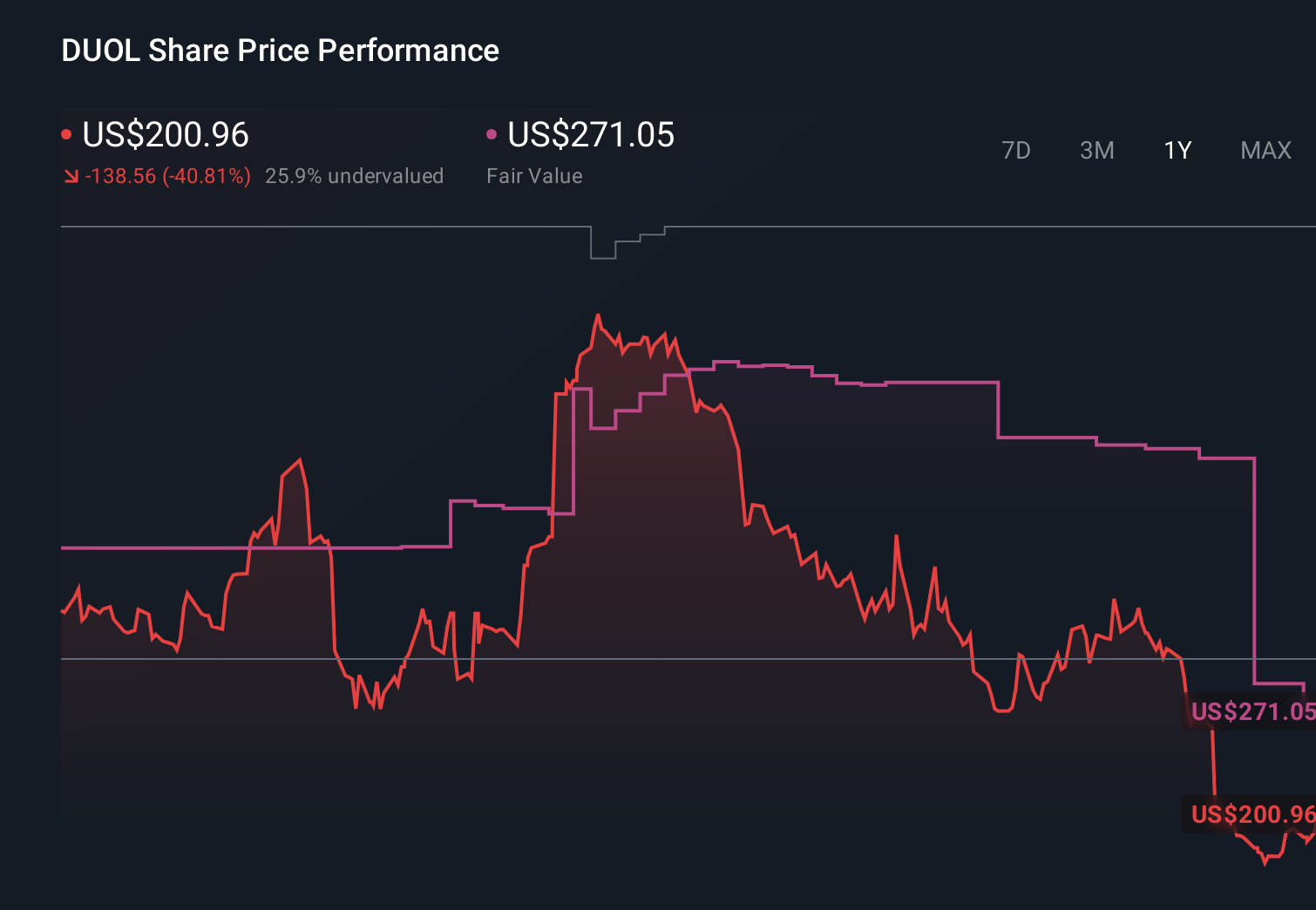
Some of the most optimistic analysts were modeling about US$1.8 billion of revenue and US$231.8 million of earnings by 2029, which is a far more bullish story than consensus, and the latest guidance plus Krawcheck’s arrival could push those expectations in either direction as you weigh very different views on Duolingo’s future.
Explore 17 other fair value estimates on Duolingo - why the stock might be worth 39% less than the current price!
Reach Your Own Conclusion
Don't just follow the ticker - dig into the data and build a conviction that's truly your own.
- A great starting point for your Duolingo research is our analysis highlighting 2 key rewards and 1 important warning sign that could impact your investment decision.
- Our free Duolingo research report provides a comprehensive fundamental analysis summarized in a single visual - the Snowflake - making it easy to evaluate Duolingo's overall financial health at a glance.
Ready To Venture Into Other Investment Styles?
Our top stock finds are flying under the radar-for now. Get in early:
- Explore 24 top quantum computing companies leading the revolution in next-gen technology and shaping the future with breakthroughs in quantum algorithms, superconducting qubits, and cutting-edge research.
- Capitalize on the AI infrastructure supercycle with our selection of the 55 best 'picks and shovels' of the AI gold rush converting record-breaking demand into massive cash flow.
- The best AI stocks today may lie beyond giants like Nvidia and Microsoft. Find the next big opportunity with these 17 smaller AI-focused companies with strong growth potential through early-stage innovation in machine learning, automation, and data intelligence that could fund your retirement.
This article by Simply Wall St is general in nature. We provide commentary based on historical data and analyst forecasts only using an unbiased methodology and our articles are not intended to be financial advice. It does not constitute a recommendation to buy or sell any stock, and does not take account of your objectives, or your financial situation. We aim to bring you long-term focused analysis driven by fundamental data. Note that our analysis may not factor in the latest price-sensitive company announcements or qualitative material. Simply Wall St has no position in any stocks mentioned.