
Should Investors Rethink Meta After Major AI Push and Surging Share Price in 2025?
Meta Platforms META | 571.87 | -1.27% |
If you have been questioning what to do with Meta Platforms stock, you are definitely not alone. Even seasoned investors are watching Meta closely, wondering if the recent gains signal more upside or if it is time to lock in profits. With a closing price of $750.82, Meta’s shares have been nothing short of impressive over multiple periods, gaining 2.5% in the last week, 1.0% over the last month, and a remarkable 25.3% since the start of the year. Look back even further and you will see returns of 30.3% over the past year and a staggering 710.9% over three years. These figures highlight sustained growth and shifting investor sentiment.
Some of these moves are directly tied to major news surrounding Meta’s ongoing investment in artificial intelligence and recent announcements about its push into mixed reality. The market seems to be recalibrating its expectations, perhaps viewing Meta as more than just a social media company and starting to price in these new growth drivers. It is also worth noting the company’s value score: a solid 4 out of 6, meaning Meta checks the box for undervaluation on four major valuation metrics. That is a strong showing in a sector where optimism often outpaces fundamentals.
So, what exactly goes into that valuation score? Next, let us break down the main approaches analysts use to assess whether Meta is truly undervalued, or if the stock’s current price reflects its full potential. And just when you think you have valuation all figured out, there is an even better lens for evaluating Meta that we will share later in the article.
Approach 1: Meta Platforms Discounted Cash Flow (DCF) Analysis
The Discounted Cash Flow (DCF) model estimates a company’s true value by projecting its future cash flows and discounting them back to today’s dollars. For Meta Platforms, analysts start with the latest free cash flow (FCF), which stands at $57.6 Billion, and forecast its growth over time. The model uses an initial set of detailed annual projections from analysts for the next five years. After that period, future estimates are extrapolated based on industry trends and company prospects.
For instance, by 2029, analyst consensus points to Meta generating $108.5 Billion in annual free cash flow, a significant increase from current figures. Beyond 2029, Simply Wall St extrapolates the FCF out to 2035, with projections rising each year. This two-stage approach helps capture both near-term business momentum and long-term stability as the business matures.
Based on this modeling, the DCF intrinsic value for Meta Platforms comes out to $1,102.77 per share. With a current share price of $750.82, the model indicates that the stock is trading at a 31.9% discount. In other words, Meta appears significantly undervalued when you base its price on future cash flow potential.
Result: UNDERVALUED
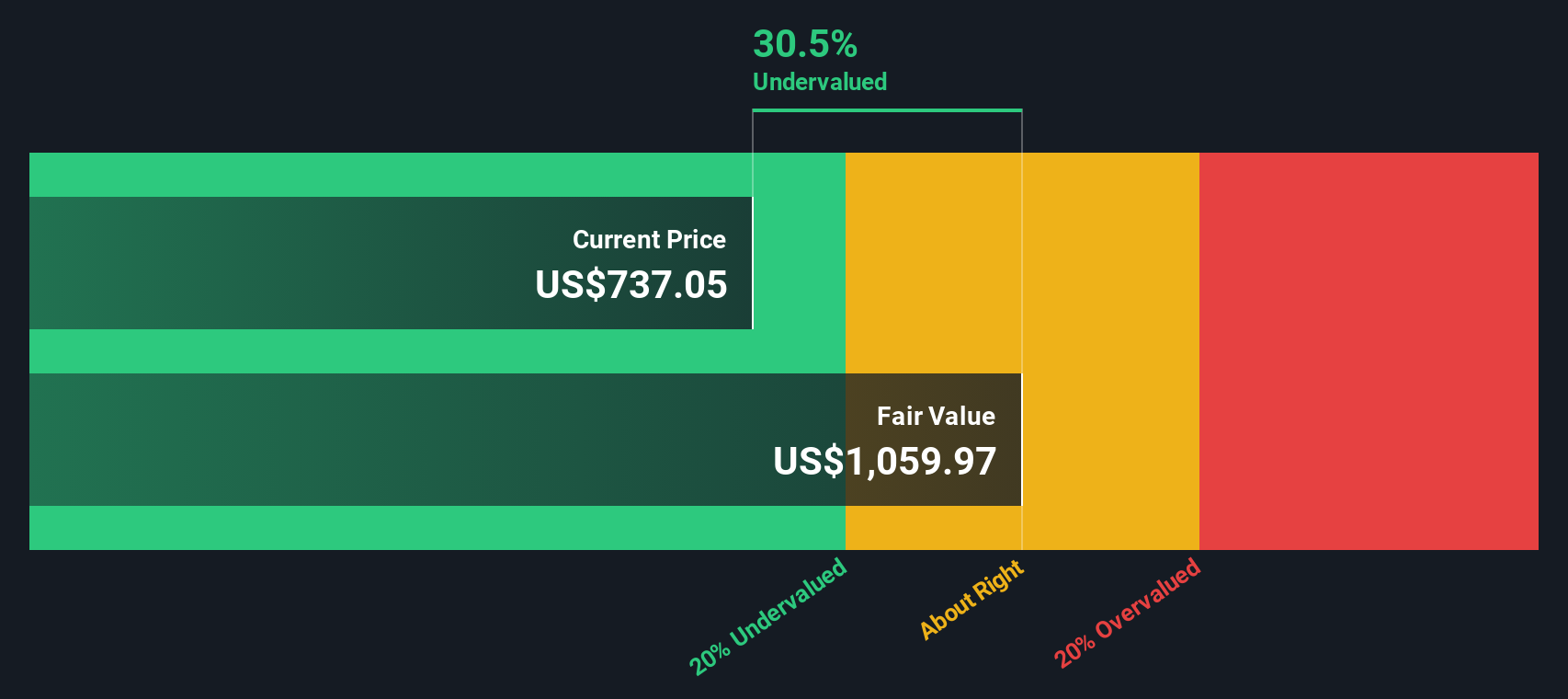
Our Discounted Cash Flow (DCF) analysis suggests Meta Platforms is undervalued by 31.9%. Track this in your watchlist or portfolio, or discover more undervalued stocks.
Approach 2: Meta Platforms Price vs Earnings
The Price-to-Earnings (PE) ratio is a popular and reliable metric for assessing profitable technology companies like Meta Platforms. Because Meta consistently reports strong earnings, the PE ratio offers investors a simple way to gauge how much the market is willing to pay for each dollar of profit. Typically, higher expected growth justifies a higher PE ratio, while greater risk may warrant a lower one. Comparing PE ratios across companies is only meaningful if you also consider these underlying factors.
Currently, Meta trades at a PE ratio of 26.4x. For context, the average PE ratio among peers is 37.9x, while the broader Interactive Media and Services industry sits at just 15.6x. This suggests Meta is priced below its peer group but well above the industry average, likely reflecting its strong profitability and growth profile.
To refine this comparison, Simply Wall St calculates a “Fair Ratio” for Meta, which is 39.3x. Unlike basic industry or peer averages, the Fair Ratio considers factors such as Meta’s robust earnings growth, profit margins, risk profile, and market capitalization. Because it incorporates the company's unique strengths and potential, it provides a more meaningful benchmark for investors.
With Meta’s current PE of 26.4x well below the Fair Ratio of 39.3x, the stock appears undervalued by this key measure.
Result: UNDERVALUED
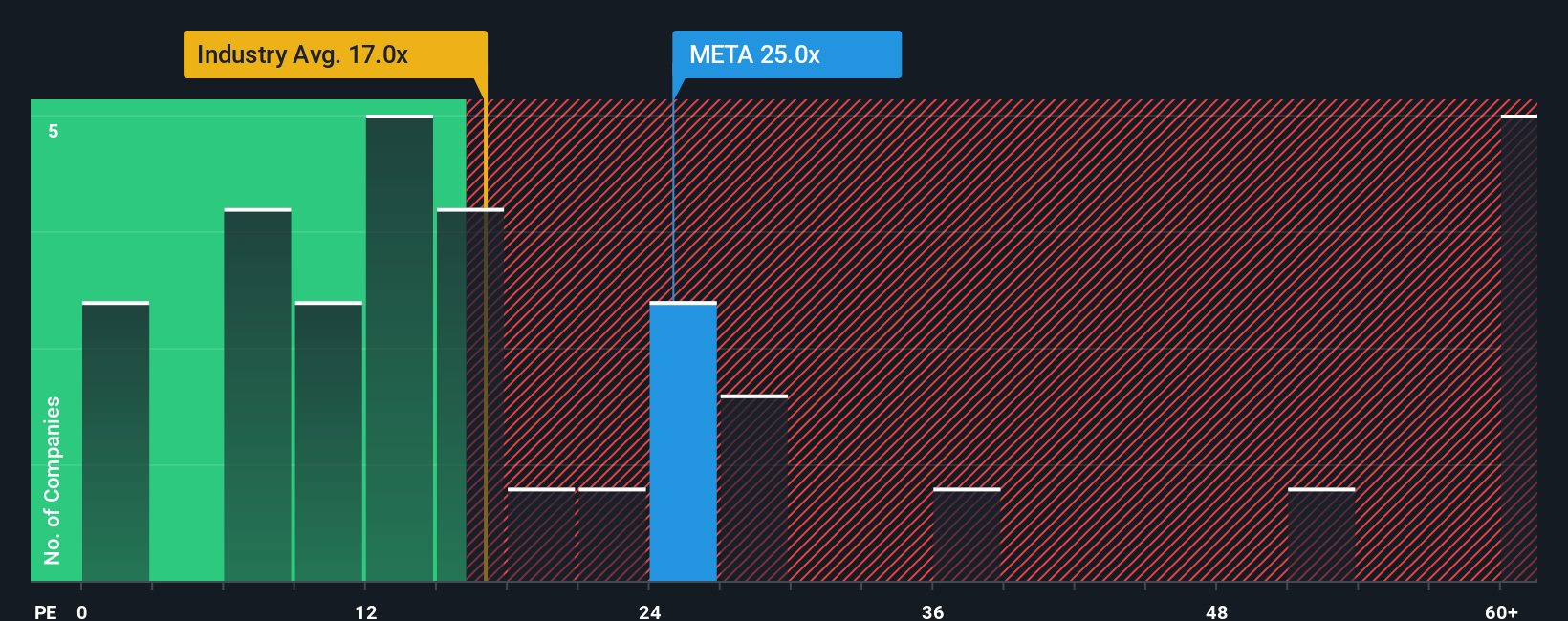
PE ratios tell one story, but what if the real opportunity lies elsewhere? Discover companies where insiders are betting big on explosive growth.
Upgrade Your Decision Making: Choose your Meta Platforms Narrative
Earlier we mentioned that there is an even better way to understand valuation. Let us introduce you to Narratives. A Narrative is your personal story about a company. It connects your perspective—how you think Meta’s products, industry trends, and management choices will play out—to the numbers, shaping your own fair value using future revenue, earnings, and margin forecasts.
With Narratives, you can link Meta’s business story directly to a financial forecast and then a fair value, making your investment decisions more meaningful and less generic. This tool is easy to access within Simply Wall St’s Community page. You can join millions of investors in building your own outlook without getting lost in spreadsheet modeling or jargon.
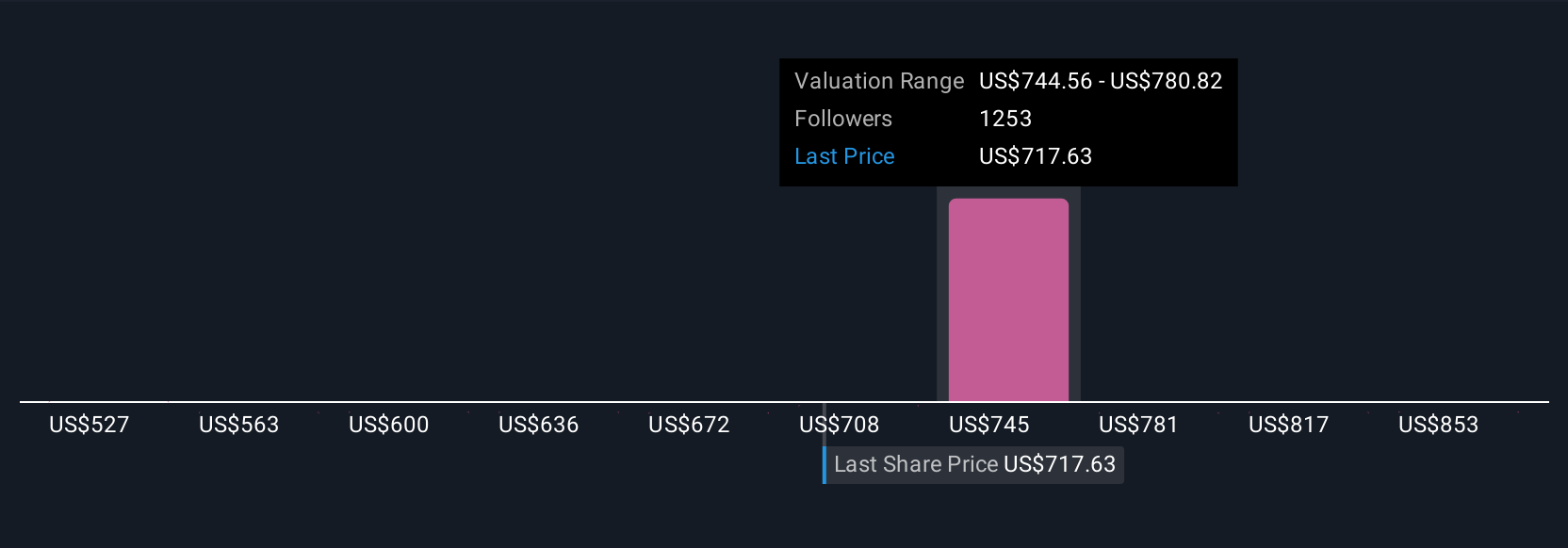
Narratives help you decide when to buy or sell by comparing your fair value to the current market price. They automatically update as new news or earnings releases come out, so your view evolves with the facts. For example, some investors see rapid AI-driven advertising revenue growth and forecast a future fair value for Meta as high as $1,086 per share. Others focus on regulatory and spending risks, resulting in more cautious projections near $658 per share.
For Meta Platforms, however, we'll make it really easy for you with previews of two leading Meta Platforms Narratives:
Analyst consensus fair value: $863.20
Currently trading at 13.0% below this fair value
Revenue growth forecast: 15.6%
- AI-driven personalization and new ad formats are expected to boost ad performance and diversify revenue streams across Meta's platforms.
- The expansion of digital advertising budgets and digital commerce should fuel continued revenue and margin growth, with strong user engagement supporting Meta's ecosystem advantage.
- Risks include high AI and metaverse investment costs, ongoing regulatory headwinds, and the challenge of monetizing new segments. Analyst consensus still forecasts robust earnings and revenue gains ahead.
Bear case fair value: $538.09
Currently trading at 39.6% above this fair value
Revenue growth forecast: 10.5%
- Meta can sustain social media leadership via innovative products, AI, and a strong balance sheet, but its valuation assumes high success in AR/VR and aggressive growth in advertising.
- Large capital investments in AI and the metaverse could weigh on profits if expected user or developer adoption falls short. Reality Labs has accrued substantial losses to date.
- Major risks include regulatory headwinds, dependence on ad revenue, ongoing high spending, and the possibility of missing growth targets in a competitive market.
Do you think there's more to the story for Meta Platforms? Create your own Narrative to let the Community know!
This article by Simply Wall St is general in nature. We provide commentary based on historical data and analyst forecasts only using an unbiased methodology and our articles are not intended to be financial advice. It does not constitute a recommendation to buy or sell any stock, and does not take account of your objectives, or your financial situation. We aim to bring you long-term focused analysis driven by fundamental data. Note that our analysis may not factor in the latest price-sensitive company announcements or qualitative material. Simply Wall St has no position in any stocks mentioned.