
Should Microsoft’s Expanding Azure and Copilot Partnerships Reshape the AI Platform Story for MSFT Investors?
Microsoft Corporation MSFT | 373.46 | +1.11% |
- In early February 2026, partners including Rain, Pathlock, Dragos, Appspace, TeamDynamix and CAEVES announced deeper integrations with Microsoft platforms such as Teams, Sentinel, Places, Azure and the Microsoft Marketplace, while Microsoft expanded its sovereign cloud collaboration with Capgemini.
- These moves highlight how Microsoft is extending Azure and Microsoft 365 from core infrastructure into embedded AI, security, and workplace services, reinforcing its role as a foundational layer for other companies’ products.
- We’ll now look at how this expanding ecosystem of Azure- and Copilot-linked partnerships may influence Microsoft’s existing AI-driven investment narrative.
This technology could replace computers: discover 23 stocks that are working to make quantum computing a reality.
Microsoft Investment Narrative Recap
To own Microsoft today, you need to believe that its AI infused cloud, productivity and security stack can justify heavy CapEx while turning its massive US$625,000,000 backlog into durable, profitable usage. The latest wave of integrations around Teams, Sentinel, Places and Marketplace modestly reinforces that thesis, but does not change the near term focus on AI infrastructure spending as the main catalyst, or the key risk that free cash flow and margins could stay under pressure if AI monetization lags.
Among the recent news, the expanded sovereign cloud collaboration with Capgemini stands out for investors. It directly supports Azure’s role in regulated, high value workloads, tying into the core catalyst of deeper AI and cloud adoption in government, healthcare and financial services, while also heightening the existing risk that any disruption to Microsoft’s elevated backlog or delivery capacity could have outsized consequences.
Yet investors should also weigh how rising CapEx, heavy OpenAI exposure and execution risks around that ballooning backlog could...
Microsoft's narrative projects $425.0 billion revenue and $158.4 billion earnings by 2028. This requires 14.7% yearly revenue growth and an earnings increase of about $56.6 billion from $101.8 billion today.
Uncover how Microsoft's forecasts yield a $603.22 fair value, a 49% upside to its current price.
Exploring Other Perspectives
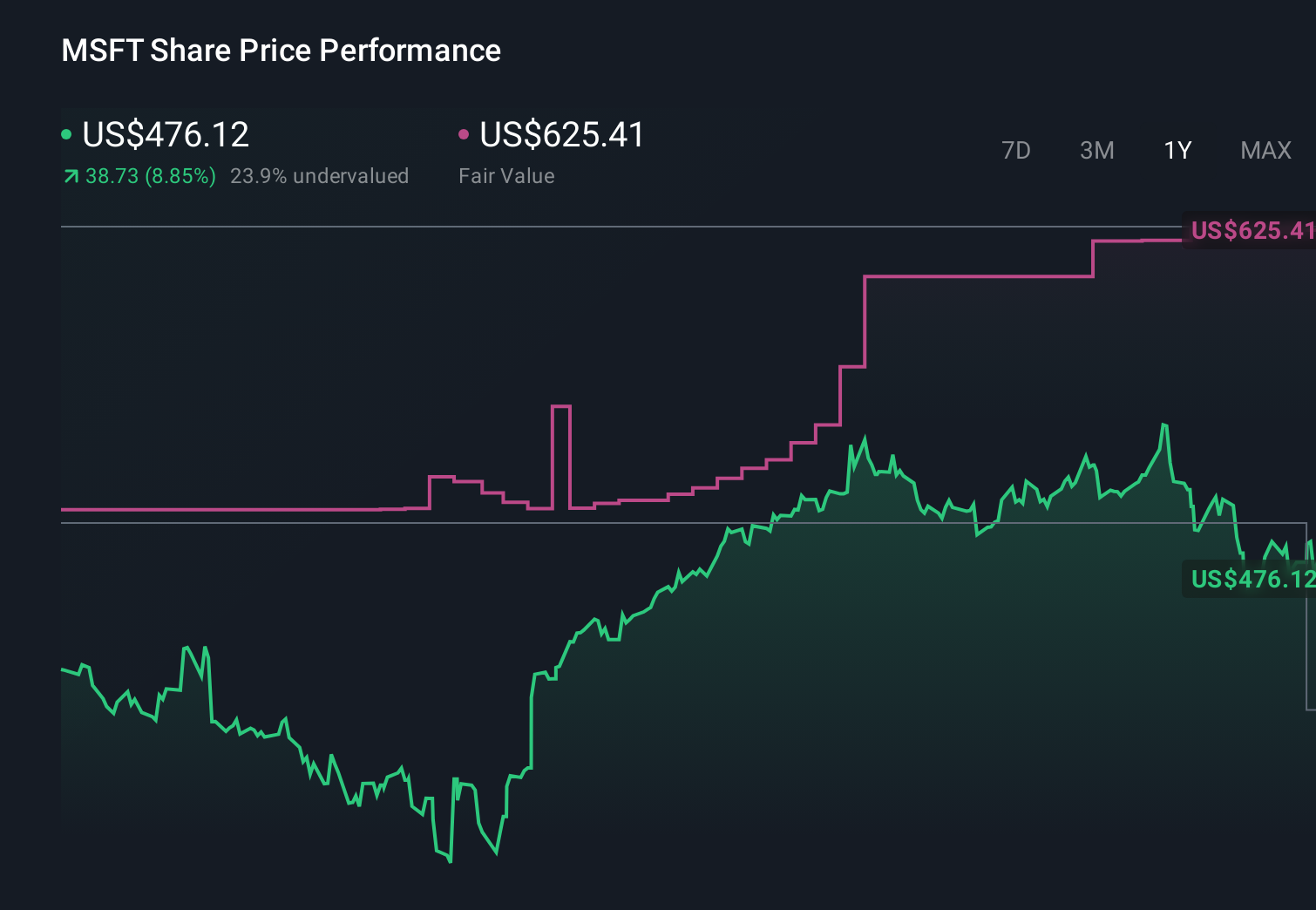
113 fair value estimates from the Simply Wall St Community span roughly US$360 to US$623 per share, showing how far apart views on Microsoft can be. Many contributors are focused on AI driven Azure and Copilot adoption as a core growth catalyst, while also pointing to elevated CapEx and monetization uncertainty as reasons to compare several different outlooks before forming a view.
Explore 113 other fair value estimates on Microsoft - why the stock might be worth 11% less than the current price!
Build Your Own Microsoft Narrative
Disagree with existing narratives? Create your own in under 3 minutes - extraordinary investment returns rarely come from following the herd.
- A great starting point for your Microsoft research is our analysis highlighting 5 key rewards and 1 important warning sign that could impact your investment decision.
- Our free Microsoft research report provides a comprehensive fundamental analysis summarized in a single visual - the Snowflake - making it easy to evaluate Microsoft's overall financial health at a glance.
Ready For A Different Approach?
Opportunities like this don't last. These are today's most promising picks. Check them out now:
- Outshine the giants: these 26 early-stage AI stocks could fund your retirement.
- Capitalize on the AI infrastructure supercycle with our selection of the 34 best 'picks and shovels' of the AI gold rush converting record-breaking demand into massive cash flow.
- Find 51 companies with promising cash flow potential yet trading below their fair value.
This article by Simply Wall St is general in nature. We provide commentary based on historical data and analyst forecasts only using an unbiased methodology and our articles are not intended to be financial advice. It does not constitute a recommendation to buy or sell any stock, and does not take account of your objectives, or your financial situation. We aim to bring you long-term focused analysis driven by fundamental data. Note that our analysis may not factor in the latest price-sensitive company announcements or qualitative material. Simply Wall St has no position in any stocks mentioned.