

Should Parker-Hannifin’s (PH) Record Aerospace Backlog and Filtration Deal Shift Investor Expectations on Cash Durability?
Parker-Hannifin Corporation PH | 0.00 |
- Parker-Hannifin recently marked its 70th consecutive fiscal year of dividend increases, reported 14% year-over-year growth in its Aerospace Systems division with a record US$12.50 billion backlog, and agreed to acquire Filtration Group Corporation to build one of the world's largest industrial filtration businesses.
- This combination of long-running dividend growth, expanding aerospace demand, and a scale-enhancing filtration deal highlights Parker-Hannifin’s focus on dependable cash generation and deeper exposure to aftermarket and longer-cycle revenues.
- With Aerospace Systems’ record backlog as a key highlight, we’ll now examine how this development influences Parker-Hannifin’s existing investment narrative.
Explore 30 top quantum computing companies leading the revolution in next-gen technology and shaping the future with breakthroughs in quantum algorithms, superconducting qubits, and cutting-edge research.
Parker-Hannifin Investment Narrative Recap
To own Parker-Hannifin, you need to believe in its ability to compound cash flow from a more aftermarket-heavy, longer-cycle portfolio while managing higher capital needs and acquisition integration. The latest aerospace backlog record and Filtration Group deal reinforce that longer-cycle tilt, but they do not change the near term tension between slowing industrial end markets and higher CapEx and restructuring plans, which still looks like the key short term catalyst and primary risk.
The Filtration Group acquisition is the clearest link to this news, because it deepens Parker-Hannifin’s push into more recurring, filtration-driven revenues that align with its Win Strategy margin focus. If integration goes to plan, that could gradually support the quality and durability of earnings, complementing the aerospace backlog, though investors still need to watch how any acquisition costs and execution issues affect margins over the next few years.
Yet behind the record backlog and dividend streak, investors also need to be aware of the risk that...
Parker-Hannifin's narrative projects $25.1 billion revenue and $4.6 billion earnings by 2029.
Uncover how Parker-Hannifin's forecasts yield a $1032 fair value, a 9% upside to its current price.
Exploring Other Perspectives
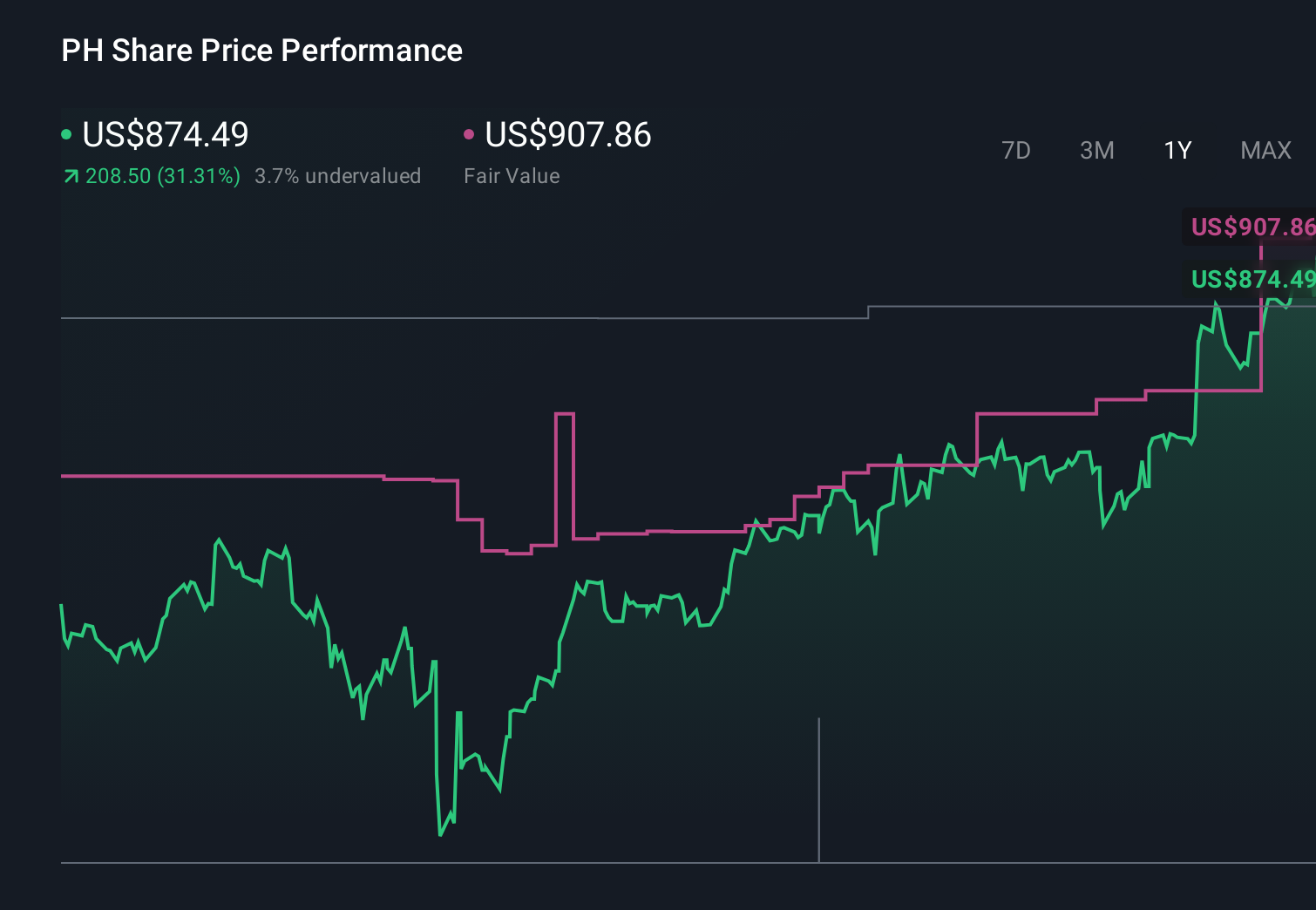
Some of the most optimistic analysts already expected Parker-Hannifin to reach about US$25.2 billion in revenue and US$4.8 billion in earnings by 2029, but the new aerospace backlog and filtration deal could either reinforce or challenge those assumptions, depending on how you view the added reliance on aerospace and acquisition execution risk.
Explore 4 other fair value estimates on Parker-Hannifin - why the stock might be worth as much as 23% more than the current price!
Decide For Yourself
Disagree with existing narratives? Extraordinary investment returns rarely come from following the herd, so go with your instincts.
- A great starting point for your Parker-Hannifin research is our analysis highlighting 2 key rewards and 1 important warning sign that could impact your investment decision.
- Our free Parker-Hannifin research report provides a comprehensive fundamental analysis summarized in a single visual - the Snowflake - making it easy to evaluate Parker-Hannifin's overall financial health at a glance.
Seeking Other Investments?
Our top stock finds are flying under the radar-for now. Get in early:
- AI is about to change healthcare. These 38 stocks are working on everything from early diagnostics to drug discovery. The best part - they are all under $10b in market cap - there's still time to get in early.
- Capitalize on the AI infrastructure supercycle with our selection of the 49 best 'picks and shovels' of the AI gold rush converting record-breaking demand into massive cash flow.
- Find 44 companies with promising cash flow potential yet trading below their fair value.
This article by Simply Wall St is general in nature. We provide commentary based on historical data and analyst forecasts only using an unbiased methodology and our articles are not intended to be financial advice. It does not constitute a recommendation to buy or sell any stock, and does not take account of your objectives, or your financial situation. We aim to bring you long-term focused analysis driven by fundamental data. Note that our analysis may not factor in the latest price-sensitive company announcements or qualitative material. Simply Wall St has no position in any stocks mentioned.