

Should Weakness in Jabal Omar Development Company's (TADAWUL:4250) Stock Be Seen As A Sign That Market Will Correct The Share Price Given Decent Financials?
JABAL OMAR 4250.SA | 0.00 |

Jabal Omar Development (TADAWUL:4250) has had a rough three months with its share price down 25%. However, the company's fundamentals look pretty decent, and long-term financials are usually aligned with future market price movements. In this article, we decided to focus on Jabal Omar Development's ROE.
Return on equity or ROE is a key measure used to assess how efficiently a company's management is utilizing the company's capital. Simply put, it is used to assess the profitability of a company in relation to its equity capital.
How To Calculate Return On Equity?
The formula for return on equity is:
Return on Equity = Net Profit (from continuing operations) ÷ Shareholders' Equity
So, based on the above formula, the ROE for Jabal Omar Development is:
7.8% = ر.س1.1b ÷ ر.س14b (Based on the trailing twelve months to March 2025).
The 'return' is the yearly profit. One way to conceptualize this is that for each SAR1 of shareholders' capital it has, the company made SAR0.08 in profit.
Why Is ROE Important For Earnings Growth?
We have already established that ROE serves as an efficient profit-generating gauge for a company's future earnings. We now need to evaluate how much profit the company reinvests or "retains" for future growth which then gives us an idea about the growth potential of the company. Assuming everything else remains unchanged, the higher the ROE and profit retention, the higher the growth rate of a company compared to companies that don't necessarily bear these characteristics.
A Side By Side comparison of Jabal Omar Development's Earnings Growth And 7.8% ROE
As you can see, Jabal Omar Development's ROE looks pretty weak. Even when compared to the industry average of 14%, the ROE figure is pretty disappointing. Despite this, surprisingly, Jabal Omar Development saw an exceptional 47% net income growth over the past five years. We believe that there might be other aspects that are positively influencing the company's earnings growth. For example, it is possible that the company's management has made some good strategic decisions, or that the company has a low payout ratio.
Next, on comparing with the industry net income growth, we found that the growth figure reported by Jabal Omar Development compares quite favourably to the industry average, which shows a decline of 3.4% over the last few years.
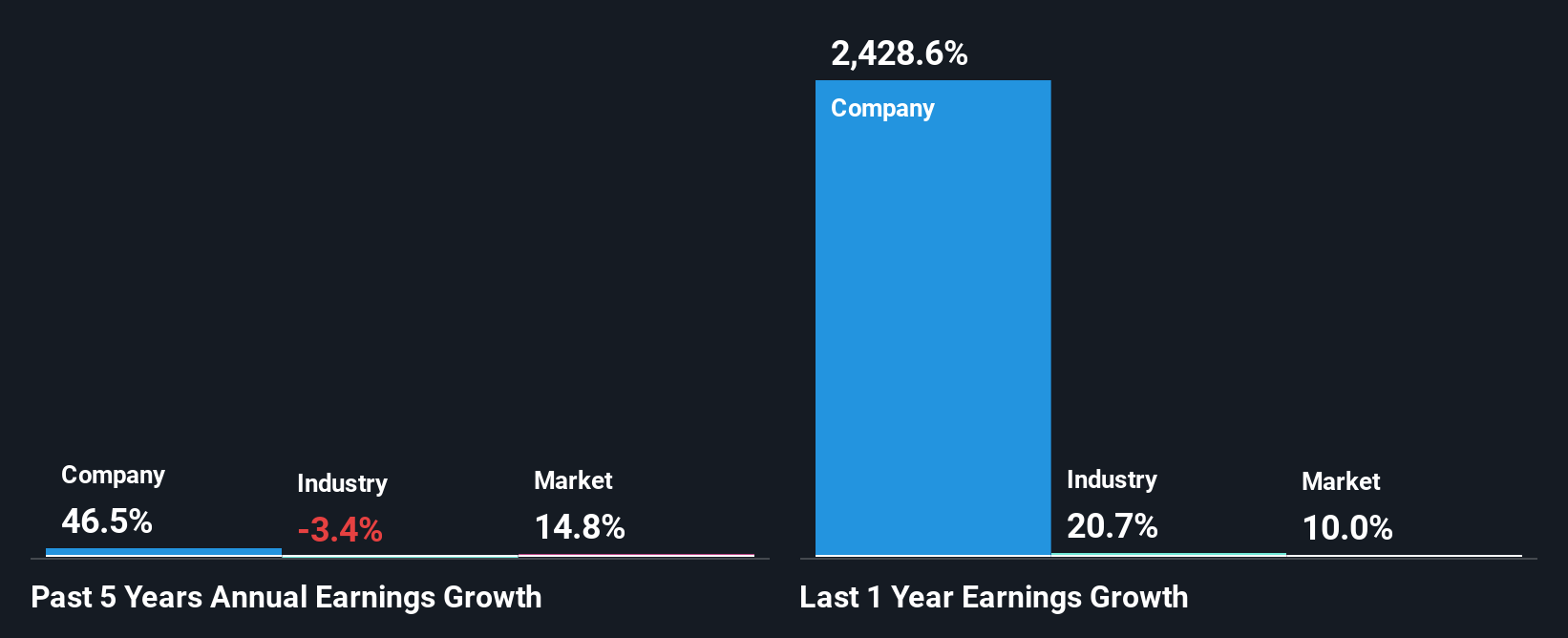
Earnings growth is an important metric to consider when valuing a stock. The investor should try to establish if the expected growth or decline in earnings, whichever the case may be, is priced in. This then helps them determine if the stock is placed for a bright or bleak future. Is Jabal Omar Development fairly valued compared to other companies? These 3 valuation measures might help you decide.
Is Jabal Omar Development Using Its Retained Earnings Effectively?
Jabal Omar Development doesn't pay any regular dividends to its shareholders, meaning that the company has been reinvesting all of its profits into the business. This is likely what's driving the high earnings growth number discussed above.
Conclusion
In total, it does look like Jabal Omar Development has some positive aspects to its business. Despite its low rate of return, the fact that the company reinvests a very high portion of its profits into its business, no doubt contributed to its high earnings growth. While we won't completely dismiss the company, what we would do, is try to ascertain how risky the business is to make a more informed decision around the company. You can see the 2 risks we have identified for Jabal Omar Development by visiting our risks dashboard for free on our platform here.
This article by Simply Wall St is general in nature. We provide commentary based on historical data and analyst forecasts only using an unbiased methodology and our articles are not intended to be financial advice. It does not constitute a recommendation to buy or sell any stock, and does not take account of your objectives, or your financial situation. We aim to bring you long-term focused analysis driven by fundamental data. Note that our analysis may not factor in the latest price-sensitive company announcements or qualitative material. Simply Wall St has no position in any stocks mentioned.