
Solventum (NYSE:SOLV) Has A Somewhat Strained Balance Sheet
Solventum Corporation SOLV | 64.35 | -1.45% |
Some say volatility, rather than debt, is the best way to think about risk as an investor, but Warren Buffett famously said that 'Volatility is far from synonymous with risk.' It's only natural to consider a company's balance sheet when you examine how risky it is, since debt is often involved when a business collapses. As with many other companies Solventum Corporation (NYSE:SOLV) makes use of debt. But the real question is whether this debt is making the company risky.
When Is Debt A Problem?
Debt assists a business until the business has trouble paying it off, either with new capital or with free cash flow. Part and parcel of capitalism is the process of 'creative destruction' where failed businesses are mercilessly liquidated by their bankers. However, a more usual (but still expensive) situation is where a company must dilute shareholders at a cheap share price simply to get debt under control. Having said that, the most common situation is where a company manages its debt reasonably well - and to its own advantage. The first step when considering a company's debt levels is to consider its cash and debt together.
What Is Solventum's Debt?
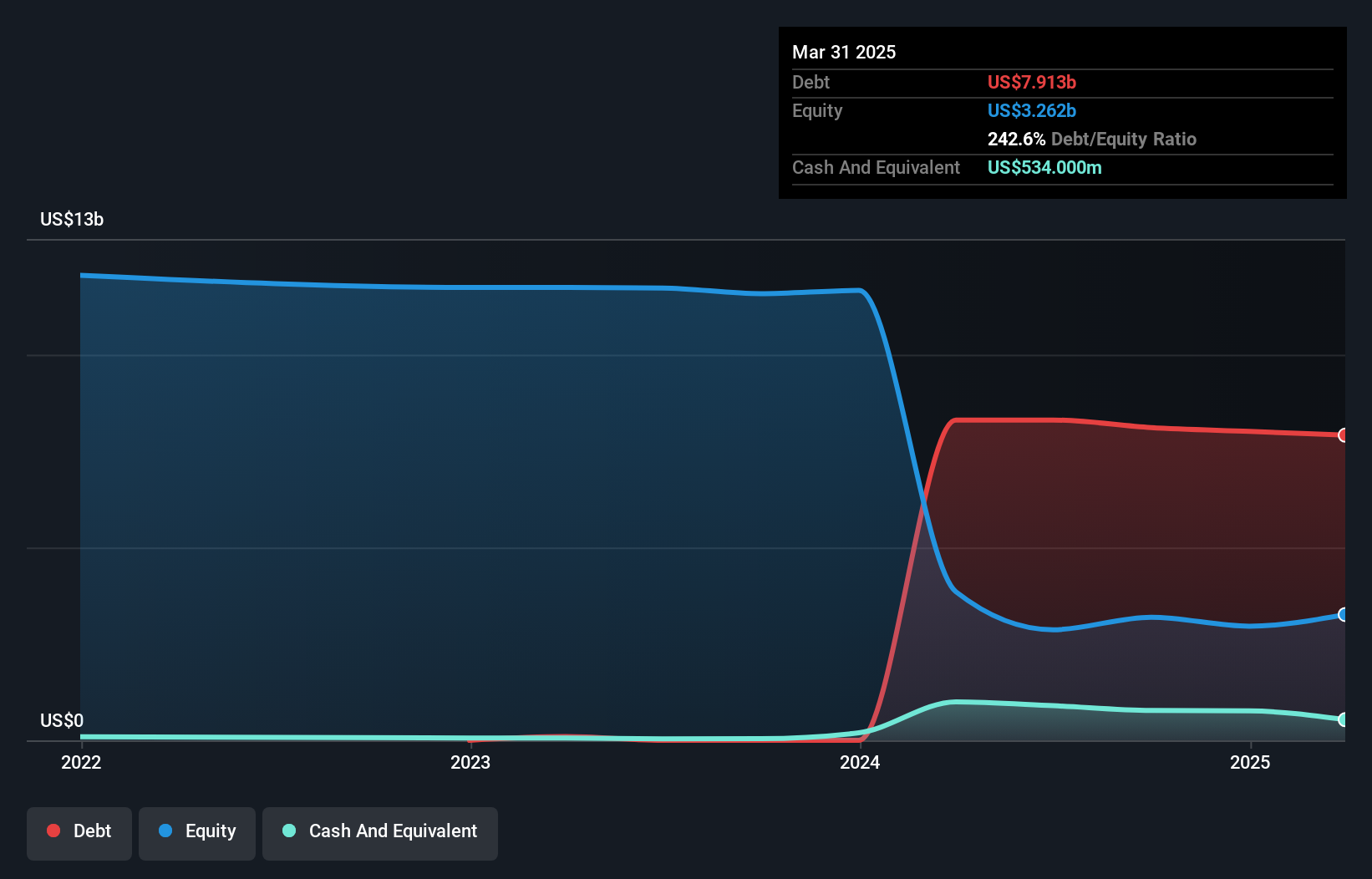
You can click the graphic below for the historical numbers, but it shows that Solventum had US$7.91b of debt in March 2025, down from US$8.30b, one year before. However, it does have US$534.0m in cash offsetting this, leading to net debt of about US$7.38b.
How Strong Is Solventum's Balance Sheet?
According to the last reported balance sheet, Solventum had liabilities of US$2.57b due within 12 months, and liabilities of US$8.70b due beyond 12 months. Offsetting this, it had US$534.0m in cash and US$1.11b in receivables that were due within 12 months. So it has liabilities totalling US$9.62b more than its cash and near-term receivables, combined.
This is a mountain of leverage even relative to its gargantuan market capitalization of US$13.2b. Should its lenders demand that it shore up the balance sheet, shareholders would likely face severe dilution.
We measure a company's debt load relative to its earnings power by looking at its net debt divided by its earnings before interest, tax, depreciation, and amortization (EBITDA) and by calculating how easily its earnings before interest and tax (EBIT) cover its interest expense (interest cover). Thus we consider debt relative to earnings both with and without depreciation and amortization expenses.
Weak interest cover of 2.0 times and a disturbingly high net debt to EBITDA ratio of 5.2 hit our confidence in Solventum like a one-two punch to the gut. The debt burden here is substantial. Worse, Solventum's EBIT was down 49% over the last year. If earnings keep going like that over the long term, it has a snowball's chance in hell of paying off that debt. When analysing debt levels, the balance sheet is the obvious place to start. But it is future earnings, more than anything, that will determine Solventum's ability to maintain a healthy balance sheet going forward. So if you want to see what the professionals think, you might find this free report on analyst profit forecasts to be interesting.
Finally, a company can only pay off debt with cold hard cash, not accounting profits. So it's worth checking how much of that EBIT is backed by free cash flow. During the last three years, Solventum generated free cash flow amounting to a very robust 83% of its EBIT, more than we'd expect. That puts it in a very strong position to pay down debt.
Our View
On the face of it, Solventum's interest cover left us tentative about the stock, and its EBIT growth rate was no more enticing than the one empty restaurant on the busiest night of the year. But on the bright side, its conversion of EBIT to free cash flow is a good sign, and makes us more optimistic. It's also worth noting that Solventum is in the Medical Equipment industry, which is often considered to be quite defensive. Looking at the balance sheet and taking into account all these factors, we do believe that debt is making Solventum stock a bit risky. Some people like that sort of risk, but we're mindful of the potential pitfalls, so we'd probably prefer it carry less debt. The balance sheet is clearly the area to focus on when you are analysing debt. However, not all investment risk resides within the balance sheet - far from it.
At the end of the day, it's often better to focus on companies that are free from net debt. You can access our special list of such companies (all with a track record of profit growth). It's free.
This article by Simply Wall St is general in nature. We provide commentary based on historical data and analyst forecasts only using an unbiased methodology and our articles are not intended to be financial advice. It does not constitute a recommendation to buy or sell any stock, and does not take account of your objectives, or your financial situation. We aim to bring you long-term focused analysis driven by fundamental data. Note that our analysis may not factor in the latest price-sensitive company announcements or qualitative material. Simply Wall St has no position in any stocks mentioned.