

SpaceX Drops Below IPO Price Ahead of Starship Test: Buy the Dip or Falling Knife?
SpaceX SPCX | 0.00 | |
PowerShares QQQ Trust,Series 1 QQQ | 0.00 | |
Rocket Lab RKLB | 0.00 | |
Ultrapro QQQ Proshares TQQQ | 0.00 | |
QUIPT HOME MEDICAL CORP PTQQD | 0.00 |
Subscribe to The Trend Catcher Topic / The Value Anchor Topic —unlock the full historical archive and never miss a weekly pick again.
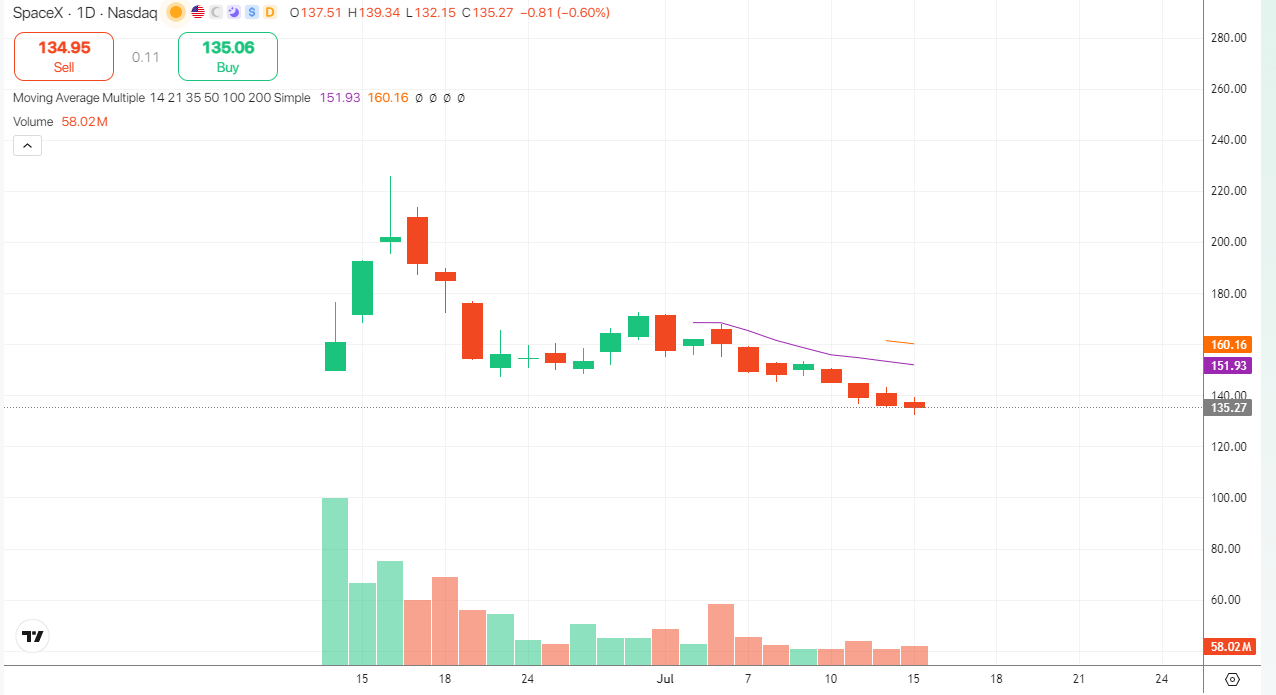
Despite a broader market rally that saw major US indices close higher, SpaceX(SPCX.US) continues to face downward pressure. In the previous trading session, the stock briefly fell below its $135 IPO price, ultimately closing at $135.27. Just one month after going public, the stock has plunged roughly one-third from its June 16 peak, wiping out approximately $860 billion in market capitalization.
Technical and Fundamental Pressures
Technically, the stock is in a sharp bottom-seeking phase. The $135 IPO price serves as a crucial psychological defense line; if broken, the stock lacks clear technical support. Meanwhile, the $140 level acts as short-term resistance.
Two main factors drive the ongoing sell-off:
- Valuation and Supply Overhang: SpaceX currently trades at a forward price-to-sales ratio of over 30x. More importantly, the market is bracing for a series of insider lock-up expirations. The initial IPO scarcity (with less than 5% of shares floating) will soon end. Phased unlockings are scheduled to begin after the Q2 earnings report, followed by monthly staggered releases, a massive 28% release after Q3 2026, and, eventually, CEO Elon Musk's shares unlocking in June 2027.
- High Implied Volatility: Options data reveals a surging put/call ratio, indicating that a growing amount of capital is betting on further downside.
Wall Street Divergence and Short-term Catalysts
Despite the market's bearish sentiment, Wall Street remains highly optimistic. Nearly 80% of analysts hold a "Buy" rating on the stock, with top-tier institutions like Morgan Stanley, Needham, and Deutsche Bank setting price targets between $250 and $300. The average price target of $244 implies a potential upside of over 70% from current levels.
A significant short-term catalyst is also approaching: the FAA has approved SpaceX's 13th Starship test flight, scheduled as early as July 16. This mission will deploy 20 next-generation Starlink satellites and test critical technologies like the in-orbit reignition of Raptor engines, which could heavily influence near-term price action.
Subscribe to The Trend Catcher Topic / The Value Anchor Topic —unlock the full historical archive and never miss a weekly pick again.
Options Strategies and Risk Management
The current high-volatility environment has created premium opportunities for options sellers:
- Cash-Secured Puts: For investors who believe in SpaceX's long-term space infrastructure potential but seek a better entry point, selling puts allows them to collect high premiums while potentially acquiring shares at a lower cost basis if the stock drops further.
- Covered Calls: Current shareholders facing floating losses can sell upside calls to hedge against ongoing lock-up supply pressures. This approach effectively lowers holding costs through premium income or acts as a phased profit-taking mechanism if the stock rebounds to technical resistance levels.
Risk Warning
While options-selling strategies offer high win rates, strict risk management is essential. Investors are advised to limit margin utilization to 20% of total capital per asset, utilize rolling strategies when necessary to avoid forced liquidation, and promptly cut losses on cash-secured puts if fundamental conditions deteriorate rapidly rather than just experiencing a normal pullback.