

Starmer On The Brink And Bond Market Turmoil
British Prime Minister Keir Starmer has lost his fight for political survival after the Labor Party’s historic local election defeat on May 7 sparked a full-scale rebellion within his own party.
The embattled leader has reportedly told close allies he has decided to step down, concluding the current situation is “unsustainable.” He will resign “in a manner of his own choosing,” the Daily Mail reported on Sunday, citing a cabinet minister.
Nearly 100 Labor Members of Parliament (MPs) have called for his resignation. Senior cabinet members, including Foreign Secretary Yvette Cooper, Home Secretary Shabana Mahmood, Defense Secretary John Healey, and Energy Secretary Ed Miliband, reportedly urged him to go.
Starmer has navigated an internal mutiny while managing mass public protest. This has added a further layer of uncertainty for investors already pricing in UK political risk. Government borrowing costs surged to post-Great Financial Crisis highs as markets priced in the mounting uncertainty.
“For many, the writing is on the wall at this stage," Jordan Rochester, Head of EMEA FICC Strategy at bank holding company Mizuho, said Tuesday. "It’s just a matter of how quickly the exit happens. If Starmer goes, it will make history. No sitting Labour prime minister has ever faced a leadership challenge or been removed by his own party.”
Starmer’s political crisis converged on Saturday with the Unite the Kingdom march organized by right-wing activist Tommy Robinson. The protest drew more than 60,000 people to central London, one of the largest far-right demonstrations in recent British history. It amplified pressure on a government already struggling to contain the fallout from its election collapse.
Starmer Pledges to Address Challenges
In a speech on May 11, Starmer pledged to “face up to the big challenges” on defense, immigration, and Europe. He stated his intention to remain prime minister, though few in his own party appeared to be listening.
"The Labour Party has a process for challenging a leader and that has not been triggered," he said. "The country expects us to get on with governing. That is what I am doing and what we must do as a cabinet."
Labour and the Conservatives, who have shaped Britain’s political landscape since the 1920s, hemorrhaged support during the elections. The economic backdrop offered little comfort. GDP grew just 0.3% month-on-month in March, slowing from 0.4% in February.
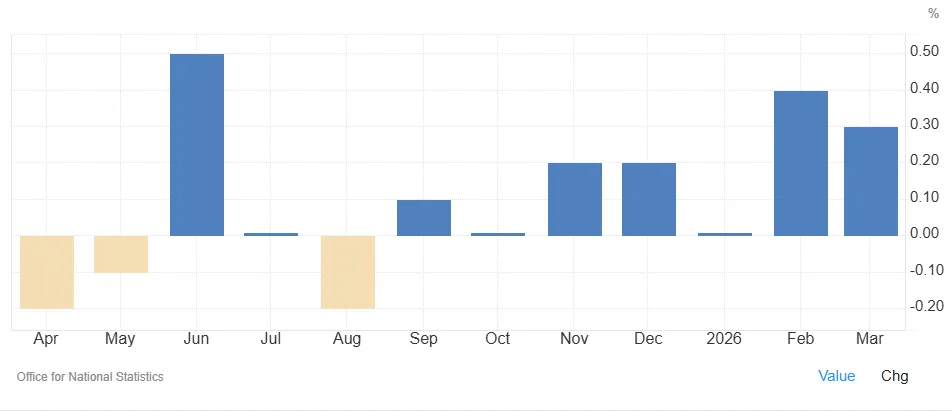
Month-on-Month GDP, source: TradingView
Labour's vote share fell by an average of 18 percentage points compared to its 2022 and 2024 results. Support for the Conservative party dropped 11 points compared to 2022 and by 10 points compared to 2024.
Reform UK, Green Party Make Gains
The results amounted to a sweeping rejection of the two-party status quo, and challengers were waiting in the wings.
Reform UK won over 1,454 council seats with a net gain of 1,372 seats. Labor recorded just 1,068 seats and a net loss of about 1,229 seats across the country. The Conservatives also suffered political blows, securing just 801 seats and suffering a net loss of 433 seats.
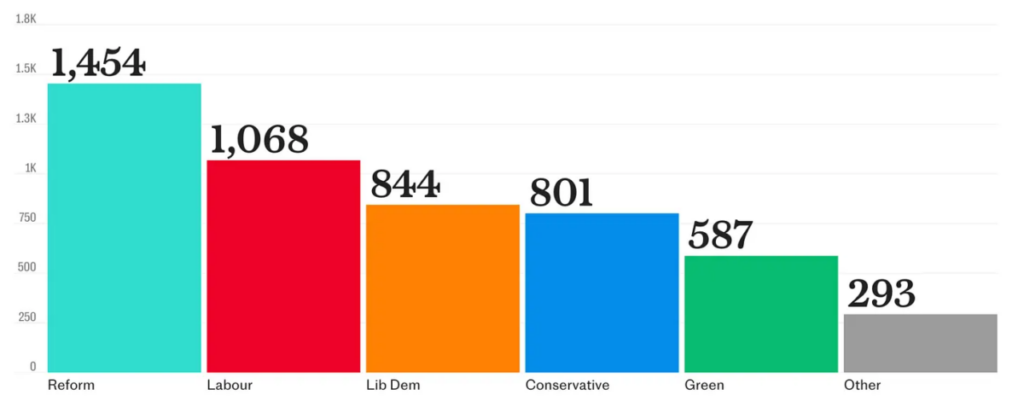
Number of Councillors Won By Party – UK Local Elections 2026, Source: The Telegraph
Reform leader Nigel Farage declared the results a “Reform-quake.” He asserted that his party “can and will win the next general election.”
"It's a big, big day, not just for our party, but for a complete reshaping of British politics in every way," Farage said on May 8 during a speech in the English town of Romford.
The Green Party made notable gains. It won 587 seats with a net gain of 393 seats, with noteworthy gains amongst London's boroughs.
"Two party politics isn't dying," Green leader Zack Polanski posted following the elections. "It's dead and it's buried."
UK's Political Structure Coming Apart
The electoral verdict did more than punish Labour at the ballot box. It ignited a full parliamentary revolt that now threatens to bring down a government less than two years into its term.
At least 97 Labor backbenchers and over a fifth of the party’s representation in the House of Commons called for Starmer to resign or set a timetable for his departure. This surpassed the threshold of 81 required to trigger a leadership contest under Labor rules.
Former UK Health Secretary Wes Streeting and former Deputy Prime Minister Angela Rayner have emerged as successors to Starmer. The most likely challenger, currently polling most favorably among potential successors, is Greater Manchester Mayor Andy Burnham.
He first needs to secure a Commons seat in order to stand. Labor's National Executive Committee has reportedly approved Burnham to contest the upcoming Makerfield by-election after Josh Simons announced he would step down as MP.
Bond Market Punishes Starmer
Markets have delivered their own judgment. The benchmark 10-year gilt yield jumped 11 basis points Tuesday to 5.11%, just below the post-2008 highs hit in March.
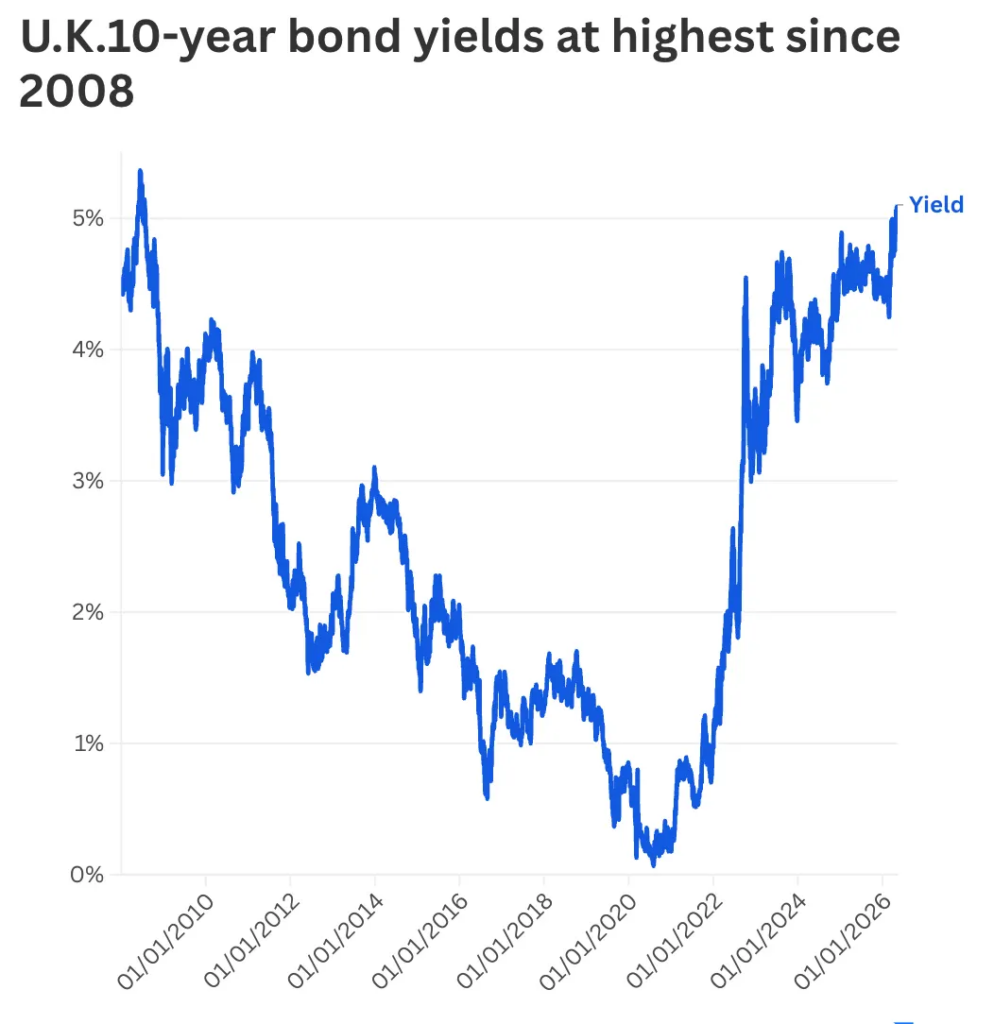
UK 10-Year Bond Yields, Source: CNBC
The 30-year yield climbed 10 basis points to 5.84%, nearing its highest level since 1998. The UK already holds the highest government borrowing costs in the G7. Its 0, 20, and 30-year debt are all above the 5% threshold.
Nigel Green, CEO of financial consultancy deVere Group, cautioned that the UK “doesn’t have much room for error” and that “growth is weak, borrowing is elevated, and inflation pressures linked to energy remain, meaning even a small dent in credibility forces a repricing.”
This comes amid rising inflationary concerns due to oil shocks from U.S.-Israel military actions against Iran. It has signaled a shift in expectations from the Bank of England to hike rates.
“The bond market is reacting not only to Starmer’s potential departure, but also to who his successor could be, and to the prospect of a drawn-out leadership battle that leads to more fiscal promises that the UK cannot afford,” Kathleen Brooks, Research Director at broker XTB, stated.
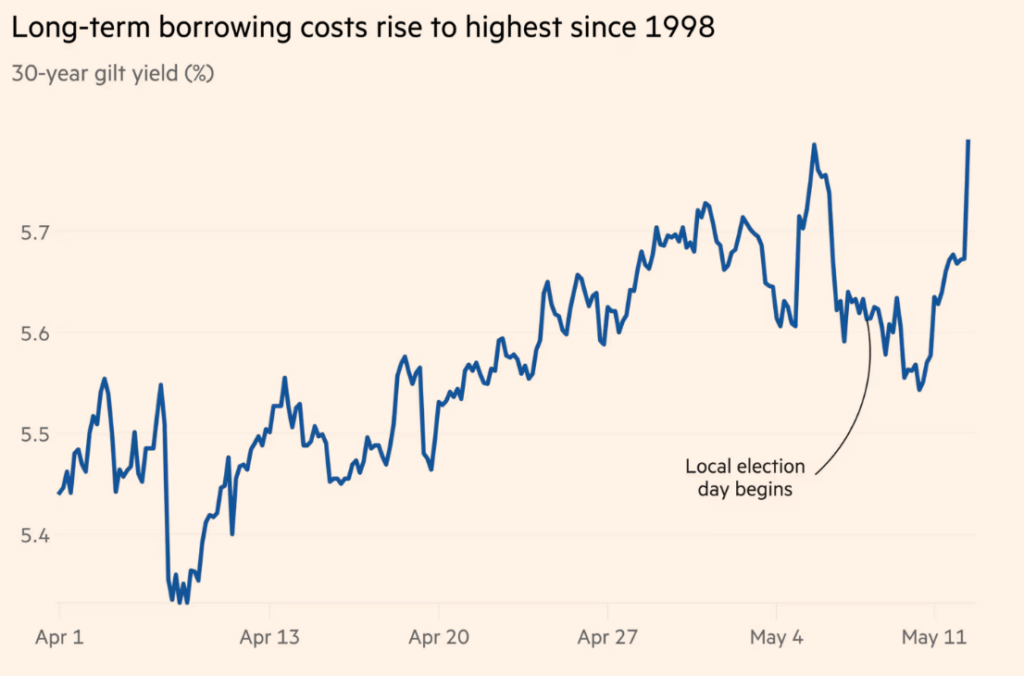
30-year Gilt Yield Chart, Source: FT
Markets Fear a Leftward Shift
Investors are concerned that a more left-leaning successor could increase public borrowing, putting further pressure on Britain’s already fragile finances. Analysts at JPMorgan expect Britain’s banking surcharge to rise to 5% from 3% with a leftward policy shift.
Political analysts have bet that Starmer's time as prime minister is hanging by a thread. Political risk consultancy Eurasia Group has raised the probability of Starmer being ousted this year to 80%, up from 65%.
"The most likely scenario is that MPs will force a leadership election by September (a 35% probability)," Eurasia Group analyst Mujtaba Rahman said. "There is a 25% chance of an orderly transition in which Starmer agrees to stand down and a 20% probability of an immediate leadership election."
With Robinson's march, calls for Starmer's resignation, and soaring gilt yields, Britain faces its gravest political and financial test in years.
Disclaimer: Any opinions expressed in this article are not to be considered investment advice and are solely those of the authors. European Capital Insights is not responsible for any financial decisions made based on the contents of this article. Readers may use this article for information and educational purposes only.
Benzinga Disclaimer: This article is from an unpaid external contributor. It does not represent Benzinga’s reporting and has not been edited for content or accuracy.