

State Street (STT) Stock Could Be 2% Overvalued As Fee Income Holds Key
State Street Corporation STT | 0.00 |
State Street stock has delivered very strong share price gains over the last three years, and current valuation checks suggest it no longer looks obviously cheap or clearly expensive. The Excess Returns intrinsic value estimate is broadly in line with the market price, while traditional multiples also indicate that State Street is trading at roughly the right level.
- State Street has returned 210.3% over three years, which puts extra focus on whether the current price already reflects much of the good news.
- Expectations that State Street can keep generating solid fee income on a large base of assets can support the current valuation, while any pressure on fees or client activity is a key risk for those cash flow assumptions.
- With a value score of 3 out of 6, the broader checks show a mixed picture rather than a clear bargain or clear overvaluation.
The key question now is whether the recent share price strength has left State Street fairly priced with limited upside, or if there is still room for further gains without stretching the valuation too far.
Does State Street Look Fairly Valued on Excess Returns?
The Excess Returns model estimates what State Street can earn above its cost of equity on its existing and future book value. For this stock, the key inputs suggest a business generating returns comfortably above its funding cost.
State Street is modeled with an average return on equity of 15.72% on a Book Value of $89.95 per share, rising to a Stable Book Value of $101.46 per share based on analyst forecasts. Those returns translate into Stable EPS of $15.95 per share, while the Cost of Equity is set at $10.33 per share. The gap between these two, an Excess Return of $5.62 per share, is what underpins the intrinsic value output from the model.
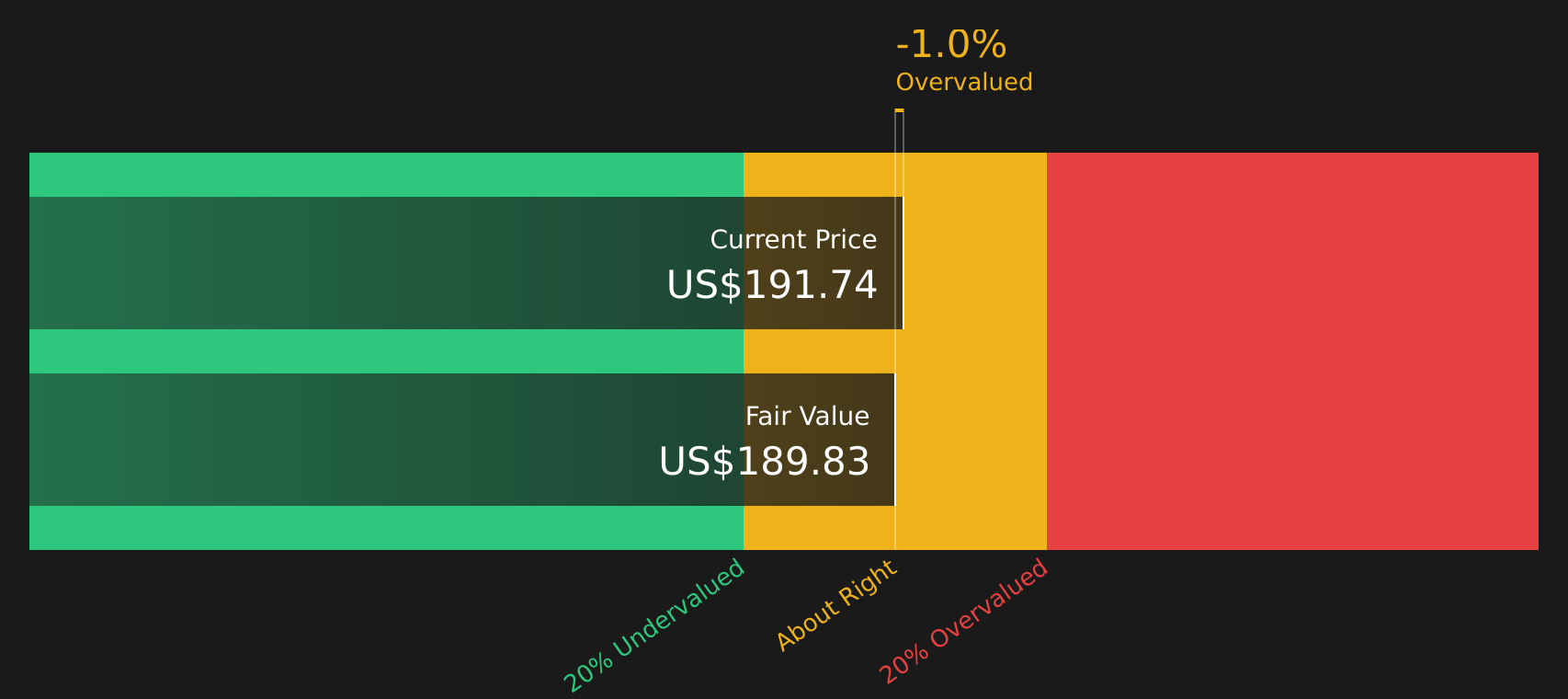
On this basis, the Excess Returns framework arrives at an intrinsic value of $188.20 per share. This is slightly above the current share price, which implies State Street screens as roughly fairly valued with a modest 1.9% premium to the model estimate.
Overall, the Excess Returns workup indicates that State Street appears to be about fairly valued at today’s price.
State Street is fairly valued according to our Excess Returns, but this can change at a moment's notice. Track the value in your watchlist or portfolio and be alerted on when to act.
Does State Street Look Fairly Valued on Earnings?
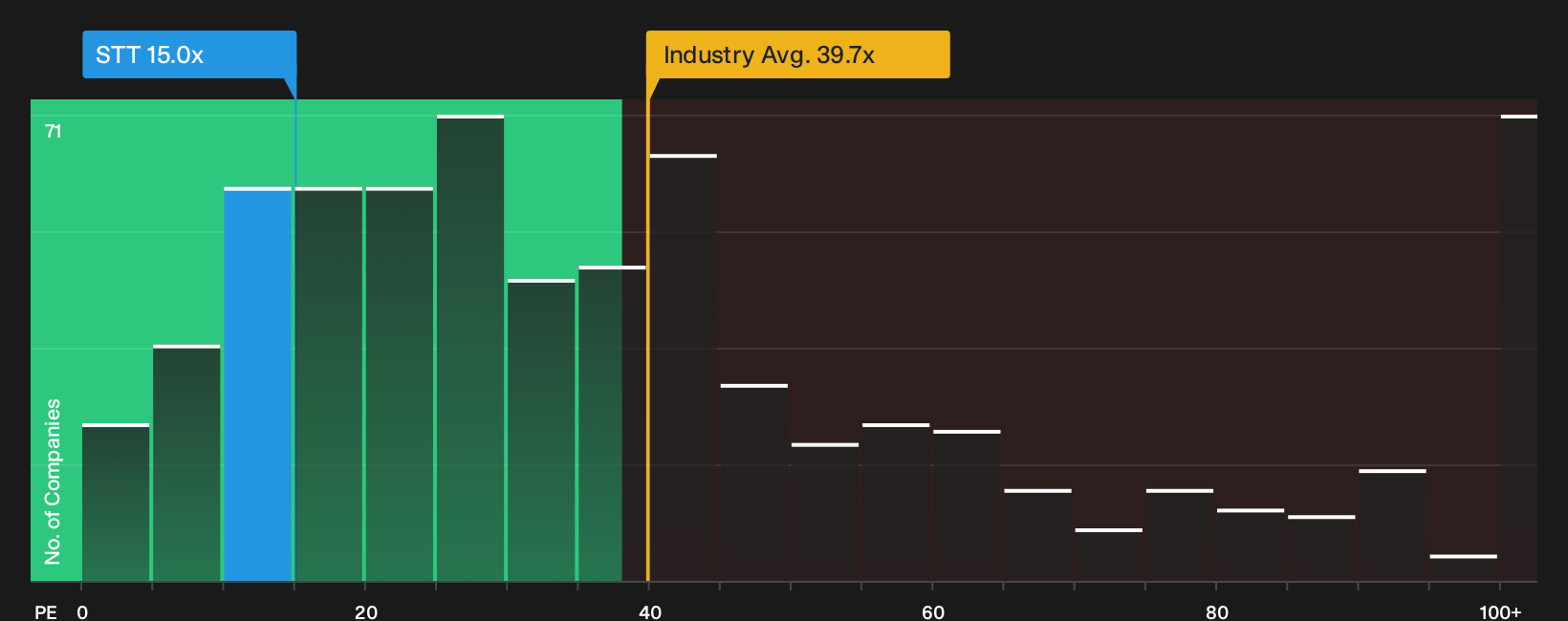
The P/E ratio is a useful way to look at State Street because earnings are a core driver of how investors typically value large established financial companies. State Street currently trades on a P/E of 16.4x, which is well below the Capital Markets industry average of 39.5x and also below the broad peer group average of 30.1x. That places the stock at a discount to many peers on simple earnings terms.
The tailored fair P/E ratio for State Street is 17.4x. This reflects what the multiple could look like after considering factors such as its margins, business mix, size and risk profile, rather than just using the raw industry average. Compared with this fair ratio, the current 16.4x suggests the stock is close to where the model would expect it to trade, with only a small gap to that reference point.
On the P/E multiple, State Street stock appears to be priced at roughly a fair level rather than offering a clear discount or premium.
The State Street Narrative: What Would Justify Today's Price?
Simply Wall St Narratives for State Street pick up where the valuation checks leave off. They spell out which paths for State Street's growth, margins and earnings would need to play out for the stock to be worth materially more or less than today. Each one sets out a fair value as a clear thesis about the business that you can revisit over time, and all of them sit together on Simply Wall St's Community page.
The community is split on State Street, with one side seeing execution upside in the fee engine and the other focusing on interest rate and capital constraints.
Bull case: 11% undervalued
"State Street's strategic focus on its Alpha platform to win new business and cross-sell additional services is expected to strengthen fee revenue while increasing client retention due to broader service dependencies..."
Bear case: 17% overvalued
"State Street's asset sensitivity could lead to earnings pressure if non-U.S. rate cuts affect revenues negatively, as $5 million to $10 million is lost per cut per quarter..."
Do you think there's more to the story for State Street? Head over to our Community to see what others are saying!
The Bottom Line
State Street now screens as about fairly valued, with the Excess Returns intrinsic value estimate and the earnings multiple both pointing to a price that is close to what the models suggest. The valuation checks are mixed rather than emphatically cheap or expensive, so the stock does not stand out as a clear bargain. From here, the key question is whether State Street can keep converting its large asset base into resilient fee income without pressure on pricing or client activity. That assumption is what most clearly separates the bull and bear views.
This article by Simply Wall St is general in nature. We provide commentary based on historical data and analyst forecasts only using an unbiased methodology and our articles are not intended to be financial advice. It does not constitute a recommendation to buy or sell any stock, and does not take account of your objectives, or your financial situation. We aim to bring you long-term focused analysis driven by fundamental data. Note that our analysis may not factor in the latest price-sensitive company announcements or qualitative material. Simply Wall St has no position in any stocks mentioned.