
TASI to 13,000 Points? Analysts Reveal 3 Scenarios for 2026
Tadawul All Shares Index TASI.SA | 11314.64 | -0.25% |
Energy TENI.SA | 5180.74 | -0.15% |
SAUDI ARAMCO 2222.SA | 27.16 | -0.15% |
The Saudi stock market (Tadawul All Shares Index(TASI.SA)) enters 2026 at a critical juncture. Following a correction of approximately 12.8% in 2025, the market is now navigating between macroeconomic headwinds and transformative regulatory catalysts. That said, Tadawul All Shares Index(TASI.SA) has already gained more than 3% to start the year of 2026.
According to a synthesis of research from SNB Capital, Riyad Capital, EFG Hermes, and Aljazira Capital, the outlook for 2026 is defined by a distinct tug-of-war between liquidity constraints and growth initiatives.
The Bull Case: Liquidity Injection & Project Momentum
Optimism for a recovery is anchored in three primary catalysts that could unlock significant upside:
- The Foreign Inflow "Game Changer": The most significant potential driver remains the liberalization of foreign access. Following the Capital Market Authority’s (CMA) recent move to scrap the "Qualified Foreign Investor" (QFI) requirement starting February 2026, market participants are now looking to price in the potential relaxation of the 49% foreign ownership cap. Riyad Capital estimates that raising these limits could trigger passive inflows of $10–15 billion, providing a critical liquidity floor for the market.
- Infrastructure Resilience: Despite broader fiscal tightening, the "Giga-Project" pipeline offers a defensive buffer. Spending mandates for the 2034 FIFA World Cup, Expo 2030, and the 2027 AFC Asian Cup ensure that construction and materials sectors will likely decouple from oil-price volatility.
- Valuation Re-rating: With TASI’s forward P/E ratio hovering around 14.3x—noticeably below its 10-year average of 15.8x—analysts argue the market has reached an "oversold" territory that limits further downside risk, offering an attractive entry point for long-term investors.
The Bear Case: Oil Volatility & Fiscal Drag
Conversely, research houses warn of structural risks that could cap gains:
- The Oil Price Ceiling: The correlation between TASI and oil prices remains high. With Brent crude forecast to average between $55 and $60 per barrel in 2026 due to supply surpluses, EFG Hermes cautions that low oil revenues could widen the fiscal deficit (projected at 3.3% of GDP), potentially forcing a reprioritization of non-essential government spending.
- Liquidity Crunch: The market is still digesting the impact of 2025's liquidity drought, where trading values hit a six-year low. SNB Capital flags that without a distinct reversal in trading volumes or fresh foreign capital, domestic liquidity may remain tight.
- Monetary Policy Lag: While the US Federal Reserve’s easing cycle is generally positive, NBK warns that sticky inflation could slow the pace of rate cuts, delaying the much-needed reduction in borrowing costs for Saudi corporates.
Scenario Analysis: Mapping the Path for 2026
Given these diverging factors, Aljazira Capital has outlined three distinct scenarios for TASI, pegging the index's performance to oil prices, GDP growth, and interest rate trajectories.
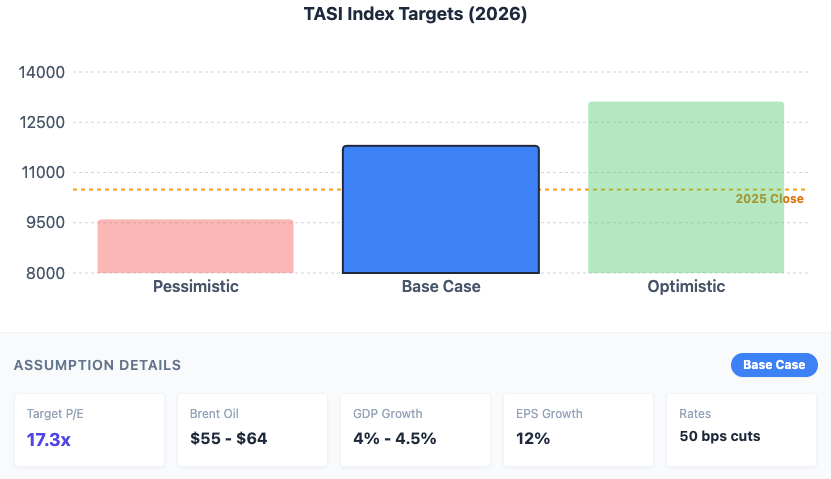
- Base Case (Most Likely): If Brent crude stabilizes between $55–64 per barrel and the Kingdom achieves GDP growth of 4%–4.5%, the index is projected to target 11,796 points. This scenario assumes a moderate P/E of 17.3x and corporate earnings growth of roughly 12%.
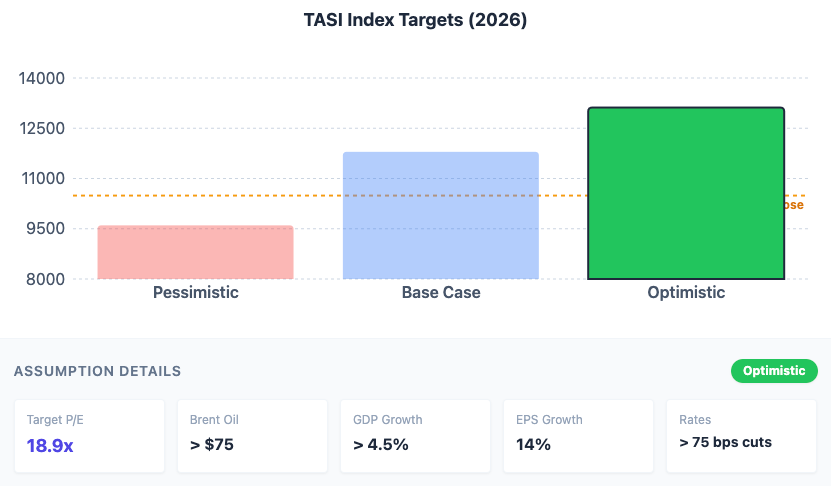
- Optimistic Scenario: In a bullish environment where oil prices reclaim levels above $75 and interest rates are cut by more than 75 basis points, the index could surge to 13,118 points, driven by aggressive earnings growth of 14%.
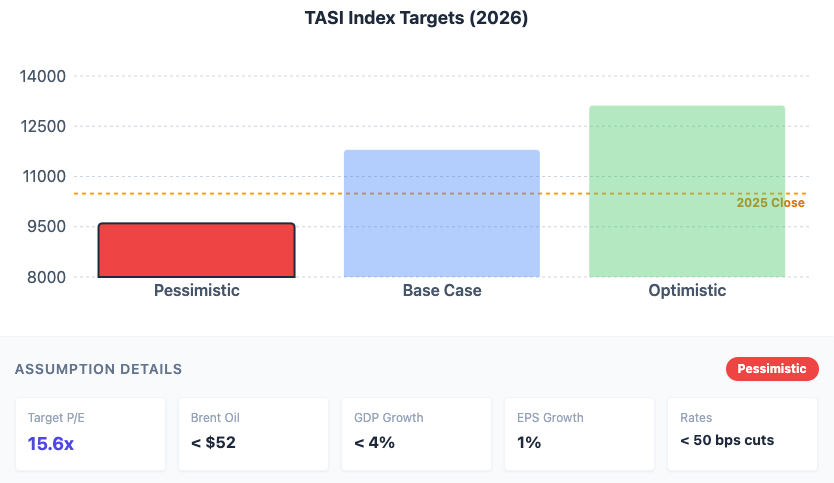
- Pessimistic Scenario: Should oil prices slide below $52 and GDP growth falter below 4%, the firm sees a risk of the index retreating to 9,601 points, with earnings growth stalling at just 1%.
While 2025 was a year of correction, 2026 is shaping up to be a year of accumulation. The market’s direction will likely be determined by the speed of regulatory reforms regarding foreign ownership and the "Giga-Project" momentum.
(Disclaimer: This article is for informational purposes only and relies on third-party research data. It does not constitute investment advice.)