

Terex (TEX) Stock Looks Undervalued On Cash Flow But Overvalued On Earnings
Terex Corporation TEX | 0.00 |
Terex stock has delivered a 53.6% total return over the past five years, yet there is a clear valuation split, with an intrinsic value estimate based on a Discounted Cash Flow (DCF) model pointing to meaningful upside while market multiples lean more cautious and the overall value score is low.
- Over five years, Terex has returned 53.6%, which puts recent valuation questions into the context of a stock that has already rewarded patient shareholders.
- Expectations for Terex to keep generating solid cash flows can support the intrinsic value case, but any pressure on margins or a heavier investment cycle may weigh on how much of that cash ultimately reaches shareholders.
- On Simply Wall St's broader valuation checks, Terex scores 2 out of 6, which suggests the stock does not screen as a clear bargain when viewed across several valuation lenses.
The issue now is whether Terex's current share price around US$67.07 still offers an attractive margin of safety relative to its intrinsic value estimate and the more cautious message from market multiples.
Is Terex Still Cheap on Cash Flow?
The Discounted Cash Flow (DCF) approach used here projects what Terex could generate for shareholders based on its future free cash flows. Terex recently produced around $288.2 million in free cash flow over the latest twelve months, and the model assumes these cash flows grow rather than contract over time, using a two stage Free Cash Flow to Equity framework.
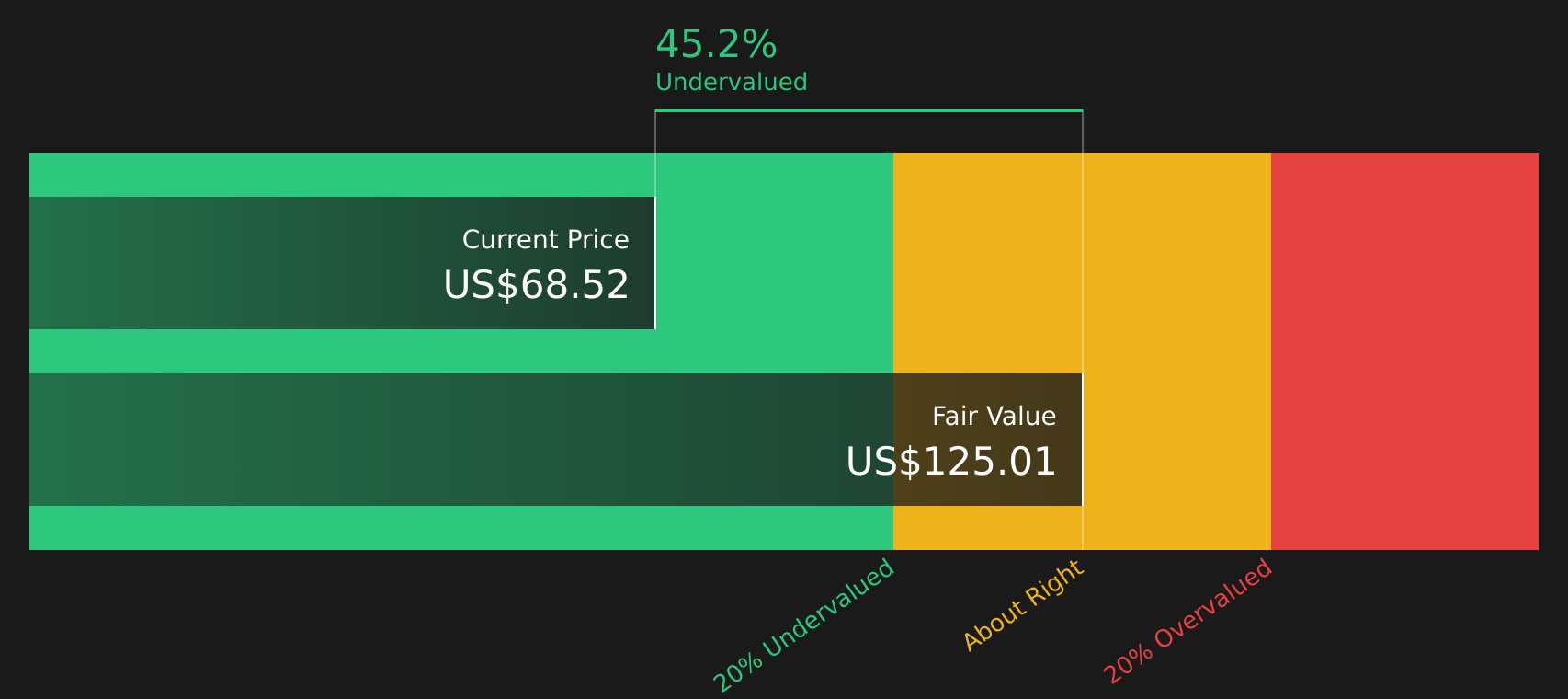
On those assumptions, the DCF model points to an estimated intrinsic value of about $124.71 per share, compared with the current share price near $67.07. That gap implies the stock trades at roughly a 46.2% discount to the model’s estimate, even after the strong total return achieved over the past five years.
On this cash flow view, Terex stock currently screens as undervalued relative to its estimated intrinsic worth.
Our Discounted Cash Flow (DCF) analysis suggests Terex is undervalued by 46.2%. Track this in your watchlist or portfolio, or discover 47 more high quality undervalued stocks.
Is Terex Getting Expensive on Earnings?
For Terex, the P/E ratio is a useful check because earnings are a key focus for many investors in capital goods companies. Terex currently trades on a P/E of about 71.6x, compared with an industry average of roughly 27.9x and a peer group average near 20.2x. That places Terex at a substantial premium to both the wider machinery sector and closer peers on this metric.
A fair P/E ratio for Terex, based on a model that factors in its sector, size and risk profile, is estimated at around 45.7x. Against the current 71.6x, the stock sits well above that fair multiple, which suggests investors are paying a high price for each dollar of current earnings, even when allowing for company specific characteristics.
On the P/E multiple, Terex stock currently appears overvalued compared with both its tailored fair ratio and industry benchmarks.

The Terex Narrative: What Would Justify Today's Price?
Simply Wall St Narratives for Terex take the valuation puzzle a step further by spelling out the specific paths for Terex's growth, margins and earnings that would need to play out for the stock to be worth materially more or less than today's price, hosted on the Community page. Instead of stopping at a single output from a ratio or model, they lay out the future that figure depends on so you can judge over time whether that story is actually playing out.
If you have a number driven view on where Terex's growth, margins and execution go from here, consider sharing a Narrative in the Simply Wall St community so others can see your thesis and watch how it fares as new results come through.
Do you think there's more to the story for Terex? Head over to our Community to see what others are saying!
The Bottom Line
For Terex, the Discounted Cash Flow (DCF) view points to meaningful intrinsic value upside, while the market multiple view signals the stock is overvalued on current earnings. That split reflects a cash flow model that is comfortable with funding needs and timing, compared with a P/E framework that leans on rich growth expectations and current sentiment. Broader valuation checks remain weak, so the key question is whether Terex can convert its cash generation into shareholder value without eroding margins, or whether the current earnings multiple proves too full if that execution falls short.
This article by Simply Wall St is general in nature. We provide commentary based on historical data and analyst forecasts only using an unbiased methodology and our articles are not intended to be financial advice. It does not constitute a recommendation to buy or sell any stock, and does not take account of your objectives, or your financial situation. We aim to bring you long-term focused analysis driven by fundamental data. Note that our analysis may not factor in the latest price-sensitive company announcements or qualitative material. Simply Wall St has no position in any stocks mentioned.