

The Bull Case For Cushman & Wakefield (CWK) Could Change Following Russell Defensive Index Addition
CUSHMAN & WAKEFIELD PLC CWK | 0.00 |
- In late June 2026, Cushman & Wakefield was added to the Russell 2000 Defensive and Russell 2000 Value-Defensive Indexes, while also securing new advisory and brokerage mandates and announcing senior leadership appointments in its Global Capital Markets platform.
- Together, these developments highlight how the firm is being repositioned by the market as a more defense-oriented real estate services provider with reinforced capital markets leadership.
- We’ll now examine how Cushman & Wakefield’s addition to defensive Russell indexes might influence its investment narrative for long-term investors.
The future of work is here. Discover the 29 top robotics and automation stocks leading the charge in AI-driven automation and industrial transformation.
Cushman & Wakefield Investment Narrative Recap
To own Cushman & Wakefield, you need to believe its shift toward more recurring, advisory-focused revenue can offset exposure to cyclical capital markets and office leasing. The biggest near term catalyst remains progress on improving profitability and cash generation, while the main risk is still sensitivity to weaker transaction volumes and relatively thin margins. The recent addition to Russell defensive indexes and new mandates is directionally supportive, but does not fundamentally change those drivers on its own.
The most relevant update here is Cushman & Wakefield’s inclusion in the Russell 2000 Defensive and Value Defensive indexes. This may draw more attention from investors who prioritize earnings resilience and may sit well alongside the company’s effort to grow consulting and occupier services. How far that shift can go, though, is still constrained by its meaningful exposure to transaction based fees and the health of commercial real estate markets.
Yet behind the appeal of “defensive” index labels, investors should be aware that Cushman & Wakefield still faces concentrated exposure to...
Cushman & Wakefield's narrative projects $12.4 billion revenue and $416.8 million earnings by 2029. This requires 5.6% yearly revenue growth and a $343.1 million earnings increase from $73.7 million today.
Uncover how Cushman & Wakefield's forecasts yield a $17.50 fair value, a 25% upside to its current price.
Exploring Other Perspectives
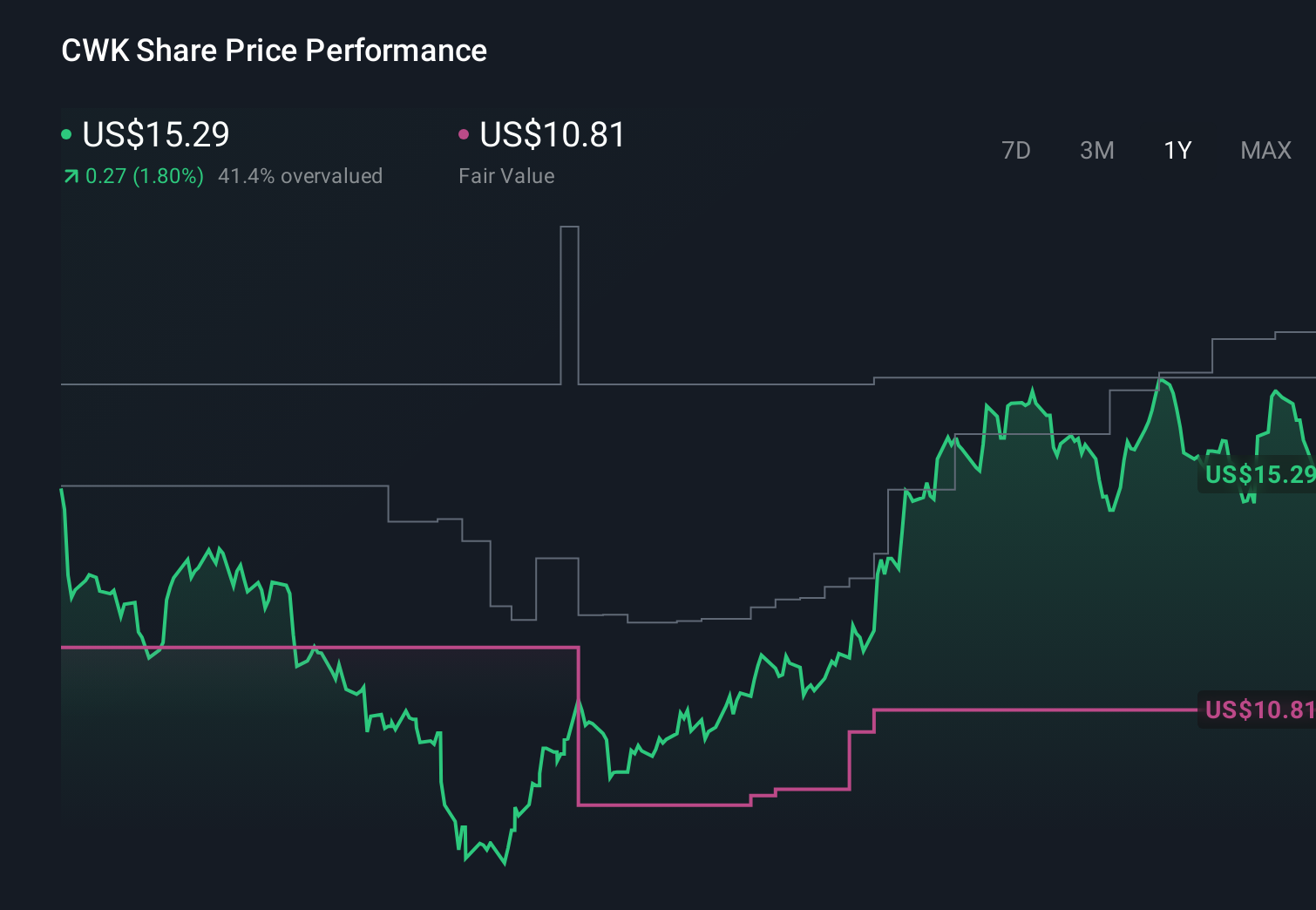
Some of the most optimistic analysts were already assuming revenue could reach about US$12.9 billion and earnings about US$502.9 million by 2029, which is far more bullish than consensus and puts a very different weight on catalysts like faster services growth compared with risks such as office demand and debt costs.
Explore 2 other fair value estimates on Cushman & Wakefield - why the stock might be worth just $17.50!
Reach Your Own Conclusion
Don't just follow the ticker - dig into the data and build a conviction that's truly your own.
- A great starting point for your Cushman & Wakefield research is our analysis highlighting 3 key rewards and 4 important warning signs that could impact your investment decision.
- Our free Cushman & Wakefield research report provides a comprehensive fundamental analysis summarized in a single visual - the Snowflake - making it easy to evaluate Cushman & Wakefield's overall financial health at a glance.
Ready To Venture Into Other Investment Styles?
Every day counts. These free picks are already gaining attention. See them before the crowd does:
- Find 44 companies with promising cash flow potential yet trading below their fair value.
- The latest GPUs need a type of rare earth metal called Terbium and there are only 31 companies in the world exploring or producing it. Find the list for free.
- We've uncovered the 7 dividend fortresses yielding 5%+ that don't just survive market storms, but thrive in them.
This article by Simply Wall St is general in nature. We provide commentary based on historical data and analyst forecasts only using an unbiased methodology and our articles are not intended to be financial advice. It does not constitute a recommendation to buy or sell any stock, and does not take account of your objectives, or your financial situation. We aim to bring you long-term focused analysis driven by fundamental data. Note that our analysis may not factor in the latest price-sensitive company announcements or qualitative material. Simply Wall St has no position in any stocks mentioned.