

The Bull Case For Verizon (VZ) Could Change Following Dow Exit And Rising Starlink Competition
Verizon Communications Inc. VZ | 0.00 |
- Verizon Communications Inc. was recently removed from both the Dow Jones Industrial Average, where it will be replaced by Alphabet, and the Russell Top 50 Index, while also restructuring part of its debt through tender and exchange offers totaling about US$1.86 billion in principal.
- At the same time, reports that SpaceX’s Starlink may launch a retail mobile internet service in the U.S. highlight a potential new competitor encroaching on Verizon’s core wireless market, especially in rural and underserved areas.
- We’ll now examine how Verizon’s exit from the Dow and rising competitive pressure from Starlink affect its existing investment narrative.
The future of work is here. Discover the 29 top robotics and automation stocks leading the charge in AI-driven automation and industrial transformation.
Verizon Communications Investment Narrative Recap
To own Verizon today, you need to believe its core U.S. connectivity business can keep throwing off steady cash, even as growth in a mature wireless market stays modest. The key short term catalyst is execution on 5G, fixed wireless and fiber to support service revenue, while the biggest current risk is intensifying competition, now including a potential Starlink retail mobile offer. Verizon’s exit from the Dow and Russell Top 50 looks largely symbolic rather than thesis changing near term.
Among Verizon’s recent moves, the US$1.86 billion of tender and exchange offers for outstanding notes feels most relevant here. In the context of a high debt load, reshaping parts of its bond stack matters for financial flexibility just as spectrum spending and new rivals like Starlink keep capital needs elevated. How effectively Verizon balances debt management with ongoing 5G and broadband investment will be crucial for the near term catalyst around cash flow resilience.
Yet even as Verizon signals stability, investors should be aware that competitive threats to its core wireless cash flows could...
Verizon Communications' narrative projects $147.7 billion revenue and $22.4 billion earnings by 2029. This requires 2.0% yearly revenue growth and about a $5.1 billion earnings increase from $17.3 billion today.
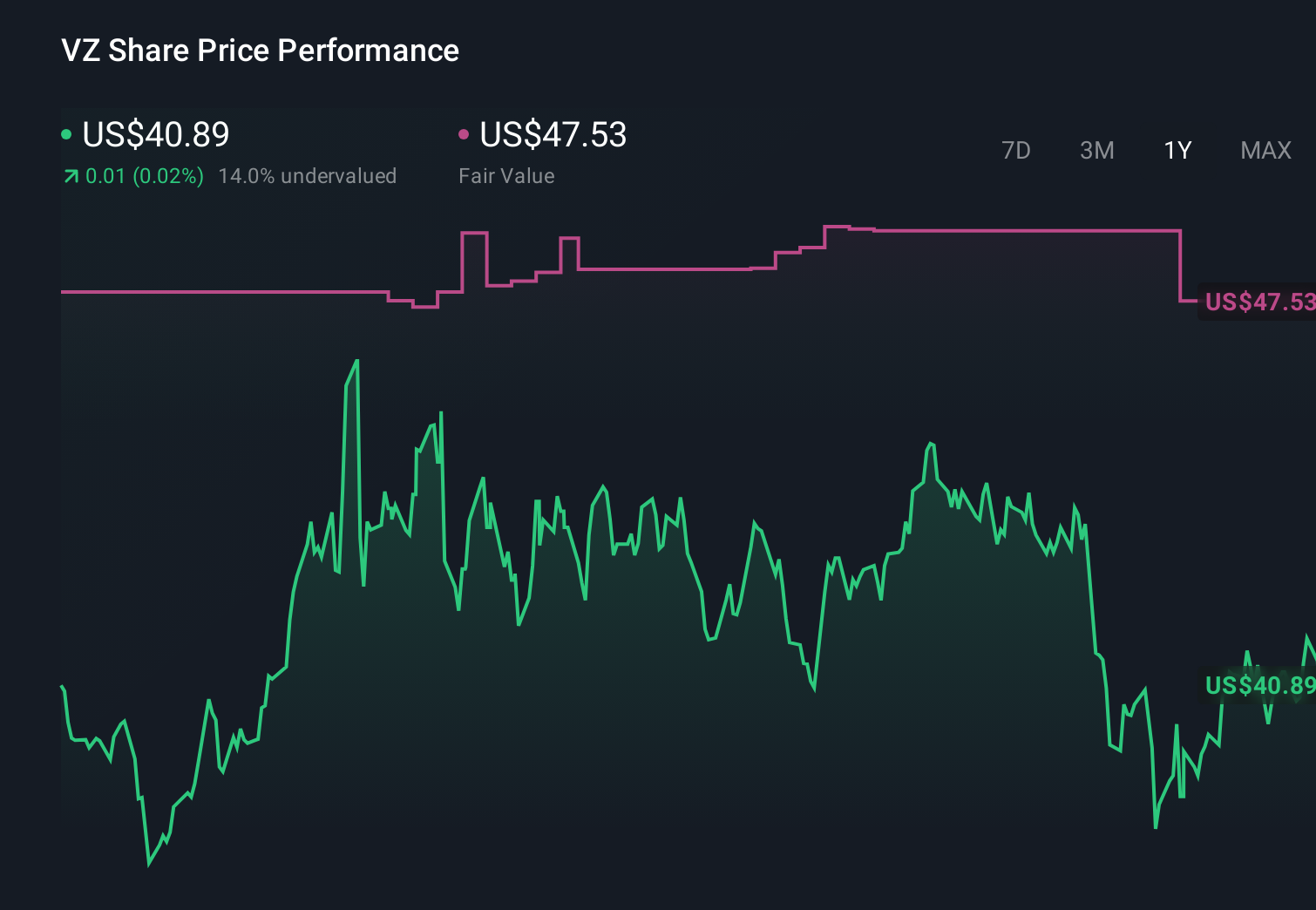
Uncover how Verizon Communications' forecasts yield a $51.90 fair value, a 12% upside to its current price.
Exploring Other Perspectives
Some of the lowest case analysts were already assuming only about 1.2% annual revenue growth and earnings of roughly US$19.9 billion, so you should expect their already cautious view on fiber heavy spending and convergence pressure to be tested again by Verizon’s index exit and Starlink’s possible entry.
Explore 19 other fair value estimates on Verizon Communications - why the stock might be worth 14% less than the current price!
The Verdict Is Yours
Don't just follow the ticker - dig into the data and build a conviction that's truly your own.
- A great starting point for your Verizon Communications research is our analysis highlighting 3 key rewards and 2 important warning signs that could impact your investment decision.
- Our free Verizon Communications research report provides a comprehensive fundamental analysis summarized in a single visual - the Snowflake - making it easy to evaluate Verizon Communications' overall financial health at a glance.
Looking For Alternative Opportunities?
Our top stock finds are flying under the radar-for now. Get in early:
- Explore 30 top quantum computing companies leading the revolution in next-gen technology and shaping the future with breakthroughs in quantum algorithms, superconducting qubits, and cutting-edge research.
- Capitalize on the AI infrastructure supercycle with our selection of the 51 best 'picks and shovels' of the AI gold rush converting record-breaking demand into massive cash flow.
- Find 44 companies with promising cash flow potential yet trading below their fair value.
This article by Simply Wall St is general in nature. We provide commentary based on historical data and analyst forecasts only using an unbiased methodology and our articles are not intended to be financial advice. It does not constitute a recommendation to buy or sell any stock, and does not take account of your objectives, or your financial situation. We aim to bring you long-term focused analysis driven by fundamental data. Note that our analysis may not factor in the latest price-sensitive company announcements or qualitative material. Simply Wall St has no position in any stocks mentioned.