

Toyota Industries (OTCPK:TYID.Y), What Is Behind The Fresh Attention?
Toyota Industries (OTCPK:TYID.Y) is back in focus after Subros Limited signed a Technical Assistance Agreement with the company and DENSO to localize electric compressors for electric and hybrid vehicles in India.
For context, Toyota Industries' share price has a 1-year share price return that sits behind its 16.34% 1-year total shareholder return, while the 3-year total shareholder return of 87.88% points to momentum that long term holders will notice.
If this electric mobility update has you thinking more broadly about opportunities around automation, it could be a good time to scan the market for 39 robotics and automation stocks.
So with Toyota Industries now tied into Subros on electric compressors, the valuation question gets sharper. Is the current pricing discounting this new revenue potential fairly, or is the market being too cautious on the stock?
Preferred P/E of 27.4x: Is it justified for Toyota Industries?
On simple earnings terms, Toyota Industries currently trades on a P/E of 27.4x, which sits just under both its Machinery industry average and the wider peer group averages.
The P/E ratio compares a company’s share price with its earnings per share. For a business like Toyota Industries that operates across automobiles, materials handling equipment and textile machinery, this metric gives a quick sense of how much investors are paying today for each dollar of current earnings.
Here, the data suggests the market is pricing Toyota Industries in a similar ballpark to comparable Machinery companies. The company is flagged as having high quality earnings and has grown profits by 7.2% per year over the past 5 years, yet its P/E is slightly below both the US Machinery industry average of 27.7x and the peer average of 29.8x. That points to a valuation that is not stretched relative to close peers and could move closer to those benchmarks if sentiment lines up with the earnings profile.
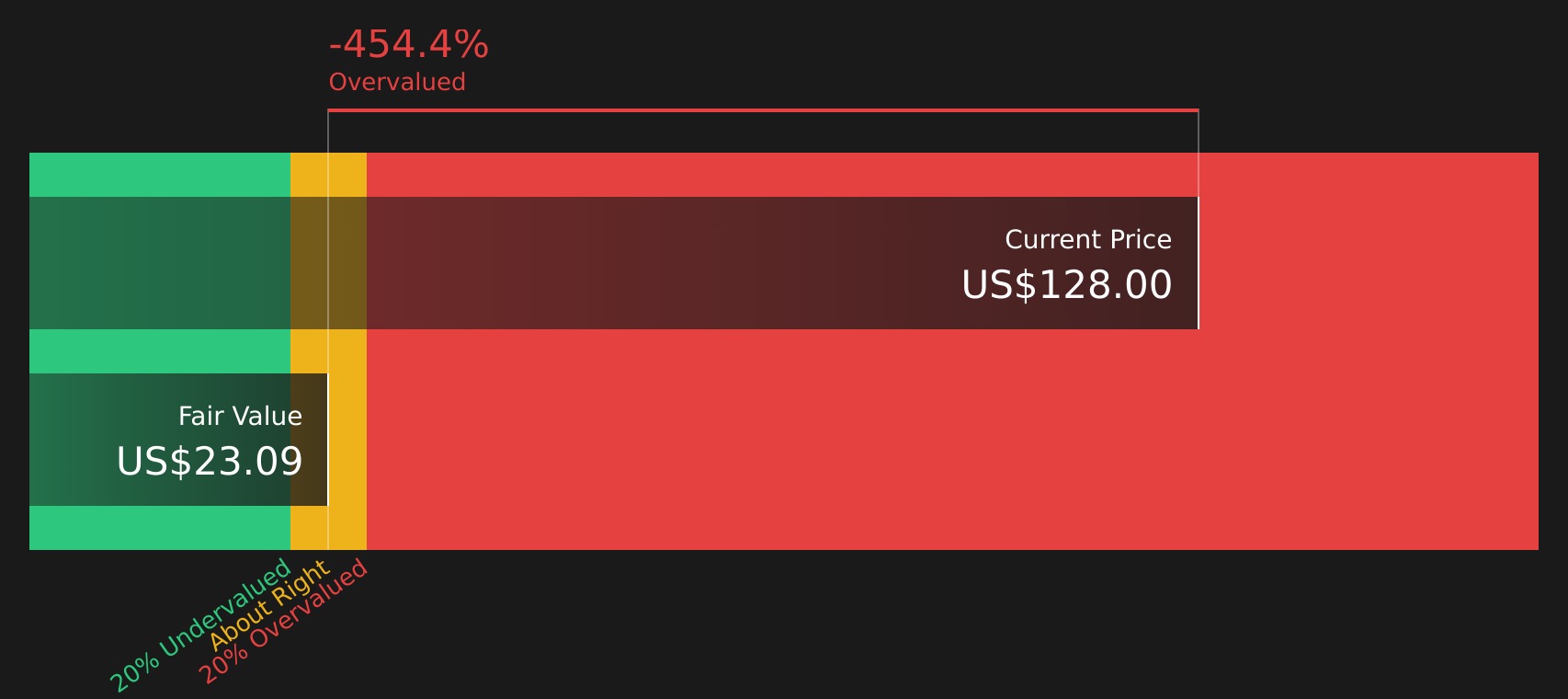
Against that context, there is also the SWS DCF model, which currently values Toyota Industries at $23.09 per share, compared with the last close of $128. This implies the share price is far above the model’s estimate of future cash flow value, so investors weighing the P/E will likely want to understand why the market price and that cash flow view differ so widely.
Result: Price-to-Earnings of 27.4x (ABOUT RIGHT)
However, the wide gap between the SWS DCF estimate and the current share price, together with Toyota Industries' relatively low value score, suggests expectations could prove too optimistic.
Another View on Toyota Industries' Valuation
While the P/E comparison makes Toyota Industries look roughly in line with Machinery peers, the SWS DCF model presents a very different view. It puts fair value at $23.09 per share versus the current $128, which indicates a stock price that sits well above modelled future cash flows. The question for you is which signal carries more weight.
Simply Wall St performs a discounted cash flow (DCF) on every stock in the world every day (check out Toyota Industries for example). We show the entire calculation in full. You can track the result in your watchlist or portfolio and be alerted when this changes, or use our stock screener to discover 49 high quality undervalued stocks. If you save a screener we even alert you when new companies match - so you never miss a potential opportunity.
Next Steps
If the mix of cautious signals and optimism around Toyota Industries feels hard to balance, it makes sense to review the data yourself and act promptly. To see what the more optimistic investors are focusing on, take a closer look at the 1 key reward.
Looking for more investment ideas beyond Toyota Industries?
Do not stop your research with Toyota Industries. Use the Simply Wall St screener to compare other opportunities and spot stocks that better match your investing style.
- Lock in your focus on income by reviewing companies in the 8 dividend fortresses that may suit a yield focused approach.
- Hunt for quality at a sensible price by checking the 49 high quality undervalued stocks and see which stocks currently stand out.
- Prioritise resilience by scanning the 85 resilient stocks with low risk scores so you are not the one hearing about steady compounders after they have moved.
This article by Simply Wall St is general in nature. We provide commentary based on historical data and analyst forecasts only using an unbiased methodology and our articles are not intended to be financial advice. It does not constitute a recommendation to buy or sell any stock, and does not take account of your objectives, or your financial situation. We aim to bring you long-term focused analysis driven by fundamental data. Note that our analysis may not factor in the latest price-sensitive company announcements or qualitative material. Simply Wall St has no position in any stocks mentioned.