

Trading Wisdom | From Losing $250,000 to a 320% Annual Return: The One Truth She Took a Decade to Learn – Trading Isn’t About Winning, It’s About Losing Well
Parallel Market Capped Index (NomuC) NOMUC.SA | 0.00 | |
Rocket Lab RKLB | 0.00 | |
MAHARAH 1831.SA | 0.00 | |
Palantir PLTR | 0.00 | |
RETAL 4322.SA | 0.00 |
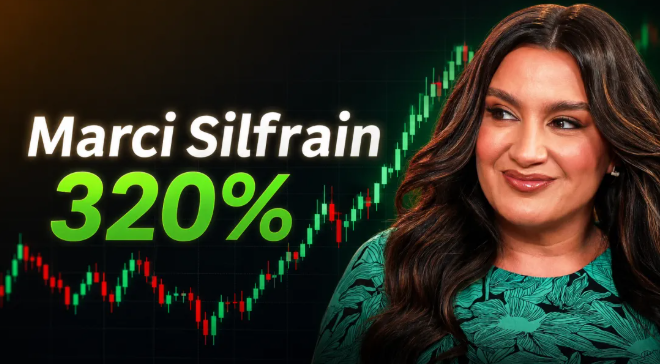
Marci Silfrain has become a prominent name in Western trading circles in recent years. A professional futures trader, she is widely recognised as one of the top performers in the World Cup Championship of Futures Trading, currently ranked second globally. Her verified 320% annual return caught widespread attention during a public interview, and she has since emerged as a leading female voice in a traditionally male‑dominated field.
But her success is anything but an overnight story.
Before reaching where she is today, Marci spent nearly a decade struggling – accumulating over $250,000 in losses, wiping out her account, and starting from scratch. It was through repeated market beatings that she came to deeply understand risk management, trading discipline, and the weight of decision‑making under pressure. Her journey offers a rare, candid look at what really separates the top 1% of traders from the rest – and why most traders, even with a decent system, never achieve lasting profitability.
The Decade of Darkness – and Why She Stayed
Marci started trading over fifteen years ago. At the time, she had some equity tied up in real estate but couldn't access it. She was transitioning careers, always someone who disliked being controlled or following rules – she wanted to forge her own path. An online ad promising “$50,000 a year from home” pulled her in. She thought, That’s it – that’s what I want.
It took her nearly ten years to make that happen.
She fell into a deep hole and couldn't stop. She became obsessed with finance, trading, and investing. Eventually, she sold the property, convinced she finally knew how to trade – only to blow up the account and have to start over. It was brutal.
When asked how she persevered through an entire decade of failure, Marci admits: “If I had known it would take ten years, I probably would never have started.” The trap is that you never realise it at the beginning. You start out believing you know what you're doing. A few winning trades here and there reinforce that illusion. The unique curse of trading is that a beginner has roughly a 55% chance of being right on any given trade – which creates the false sense of having an edge when you actually have none. You can't walk into a neurosurgery room on day one and succeed – your odds are zero. But in trading, you get that 55% immediately, so you mistake luck for skill.
It took Marci about ten years to fully grasp that she didn't know what she was doing. Looking back, she admits she was arrogant, overconfident, and saw that same trait in many online traders. The market will eventually humble you – and it's that humiliation that forces you to look inward and ask: What am I doing wrong? The answer, almost always, is risk management.
Everything She Learned Came from Losses
Marci is adamant that she never learned anything from winning trades – only from losses. Wins gave her a false sense of brilliance; losses taught her that risk management must come before every single action. You don't enter a trade planning to win – you enter planning to lose. You must always have the worst‑case scenario front and centre: how much you'll lose, and what you'll do after that loss. When you do make money, you simply acknowledge it and move on.
She believes trading is almost impossible to teach online because you can't learn it by watching others. You have to put your own money on the line and feel the pain. You have to take on excessive risk and lose sleep over it. Her personal “sleep rule” is simple: If you can't sleep because of a trade, you shouldn't be in it. She learned that the hard way, with no mentor and no online guru to follow. She figured everything out through trial and error.
When people ask her about the turning point – the moment when she finally became profitable – she always answers: “I could become unprofitable tomorrow.” There is no permanent state of being a profitable trader. One bad decision can wipe you out, even years into success. So you never stop being cautious.
The Hardest Moment – and the Best Decision
The lowest point came when Marci realised she had actually lost that $250,000. She sat there thinking, Now what? She went out and got a nine‑to‑five job – an incredibly humbling experience for someone who always wanted to be her own boss. But it turned out to be the best decision she ever made.
Having a job removed the immense pressure of needing to live off trading income. That pressure, she realised, had been driving many of her bad decisions. With a steady salary, she could trade part‑time, rebuild slowly, and apply every lesson she had learned. She became obsessed with protecting herself from losses – not just avoiding them, but actively studying everything that could kill her account so she could steer clear. That shift in focus – from chasing profits to defending against losses – was the real turning point.
Her advice to anyone starting out: Do not quit your day job. Even after a profitable year, keep working. Let your trading capital grow gradually while you live on your salary. Without the stress of having to be right to pay the rent or mortgage, you think more clearly and make far better decisions.
Self‑Taught, from the Ground Up
Marci has no formal financial background. She is entirely self‑taught. In her early days, she would spend hours watching CNBC, understanding nothing they said. She'd pause, Google every unfamiliar term – “revenue,” “net income” – and force herself to digest it. She dissected interviews with Wall Street billionaires until she could speak their language. Then she became obsessed with how they started – what path did they follow? She piece by piece built her own understanding.
She believes most beginners drastically underestimate everything – the difficulty, the emotional toll, the toll on relationships and personal life. They see top hedge fund managers making 40–60% a year and think they'll be the one to make 200–300% consistently. You might have a few such years, but only by taking extreme risk, and it never lasts.

Evolving Her Style – From Day Trading to Swing Trading
Marci's trading style evolved dramatically over that decade. She started as a day trader, glued to 1‑minute charts, making up to 40 trades a day. She loved the intensity. But over time, she realised that the fewer decisions she makes in a day, the higher the quality of each decision. She transitioned to swing trading, which she finds psychologically far easier.
She moved from stocks and options to futures – primarily the Nasdaq and S&P 500 indices. Futures trade 23 hours a day, so stops can trigger even when she's asleep – a critical risk management advantage over stocks or options, where overnight gaps can trap you. She found her niche in index futures because they're less prone to idiosyncratic shocks (a single stock can drop 50% overnight; the S&P 500 rarely does). She sticks to what she understands – charts and price patterns – and leaves stock‑picking and balance‑sheet analysis to others.
Her trade frequency varies wildly. Some months she takes zero trades; other months, five or ten. When a strong trend is in place, she might hold a single position for three months. Choppy markets may trigger more entries and more stops. Ironically, her busiest months are often her worst; quiet months usually mean she's riding a strong trend.
The One Rule for Every Entry
Marci's golden rule for entering a trade is not about when to buy – it's about when to sell. She insists that you must have a clear exit plan before you click buy. It can be a price level, a percentage, a point target, or even a moving average – but it must be defined. Without an exit plan, you fall prey to FOMO, emotional clinging, averaging down, and doubling up – which is where real disasters happen.
She stresses that even a random entry has roughly a 54% chance of being profitable. The real edge comes from knowing when to get out – both for losses and for profits – and sticking to that plan with extreme discipline.
Discipline – The Only Quality You Need
Marci now describes herself as extremely disciplined – perhaps even over‑cautious. That discipline shows in her position sizing, her exit execution, and her ability to let winners run. Letting profits run was one of her biggest early struggles; now she has developed a mental framework that works for her. Discipline also means staying out of the market when there's no setup. She jokes that live‑trading streams would bore viewers – she spends most of her time reading or watching TV, and only occasionally says, “Oh, this one is setting up.” Much of trading is waiting, not chasing dopamine.
Preparing for 20 Losing Trades in a Row
One of the hardest psychological hurdles is accepting that you could lose 20 consecutive trades. Marci tackles this by detaching from the nominal account balance. She constantly reminds herself not to get attached to the cash number – if a crash comes, that $1 million could become $200,000. She mentally treats her capital as if it were already reduced by 80%. She embraces the mindset: If you're not prepared to lose money, you'll never make money. If you can't stomach any loss, buy Treasuries – but that's not trading. She plans for losses before they happen, and that mental preparation makes the reality far less painful.
Practical Risk Management for Beginners
For newcomers, Marci suggests starting with a 1:1 risk‑reward ratio – risking 10 points to make 10 points, for example – and strictly adhering to that. Avoid the urge to average down or add to losing positions; if you add at all, add to winners. She emphasises that trading has no final destination – there is no permanent edge that works forever. It takes much longer than you expect, and you must experience different market cycles – bull, bear, and sideways – before you truly understand your own reactions.
She also warns against overcomplicating technical analysis. Start simple: learn to read a single candlestick – its open, high, low, close – without memorising dozens of patterns. Then pick one basic indicator like RSI to gauge overbought/oversold conditions. She personally loves Fibonacci retracements and extensions. Trendlines are also timeless. She doesn't follow order‑flow tools, though they're popular – because in her view, all these tools are ultimately telling you the same thing: the balance between buyers and sellers. Find the tool that resonates with you, like an artist choosing their favourite brush.
The Final Word: Discipline Above All
If there's one mantra Marci wishes every trader would repeat daily, it is this: You need only one quality – discipline. That's it. Everything starts with discipline – whether it's a fitness routine, relationships, or becoming a better trader. Discipline is the root of all other virtues. She even has friends send her that reminder and keeps it posted at home.
Her journey proves that trading is not a sprint, nor a destination. It's an ongoing, humbling, lifelong learning process. The market will constantly change, and you must evolve with it. But if you anchor yourself in discipline – especially in how you manage losses – you stand a far better chance of not only surviving but thriving.
In the end, Marci Silfrain's story is a powerful testament that trading success is built not on brilliant wins, but on the quiet, unglamorous art of losing well.