

Trading Wisdom | How Buffett Thinks: Master the 20% That Matters, Ignore the 80% Noise
Tadawul All Shares Index TASI.SA | 0.00 | |
Parallel Market Capped Index (NomuC) NOMUC.SA | 0.00 | |
S&P 500 index SPX | 0.00 | |
Dow Jones Industrial Average DJI | 0.00 | |
NASDAQ IXIC | 0.00 |
While many executives pride themselves on packed schedules and constant motion, the world’s most successful investor takes the exact opposite approach. Warren Buffett, CEO of Berkshire Hathaway, has famously designed his life to spend the vast majority of his time doing just two things: reading and thinking.
Free time at the top of the corporate ladder doesn’t just magically appear; it is the result of a deliberate, often ruthless strategy. Behind Buffett's folksy, relaxed demeanor lies a masterclass in prioritization, driven by a strict adherence to the 80/20 rule (the Pareto Principle).
For investors looking to cut through market noise and replicate a fraction of the Oracle of Omaha's success, here are the six core strategies Buffett uses to protect his time and focus:
1. Kill the "Busywork"
Buffett actively avoids the typical duties of a Fortune 500 CEO. He rarely speaks to Wall Street analysts, avoids industry events, does minimal media interviews, and largely skips internal meetings. To achieve this, Buffett uses a famous 3-step prioritization rule: Write down your top 25 goals, circle the top 5, and put the remaining 20 on an "Avoid-At-All-Costs" list. According to Buffett, those 20 secondary goals are the most dangerous distractions.
2. Only Work with Lifelong Partners
Buffett heavily scrutinizes the people he works with. He only partners with competent CEOs he trusts and can see himself working with for decades. Because of this high threshold for trust, he conducts minimal due diligence during acquisitions and rarely interferes with his companies' management.
3. Maintain Radical Simplicity
Despite overseeing a massive conglomerate with nearly 400,000 employees globally, Berkshire Hathaway's actual headquarters in Omaha employs roughly two dozen people. Buffett avoids corporate bureaucracy at all costs. His personal life reflects this minimalism as well; he still lives in the modest house he bought six decades ago.

4. Make Fewer, High-Quality Bets
Buffett is a firm believer in concentrated portfolios, knowing that truly great investment opportunities are rare. He often advises students to view their investing careers as a "20-slot punch card." By limiting the number of investments you can make in a lifetime, you are forced to think critically and only swing at the perfect pitch, significantly reducing risk.
5. Play the Long Game
Berkshire Hathaway’s holding periods for its top stocks average over two decades—a stark contrast to the typical mutual fund's holding period of less than a year. Buffett calls this approach "lethargy bordering on sloth." He applies this same long-term horizon to knowledge, choosing to learn cumulative, foundational principles that will make him smarter 20 years from now, rather than studying fleeting, short-term trends.
6. Ignore the Technological Noise
You would expect a billionaire investor to be equipped with the latest data-streaming technology. Instead, Buffett has historically avoided having a computer in his office, never used a stock ticker, and resisted smartphones for years. He knows exactly what data he needs to make an investment decision and purposefully engineers his environment to eliminate the rest of the market's noise.
The Investor's Takeaway: Applying the 80/20 Rule
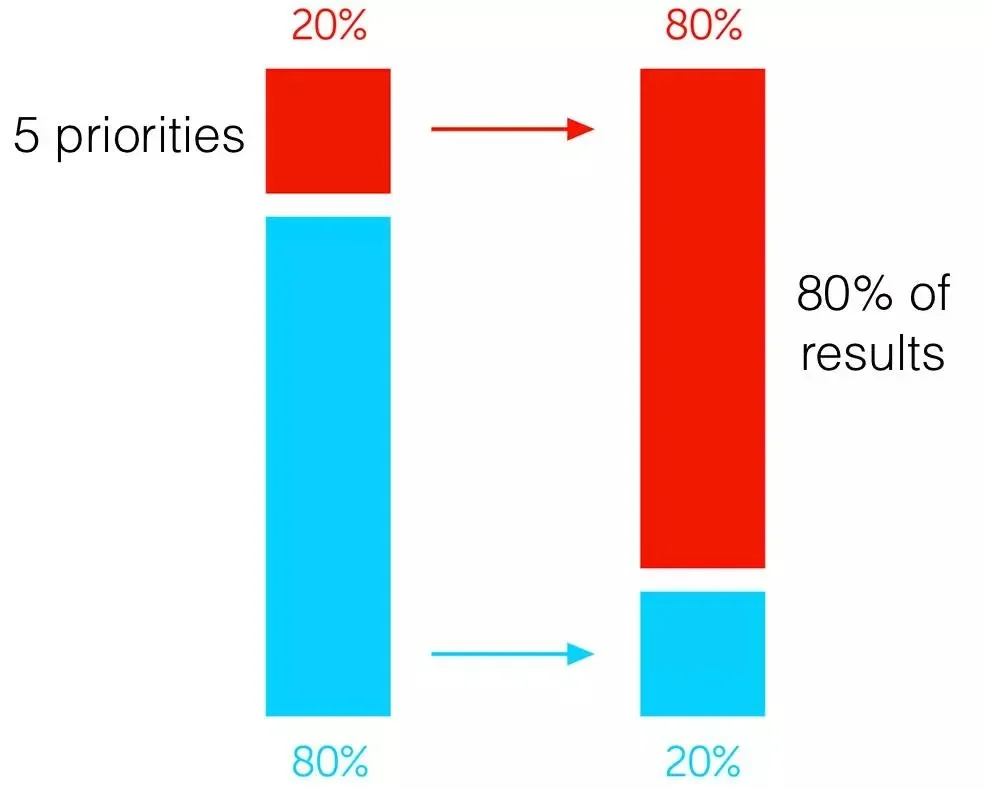
Buffett's lifestyle isn't an accident; it is the ultimate execution of the 80/20 rule, where 20% of your efforts generate 80% of your results.
To apply this mental model to your own investing and professional life, experts suggest taking a systematic approach. Start by identifying your true values and setting clear, measurable goals. Dedicate strict blocks of time strictly for prioritization, identify your single most important task, and tackle it first thing in the morning. Most importantly, build the discipline to say "no" to the activities that offer short-term satisfaction but fail to move the needle.
In investing and in life, everyone has the same 24 hours. "Hustling" harder has a ceiling. True outperformance comes from extreme focus—a difficult skill to master, but one that allows the best in the business to achieve in one year what takes others a decade.