
UBS Firmly Bullish on Gold: Targeting $2,600 Amid Strong Market Drivers
ALBILAD GOLD ETF 9405.SA | 24.40 | +0.74% |
Tadawul All Shares Index TASI.SA | 11249.54 | +0.74% |

UBS has highlighted that the market is gradually adjusting to current higher price level, with potential for further upward momentum.
This article provides an analysis of the current opportunities in gold investment, focusing on the factors influencing gold prices.
1. Market Dynamics:
According to UBS, while gold prices have shown signs of stabilization after reaching $2,500 per ounce, the outlook remains positive. The anticipation of an upcoming rate cut by the U.S. Federal Reserve, combined with robust demand from central banks, supports the potential for further price increases.
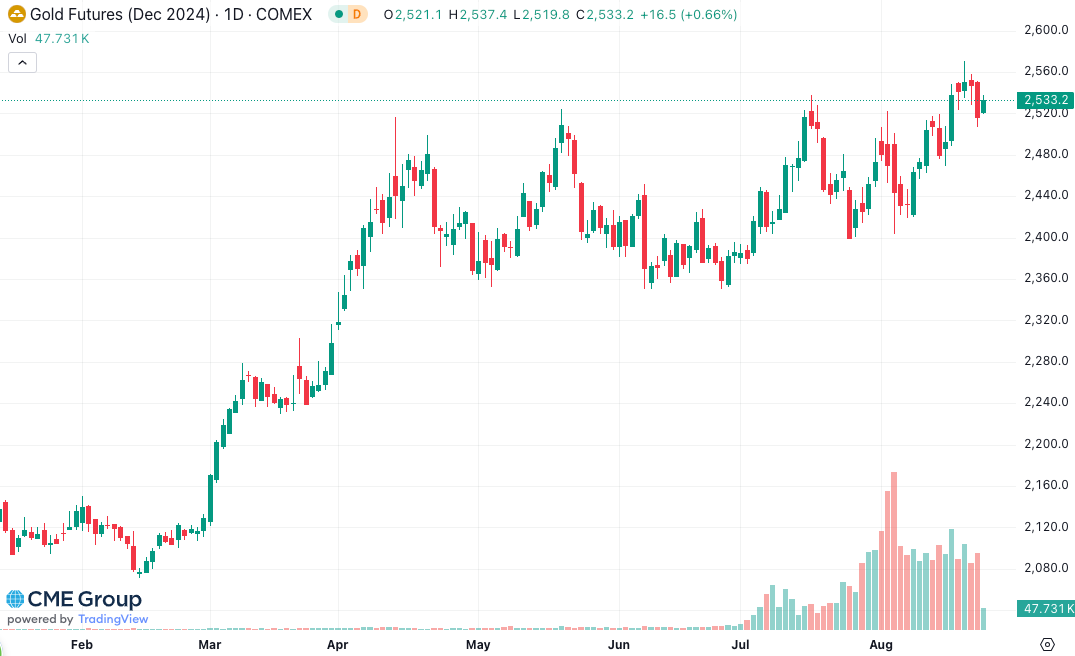
However, the short-term gold price trajectory largely depends on the policy signals delivered by Federal Reserve Chair Jerome Powell at the Jackson Hole Economic Symposium later this week, with the possibility of a temporary pullback. Powell's speech is scheduled for 10 a.m. Eastern Time (5 p.m. Riyadh time) on August 23 Today, and any policy shifts could introduce short-term volatility.
Several macroeconomic conditions have contributed to the recent rise in gold prices:
- Monetary Policy Expectations: The market is increasingly pricing in expectations of monetary easing by the Federal Reserve. Lower interest rates reduce the opportunity cost of holding gold, making it more attractive to investors.
- Declining Real Interest Rates: As real interest rates decrease, gold becomes a more appealing hedge against inflation and economic uncertainty.
- Weaker U.S. Dollar: A depreciating dollar makes gold cheaper for holders of other currencies, boosting demand.
2. Investment Flows and Demand Trends:
In the past year, Asian investors have led the charge in gold purchases, but Western investors are now also showing interest as the likelihood of rate cuts increases. Data from the World Gold Council reveals that physical gold ETFs have seen inflows of 90.4 tons since May, equivalent to $7.3 billion. This trend suggests that despite the recent price gains, there is still room for additional investment in gold.
UBS notes that while net long positions on the New York Commodity Exchange (Comex) have increased, they remain below historical highs, indicating that the market is not yet fully priced. This presents further opportunities for investors to allocate more funds to gold.
3. Central Bank Activity:
Central banks, particularly in emerging markets, continue to be net buyers of gold. Although the pace of purchases has slowed in recent months, UBS expects that central banks will continue to acquire gold, as their current gold reserves relative to total assets are still relatively low. This ongoing demand provides a solid foundation for sustained gold price support.
For example, India's gold reserves increased by 5 tons in July, while China maintained its gold holdings for the third consecutive month. These activities underscore the strategic importance of gold as a reserve asset, particularly in times of economic uncertainty.
4. Physical Demand:
On the physical demand front, UBS has observed some pressure due to the rising prices. In July, the combined gold imports of China and India fell by 58% year-over-year. However, year-to-date imports remain up by 5% due to strong demand earlier in the year.
Looking forward, seasonal demand from China and India is expected to recover as festive and wedding seasons approach. In India, favorable economic conditions and reduced import taxes are likely to support an increase in gold purchases during this period.
5. Analyst Opinions:
UBS analysts Giovanni Staunovo and Joni Teves have both provided insights into the gold market. Giovanni Staunovo, in particular, noted that gold prices have risen more rapidly than expected, reaching the $2,500 per ounce target well ahead of the original forecast of September 2024. Despite this early achievement, Staunovo reiterated UBS's bullish outlook, projecting that gold could reach $2,600 per ounce by the end of this year and $2,700 per ounce by mid-2025.
Staunovo also pointed out that central bank purchases are likely to continue increasing over the next two years, albeit at a slower pace compared to the record levels seen earlier in the year. Additionally, although jewelry demand has softened, UBS expects seasonal factors to boost demand in the fourth quarter of 2024.
6. Considerations for Saudi Investors:
One of the accessible way for Saudi investors to gain exposure to gold is through the Albilad Gold ETF(9405.SA), trading on the Saudi Stock Exchange, is an open-ended, Shariah-compliant Exchange Traded Fund.
This ETF offers the benefits of investing in physical gold without the challenges of storage and insurance. It tracks the returns of gold closely through its structure and is easily tradable on the Saudi Stock Exchange, making it a convenient option for those looking to capitalize on gold's potential.
As the U.S. dollar continues to fluctuate and inflationary pressures remain, gold serves as a hedge against potential economic instability. Investors should, however, remain mindful of short-term volatility, particularly around key events such as Powell's Jackson Hole speech.