

Union Pacific (UNP) Stock Looks Fairly Valued With Limited Room For Error
Union Pacific Corporation UNP | 0.00 |
Union Pacific stock has returned 54.0% over the past five years, and at around US$299.30 the key issue for investors is whether that rise still lines up with what the current valuation checks say about the business.
- A 54.0% five year return suggests Union Pacific has already rewarded patient shareholders. As a result, fresh buyers need to think carefully about how much of the story is already in the price.
- Recent agreements to improve North American rail connectivity and long term rail supply may support expectations for future cash flows. At the same time, any setback in freight volumes or efficiency gains could challenge those assumptions.
- Union Pacific scores 3 out of 6 on the valuation checks, which points to a mixed picture rather than a clear bargain or clear overvaluation.
The issue now is whether Union Pacific's current share price sits close enough to its intrinsic value estimate to justify that five year run or if the recent strength leaves limited room for error.
Where Does Union Pacific Sit on Cash Flow?
The Discounted Cash Flow (DCF) model here takes Union Pacific's projected free cash flows and discounts them back to today. On this basis, the latest twelve month free cash flow sits at about $6.5b, with the model assuming that cash flows continue growing over time from this level.
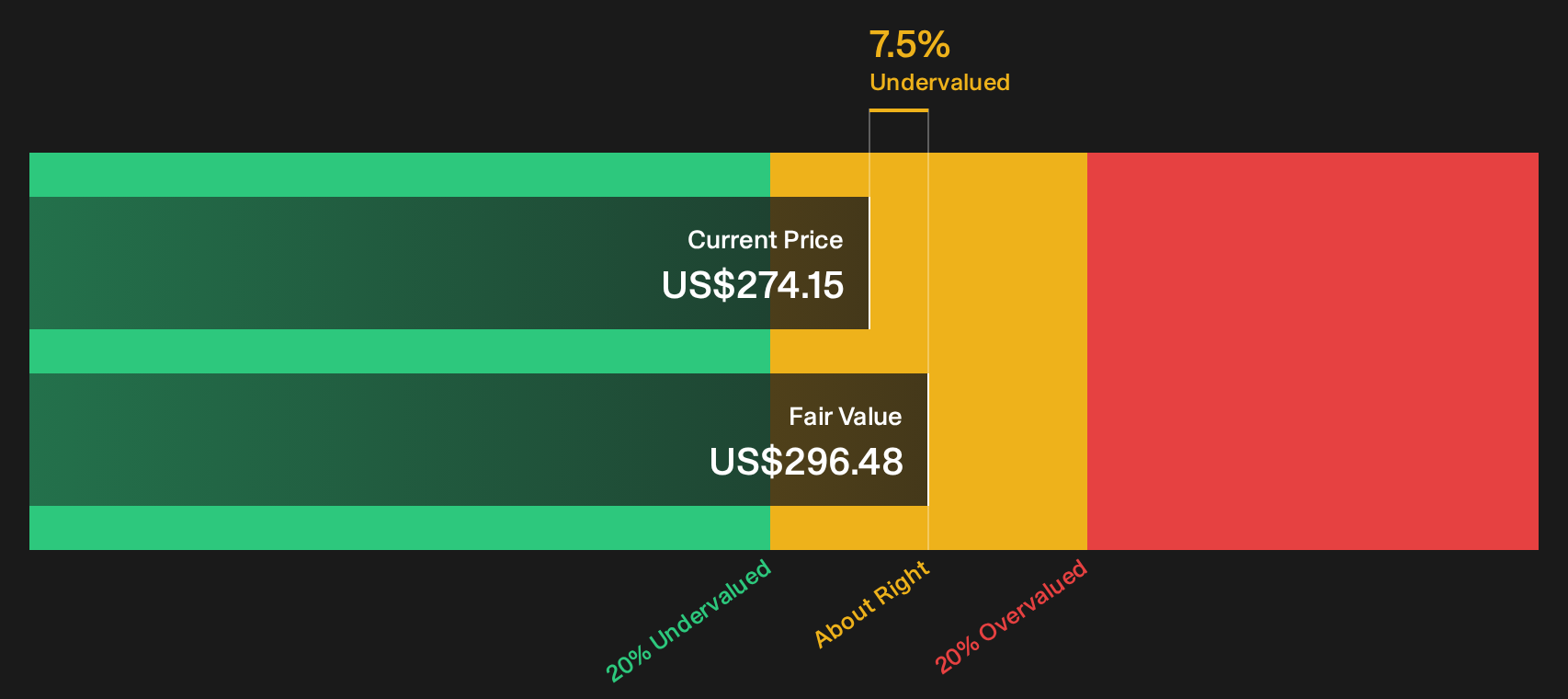
Those projections translate into an estimated intrinsic value of around $296 per share, which is very close to the current share price of about $299. Because the DCF suggests Union Pacific is only about 1.1% above this estimate, the stock screens as roughly in line with what its cash flows support rather than offering a clear discount or premium.
Recent agreements on North American rail connectivity and long rail supply help explain why the market is comfortable valuing Union Pacific close to this intrinsic value estimate.
Overall, Union Pacific appears roughly fairly valued on this DCF view, with the current price sitting close to its estimated intrinsic worth.
Union Pacific is fairly valued according to our Discounted Cash Flow (DCF), but this can change at a moment's notice. Track the value in your watchlist or portfolio and be alerted on when to act.
Is Union Pacific Still Cheap on Earnings?
The P/E ratio is a reasonable way to look at Union Pacific because earnings are a core focus for many shareholders in a mature, cash generative rail business. Union Pacific currently trades at about 24.3x earnings, which sits below both the Transportation industry average of roughly 37.6x and a peer group average of about 30.5x.
The fair P/E ratio implied by the model is around 28.3x. That is higher than where Union Pacific trades today, which suggests the market price may not fully reflect the earnings level implied by its size, margins and risk profile. When put alongside the DCF view that prices the stock close to intrinsic value, this earnings multiple indicates that the company is not priced aggressively relative to its sector.
On the P/E yardstick, Union Pacific stock currently appears undervalued compared with what its earnings profile would typically justify.

The Union Pacific Narrative: What Would Justify Today's Price?
Simply Wall St Narratives for Union Pacific build on the valuation picture above by explaining which assumptions about Union Pacific's future growth, margins and earnings would need to hold for the stock to be worth meaningfully more or less than the current price. These Narratives are available on the company's Community page. Instead of just giving you a single output from a ratio or model, they spell out the future those numbers rely on so you can monitor whether it plays out over time.
You can add your own narrative on Union Pacific and set out a data-driven case that others in the Simply Wall St community can track as new rail connectivity agreements and long rail supply contracts flow through to the results.
Share a clear view on how Union Pacific's growth, margins and execution might respond to these developments so you can see over time whether the story you see today holds up.
Do you think there's more to the story for Union Pacific? Head over to our Community to see what others are saying!
The Bottom Line
Union Pacific looks roughly fairly valued on Discounted Cash Flow, with the share price sitting close to the intrinsic value estimate. The earnings multiple view tilts a bit more supportive, since the P/E screens as undervalued relative to peers. Together with a mixed broader valuation score, that leaves Union Pacific looking neither like a clear bargain nor obviously stretched. The real dividing line between optimists and skeptics is whether the company can keep translating its rail agreements and efficiency efforts into steady cash flows that justify holding or expanding the current earnings multiple.
This article by Simply Wall St is general in nature. We provide commentary based on historical data and analyst forecasts only using an unbiased methodology and our articles are not intended to be financial advice. It does not constitute a recommendation to buy or sell any stock, and does not take account of your objectives, or your financial situation. We aim to bring you long-term focused analysis driven by fundamental data. Note that our analysis may not factor in the latest price-sensitive company announcements or qualitative material. Simply Wall St has no position in any stocks mentioned.