

United Airlines (UAL) Is Down 8.6% After Cutting 2026 Profit Outlook Despite Strong Q1 Results
United Airlines Holdings UAL | 0.00 |
- Earlier this week, United Airlines Holdings reported first-quarter 2026 results showing revenue of US$14,608 million and net income of US$699 million, alongside completing US$745.16 million of share repurchases under its existing buyback program.
- Despite delivering higher earnings per share and record operating revenue, United cut its full-year profit outlook as rising jet fuel costs and new fees, including a cargo “market disruption fee,” reshape its pricing and capacity decisions.
- We’ll now examine how United’s strong first-quarter results but lower full-year profit guidance might influence its investment narrative built around premium demand and capacity discipline.
Find 54 companies with promising cash flow potential yet trading below their fair value.
United Airlines Holdings Investment Narrative Recap
To own United today, you need to believe its focus on premium demand, disciplined capacity, and debt reduction can outweigh pressure from rising jet fuel and labor costs. The latest quarter supports that story with record Q1 revenue and earnings, but the cut to full year profit guidance underlines how exposed near term results are to fuel price shocks, which now look like the key short term catalyst and the biggest risk.
The most relevant recent announcement here is United’s Q1 2026 earnings: US$14,608 million in revenue, US$699 million in net income, and US$2.14 in diluted EPS, all up year on year. That performance, alongside ongoing share buybacks totaling US$745.16 million since late 2024, shows management acting from a position of financial strength even as it pares back profit expectations in response to higher fuel and new cost recovery fees.
Yet investors should be aware that surging fuel costs and new cargo fees could reshape United’s pricing power and demand in ways that ...
United Airlines Holdings’ narrative projects $72.3 billion in revenue and $4.7 billion in earnings by 2029.
Uncover how United Airlines Holdings' forecasts yield a $130.17 fair value, a 40% upside to its current price.
Exploring Other Perspectives
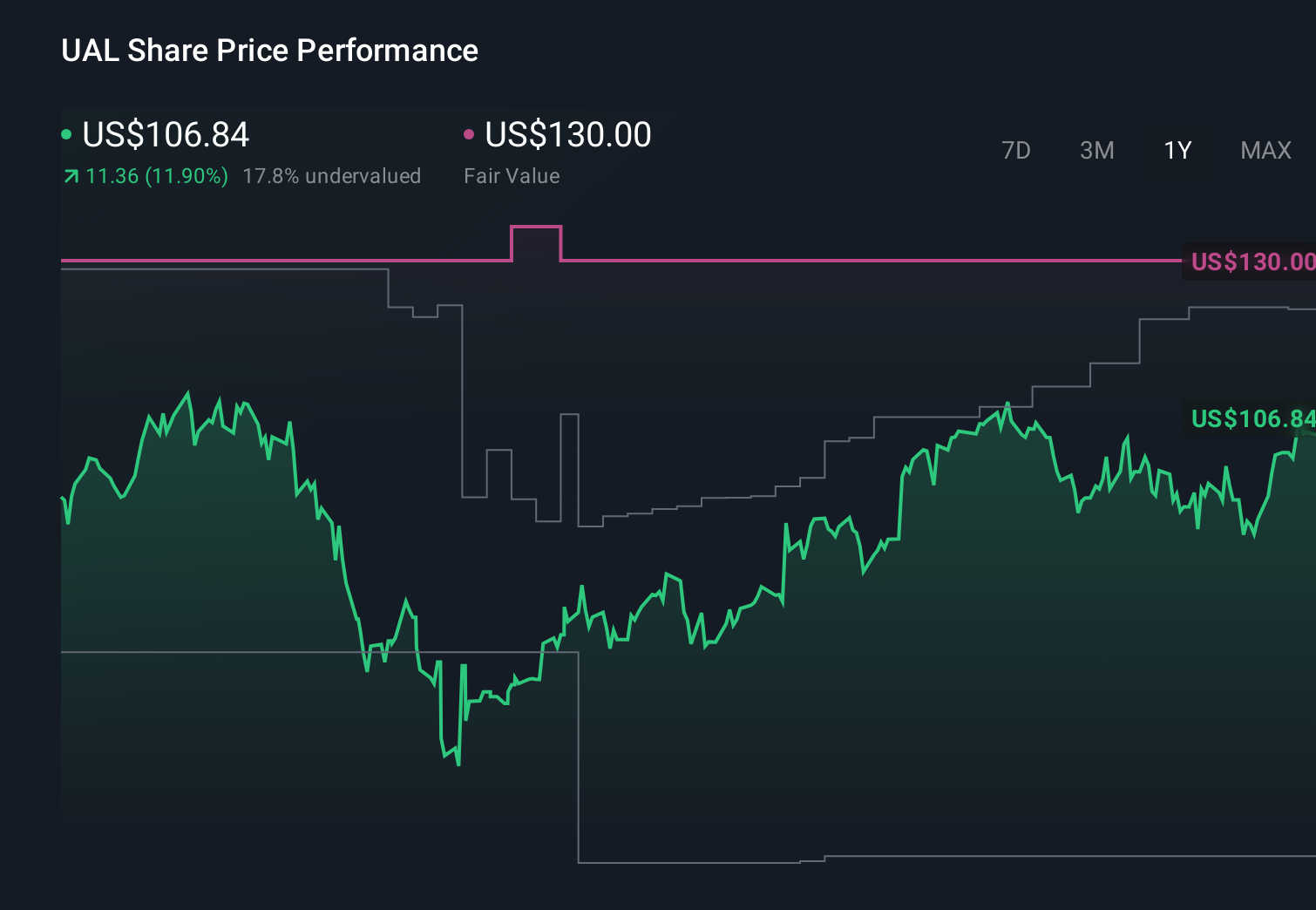
More optimistic analysts were previously modeling United’s revenue reaching about US$71.4 billion and earnings of roughly US$5.7 billion by 2028, which is a far brighter scenario than the baseline view that highlights rising fuel and labor costs as persistent margin risks. The latest guidance cut suggests those bullish assumptions might need revisiting, and it is a reminder that your own outlook can reasonably differ from either narrative.
Explore 5 other fair value estimates on United Airlines Holdings - why the stock might be worth as much as 40% more than the current price!
Reach Your Own Conclusion
Disagree with existing narratives? Extraordinary investment returns rarely come from following the herd, so go with your instincts.
- A great starting point for your United Airlines Holdings research is our analysis highlighting 5 key rewards and 2 important warning signs that could impact your investment decision.
- Our free United Airlines Holdings research report provides a comprehensive fundamental analysis summarized in a single visual - the Snowflake - making it easy to evaluate United Airlines Holdings' overall financial health at a glance.
Seeking Other Investments?
Early movers are already taking notice. See the stocks they're targeting before they've flown the coop:
- The future of work is here. Discover the 35 top robotics and automation stocks leading the charge in AI-driven automation and industrial transformation.
- We've uncovered the 13 dividend fortresses yielding 5%+ that don't just survive market storms, but thrive in them.
- Explore 26 top quantum computing companies leading the revolution in next-gen technology and shaping the future with breakthroughs in quantum algorithms, superconducting qubits, and cutting-edge research.
This article by Simply Wall St is general in nature. We provide commentary based on historical data and analyst forecasts only using an unbiased methodology and our articles are not intended to be financial advice. It does not constitute a recommendation to buy or sell any stock, and does not take account of your objectives, or your financial situation. We aim to bring you long-term focused analysis driven by fundamental data. Note that our analysis may not factor in the latest price-sensitive company announcements or qualitative material. Simply Wall St has no position in any stocks mentioned.