
Universal Electronics (NASDAQ:UEIC) Has Debt But No Earnings; Should You Worry?
Universal Electronics Inc. UEIC | 4.10 | -1.44% |
Warren Buffett famously said, 'Volatility is far from synonymous with risk.' It's only natural to consider a company's balance sheet when you examine how risky it is, since debt is often involved when a business collapses. We can see that Universal Electronics Inc. (NASDAQ:UEIC) does use debt in its business. But should shareholders be worried about its use of debt?
When Is Debt A Problem?
Debt and other liabilities become risky for a business when it cannot easily fulfill those obligations, either with free cash flow or by raising capital at an attractive price. In the worst case scenario, a company can go bankrupt if it cannot pay its creditors. However, a more common (but still painful) scenario is that it has to raise new equity capital at a low price, thus permanently diluting shareholders. Of course, plenty of companies use debt to fund growth, without any negative consequences. When we think about a company's use of debt, we first look at cash and debt together.
How Much Debt Does Universal Electronics Carry?
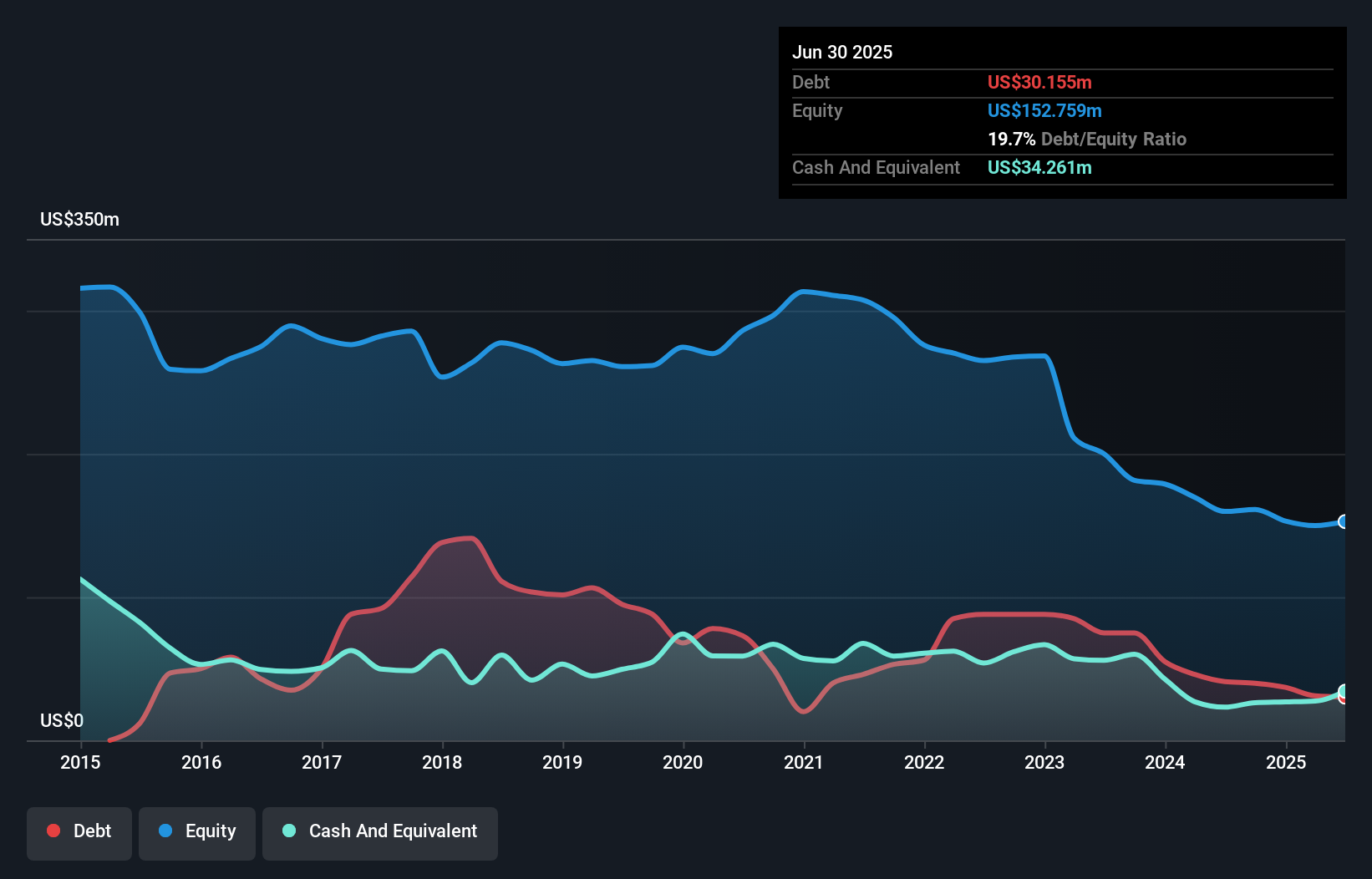
You can click the graphic below for the historical numbers, but it shows that Universal Electronics had US$30.2m of debt in June 2025, down from US$41.0m, one year before. However, its balance sheet shows it holds US$34.3m in cash, so it actually has US$4.11m net cash.
A Look At Universal Electronics' Liabilities
According to the last reported balance sheet, Universal Electronics had liabilities of US$140.1m due within 12 months, and liabilities of US$11.3m due beyond 12 months. Offsetting this, it had US$34.3m in cash and US$106.5m in receivables that were due within 12 months. So its liabilities total US$10.6m more than the combination of its cash and short-term receivables.
Of course, Universal Electronics has a market capitalization of US$53.2m, so these liabilities are probably manageable. But there are sufficient liabilities that we would certainly recommend shareholders continue to monitor the balance sheet, going forward. While it does have liabilities worth noting, Universal Electronics also has more cash than debt, so we're pretty confident it can manage its debt safely. There's no doubt that we learn most about debt from the balance sheet. But ultimately the future profitability of the business will decide if Universal Electronics can strengthen its balance sheet over time.
Over 12 months, Universal Electronics reported revenue of US$403m, which is a gain of 4.0%, although it did not report any earnings before interest and tax. We usually like to see faster growth from unprofitable companies, but each to their own.
So How Risky Is Universal Electronics?
Although Universal Electronics had an earnings before interest and tax (EBIT) loss over the last twelve months, it generated positive free cash flow of US$23m. So taking that on face value, and considering the net cash situation, we don't think that the stock is too risky in the near term. Until we see some positive EBIT, we're a bit cautious of the stock, not least because of the rather modest revenue growth. When analysing debt levels, the balance sheet is the obvious place to start. However, not all investment risk resides within the balance sheet - far from it.
This article by Simply Wall St is general in nature. We provide commentary based on historical data and analyst forecasts only using an unbiased methodology and our articles are not intended to be financial advice. It does not constitute a recommendation to buy or sell any stock, and does not take account of your objectives, or your financial situation. We aim to bring you long-term focused analysis driven by fundamental data. Note that our analysis may not factor in the latest price-sensitive company announcements or qualitative material. Simply Wall St has no position in any stocks mentioned.