

Verizon’s Retail Cuts and 5G Auto Push Could Be A Game Changer For Verizon Communications (VZ)
Verizon Communications Inc. VZ | 0.00 |
- In recent days, Verizon Communications announced further restructuring by selling 274 company-owned retail stores and cutting about 3,000 retail and corporate roles, while also expanding its connected-vehicle presence through a new 5G and IoT collaboration with BMW Group and KDDI in the U.S.
- These moves highlight Verizon’s push to lower operating costs and streamline its footprint even as it invests in higher-value connectivity ecosystems, from cars to kid-focused wearables, to support a more flexible, service-centric business model.
- We’ll now examine how Verizon’s latest store divestitures and workforce reductions may reshape its investment narrative and future cash-flow profile.
Capitalize on the AI infrastructure supercycle with our selection of the 53 best 'picks and shovels' of the AI gold rush converting record-breaking demand into massive cash flow.
Verizon Communications Investment Narrative Recap
To own Verizon today, you need to believe its core wireless and broadband franchise can generate steady cash while it tightens costs and leans into new connectivity use cases. The latest sale of 274 stores and roughly 3,000 job cuts fits that cost focus, but also underlines a key near term risk: whether aggressive belt tightening and competition, including from emerging satellite offerings, could chip away at subscriber loyalty and slow the momentum behind fixed wireless and fiber as core growth drivers.
Against that backdrop, Verizon’s new 5G and IoT collaboration with BMW Group and KDDI looks especially relevant. It reinforces the idea that Verizon is trying to build higher value ecosystems around its network, from connected vehicles to wearables like the new Gizmo Watch 4, that sit on top of its fiber and 5G investments and could become an important offset if promotions, churn or SpaceX related fears pressure the core wireless story.
Yet, behind the cost cuts and new partnerships, there is a less obvious risk investors should be aware of around...
Verizon Communications' narrative projects $147.7 billion revenue and $22.4 billion earnings by 2029. This requires 2.0% yearly revenue growth and about a $5.1 billion earnings increase from $17.3 billion today.
Uncover how Verizon Communications' forecasts yield a $51.90 fair value, a 21% upside to its current price.
Exploring Other Perspectives
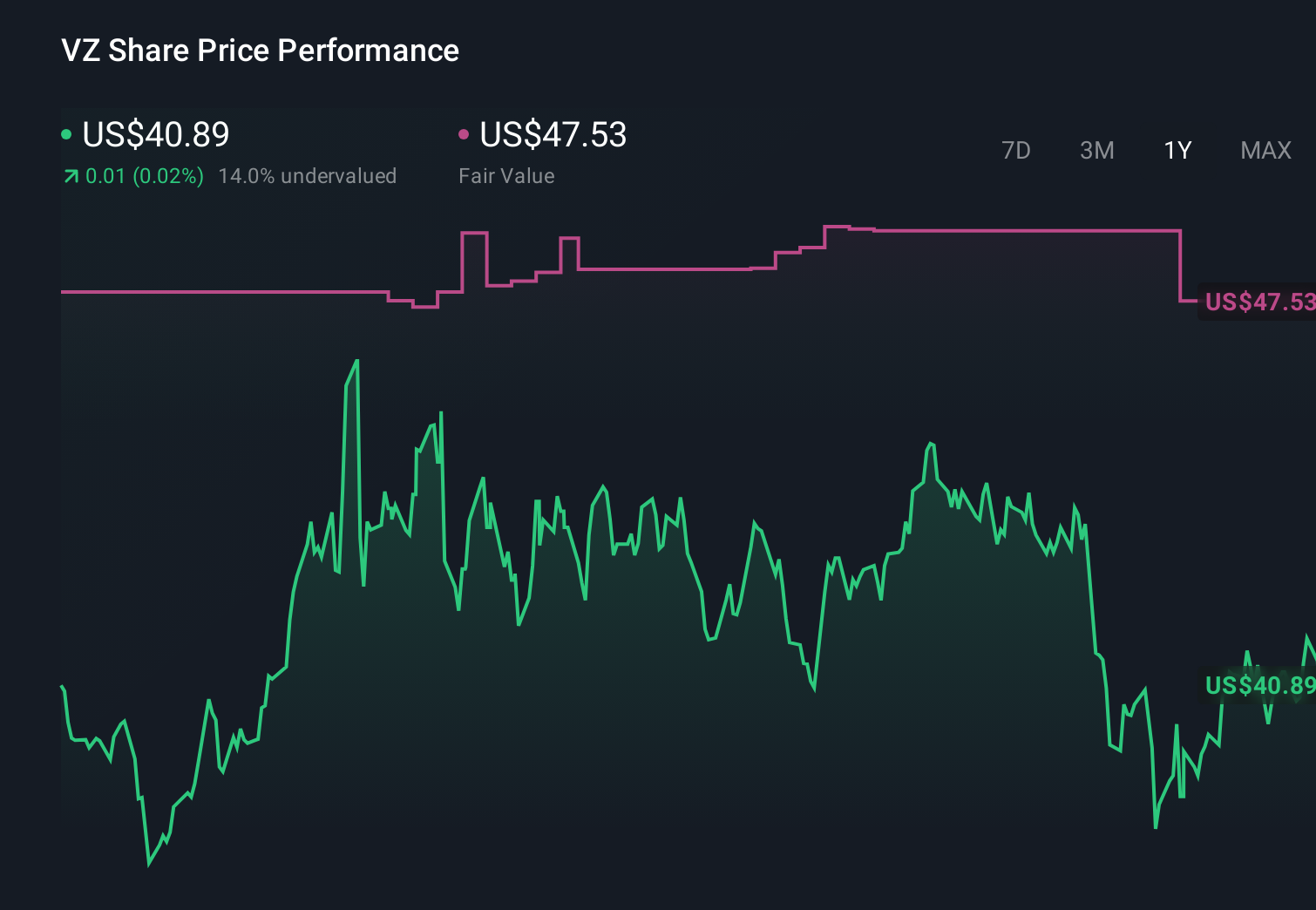
Some of the lowest ranked analysts were already cautious, assuming revenue would grow only about 1.3 percent a year to roughly US$144.7 billion by 2029, and the fresh restructuring plus connected car push may either reinforce that caution around execution or prompt a rethink of how much Verizon can get out of fiber, fixed wireless and convergence over time.
Explore 15 other fair value estimates on Verizon Communications - why the stock might be worth just $46.00!
Reach Your Own Conclusion
Disagree with existing narratives? Extraordinary investment returns rarely come from following the herd, so go with your instincts.
- A great starting point for your Verizon Communications research is our analysis highlighting 3 key rewards and 2 important warning signs that could impact your investment decision.
- Our free Verizon Communications research report provides a comprehensive fundamental analysis summarized in a single visual - the Snowflake - making it easy to evaluate Verizon Communications' overall financial health at a glance.
No Opportunity In Verizon Communications?
Right now could be the best entry point. These picks are fresh from our daily scans. Don't delay:
- Find 47 companies with promising cash flow potential yet trading below their fair value.
- Invest in the nuclear renaissance through our list of 90 elite nuclear energy infrastructure plays powering the global AI revolution.
- The latest GPUs need a type of rare earth metal called Neodymium and there are only 29 companies in the world exploring or producing it. Find the list for free.
This article by Simply Wall St is general in nature. We provide commentary based on historical data and analyst forecasts only using an unbiased methodology and our articles are not intended to be financial advice. It does not constitute a recommendation to buy or sell any stock, and does not take account of your objectives, or your financial situation. We aim to bring you long-term focused analysis driven by fundamental data. Note that our analysis may not factor in the latest price-sensitive company announcements or qualitative material. Simply Wall St has no position in any stocks mentioned.