

Visa And Samsung Expand Stablecoin Push As CLARITY Act Faces Final Senate Test
Congress has a little more than a week left to decide how to regulate stablecoins in America, and it still has not scheduled a vote.
Sixteen signatures on a cloture petition, a Wednesday filing deadline, and an August 10 recess stand between the CLARITY Act and the floor of the Senate. Nobody in the private sector is waiting to find out how that goes.
Ahead of this, Visa recently told the market it moved $3.7 billion through stablecoin-linked cards over the past year.
At the same time, Samsung put a digital dollar balance next to a boarding pass on a stage in London.
Both moves happened while the bill meant to give this entire market a legal foundation sat parked on the Senate calendar.
That is the story this week. Not just whether the CLARITY Act passes, but what it means that Visa and Samsung are building at full speed regardless of the answer.
Where the CLARITY Act Actually Stands
The Digital Asset Market Clarity Act, known as the CLARITY Act, passed the House by a bipartisan 294-to-134 vote in July 2025.
Almost a year later, the Senate Banking Committee advanced its version from 15 to 9 in May 2026.
Furthermore, on July 22, Senator Cynthia Lummis released a merged Banking and Agriculture Committee text that aimed to finally get the bill to the floor.
That merged text dropped an ethics provision that a group of Senate Democrats had named as their price for support. Senator Elizabeth Warren came out against the revised bill outright.
A separate group of seven Democratic negotiators, including Catherine Cortez Masto, Angela Alsobrooks, Cory Booker, Ruben Gallego, John Hickenlooper, Mark Warner, and Raphael Warnock, said the draft was inadequate but committed to continuing discussions.
Treasury Secretary Scott Bessent spent this past week publicly pressing senators to vote now. During that period, he accused Democrats of stalling on legislation that he said the industry could not afford to lose.
However, August 10 is the date that actually matters. That is when the Senate leaves for its state work period, and most observers treat it as the practical cutoff for passage this year.
Under ordinary Senate rules, a cloture filing this week could set up a procedural vote. That vote, while it would only open debate rather than pass the bill, still requires 60 votes to succeed. Leadership does have faster options on the table.
Such options could include a bipartisan petition or a unanimous consent agreement, either of which could compress the timeline if enough senators sign on. None of those paths is guaranteed.
It’s worth noting, since coverage often flattens this point, that the CLARITY Act is not the stablecoin bill. That is the GENIUS Act, in force since mid-2025, which already regulates payment stablecoin issuers directly.
CLARITY Act, on the other hand, governs the wider market, deciding which regulator, the SEC or the CFTC, oversees exchanges, brokers, and digital asset activity beyond stablecoins themselves.
Its outcome still shapes the environment stablecoins operate in, which is precisely why what Visa and Samsung did this month reads as more than routine corporate news.
Visa’s Number Is the Argument for Why This Vote Matters
Five days ago, Visa said it processed $3.7 billion in payments through stablecoin-linked cards across more than 200 markets over the past year, generated by 1.9 million stablecoin-denominated cards.
Colombia, Argentina, and Brazil posted the strongest growth, which is not an accident.
In markets where local currency volatility eats into savings, and cross-border transfer fees run high, a dollar-backed balance that lives on a card is not a speculative bet. It is a practical upgrade, already happening at scale, with or without a finished federal statute behind it.
The card volume is the visible layer. Underneath it, Visa has settled nearly $800 million in digital assets, mostly USDC, since introducing stablecoin settlement in 2023. Besides that, monthly settlement activity has now crossed a $2.5 billion annualized run rate.
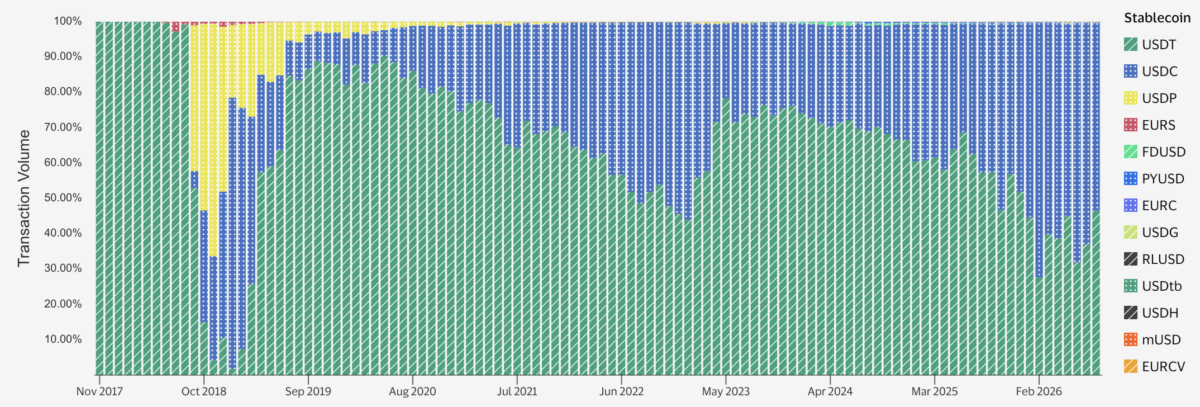
The company also added stablecoin prefunding to Visa Direct, letting businesses fund cross-border payouts outside normal banking hours, and a pilot launched in November now routes earnings straight into a digital wallet for creators, freelancers, and gig workers.
Then, on July 16, Visa introduced the Visa Stablecoin Platform, an enterprise product built to let financial institutions mint, move, and manage stablecoins, starting with Open USD through a partnership with Open Standard. The platform allows institutions to connect stablecoin operations directly to the treasury and settlement workflows they already use through Visa.
Samsung Raises the Same Question at Consumer Scale
Samsung made a comparable bet at Galaxy Unpacked in London on July 22. The company confirmed that Samsung Wallet will add native stablecoin support, with a live demo showing Circle’s USDC handling send, receive, and top-up functions.
Meanwhile, Samsung has not named a launch date, confirmed which stablecoins ship first, or disclosed custody and blockchain details.
However, context matters here. Samsung integrated Coinbase into Wallet in 2025, giving well over 75 million Galaxy users a way to buy crypto without leaving the app. That was a referral.
Native stablecoin support is a different kind of move, because it puts a dollar-equivalent balance directly inside a wallet that already stores boarding passes, loyalty cards, and payment methods for roughly 241 million Galaxy devices, by industry estimates.
The more important detail is structural. Once a stablecoin lives inside a wallet that ships by default on nearly every Galaxy device, access stops being a download decision and becomes a settings toggle, governed by whatever legal framework exists at the time, or does not.
What Happens If the Senate Misses the Window
Missing the August window would not kill the CLARITY Act outright. However, it would likely push final passage into 2027, a year already shadowed by the midterm election calendar, when floor time gets scarcer and every vote becomes more politically loaded.
In the meantime, the market structure that currently guides digital assets, including the joint SEC and CFTC classification of major tokens issued this year, would still be agency guidance, not statute. The next administration can rewrite guidance in a single memo. A law cannot.
JPMorgan analysts have described CLARITY passage as a positive catalyst for digital assets, pointing to regulatory certainty and institutional scaling as the reasons why.
Coinbase’s chief policy officer, Faryar Shirzad, has defended the bill’s approach of splitting oversight, arguing it gives digital commodity markets the CFTC supervision they need while leaving securities regulation where it already sits.
Blockchain Association CEO Summer Mersinger has framed the passage as no longer a question of if but when.
In addition, Beacon Policy Advisors, a Washington research firm, has been more blunt, telling clients the Senate needs to pass the bill before the August recess for it to become law this year at all.
The Real Fight Is Over Distribution, Not Issuance
Put all three developments together, and the real conflict becomes clearer. Visa is not trying to launch the biggest stablecoin. It is building the settlement rails, cards, and enterprise tools that let any compliant stablecoin move through its network.
Samsung is not picking a winning issuer either. It is turning Wallet into the checkout point where a stablecoin, whichever one clears Samsung’s compliance review, reaches the largest possible number of everyday users.
Congress is the only actor in this story deciding whether that entire system runs on a durable federal statute or continues to depend on guidance that could shift with the next election.
Industry executives are increasingly framing the coming fight as one over who controls distribution rather than who issues the winning token.
CLARITY Act: Frequently Asked Questions (FAQs)
Where does the CLARITY Act stand in the Senate right now?
No floor vote was scheduled as of this week. A cloture filing could set up a procedural vote within days, ahead of the August 10 recess deadline, though passage is not guaranteed and would still require 60 votes.
What happens if the CLARITY Act misses the August deadline?
The bill would not die. However, passage would likely slip into 2027, an election-shadowed year with less available floor time, leaving the current agency-guided market structure in place and vulnerable to reversal by a future administration.
How much stablecoin volume has Visa processed?
Visa has processed $3.7 billion in stablecoin-linked card volume over the past year across more than 200 markets, generated by 1.9 million stablecoin-denominated cards.
Will Samsung Wallet support USDC?
Samsung demoed Circle’s USDC at Galaxy Unpacked on July 22. But the company has not confirmed a launch date or finalized which stablecoins will ship first.
What is the difference between the CLARITY Act and the GENIUS Act?
The GENIUS Act, in force since mid-2025, regulates payment stablecoin issuers directly. On the other hand, the CLARITY Act addresses broader market structure, deciding which regulator oversees exchanges, brokers, and other digital asset activity.
Benzinga Disclaimer: This article is from an unpaid external contributor. It does not represent Benzinga’s reporting and has not been edited for content or accuracy.