

What Insmed (INSM)'s 12‑Month TPIP Pulmonary Hypertension Data Means For Shareholders
Insmed Incorporated INSM | 0.00 |
- On July 16, 2026, Insmed announced positive 12‑month data from its ongoing open-label extension study of once-daily treprostinil palmitil inhalation powder (TPIP) in pulmonary arterial hypertension, showing sustained improvements in six-minute walk distance, NT-proBNP, WHO Functional Class, and REVEAL Lite 2.0 score, with no new safety signals identified.
- A particularly striking finding was that about 65% of patients achieved Refined Low Risk status, a category associated with a very low estimated three-year mortality and relatively low risk of clinical worsening at one year, underscoring TPIP’s potential clinical impact if future controlled trials confirm these results.
- We’ll now consider how the sustained 12‑month improvements in six-minute walk distance with TPIP may influence Insmed’s broader investment narrative.
The latest GPUs need a type of rare earth metal called Terbium and there are only 29 companies in the world exploring or producing it. Find the list for free.
Insmed Investment Narrative Recap
To be comfortable owning Insmed today, you need to believe that brensocatib can scale into a durable respiratory franchise while TPIP matures into a second growth pillar. The new 12 month TPIP PAH data support that longer term story by reinforcing durability and safety, but they do not change the near term focus: the brensocatib U.S. launch and regulatory timing, along with execution and payer risk around that launch, still look like the dominant short term swing factors.
Among recent updates, the upcoming Q2 2026 earnings release and business update on August 6 stands out as most relevant here. Management guidance around TPIP trial progress, brensocatib launch trends and ARIKAYCE trajectory will frame how investors interpret the OLE TPIP data in the context of cash burn, spending plans and the path toward the company’s long term revenue targets and potential profitability.
Yet despite the encouraging TPIP data, investors should also recognize the possibility that longer, competitive Phase III TPIP trials could weigh on timelines and pricing power...
Insmed's narrative projects $4.1 billion revenue and $1.0 billion earnings by 2029.
Uncover how Insmed's forecasts yield a $197.14 fair value, a 84% upside to its current price.
Exploring Other Perspectives
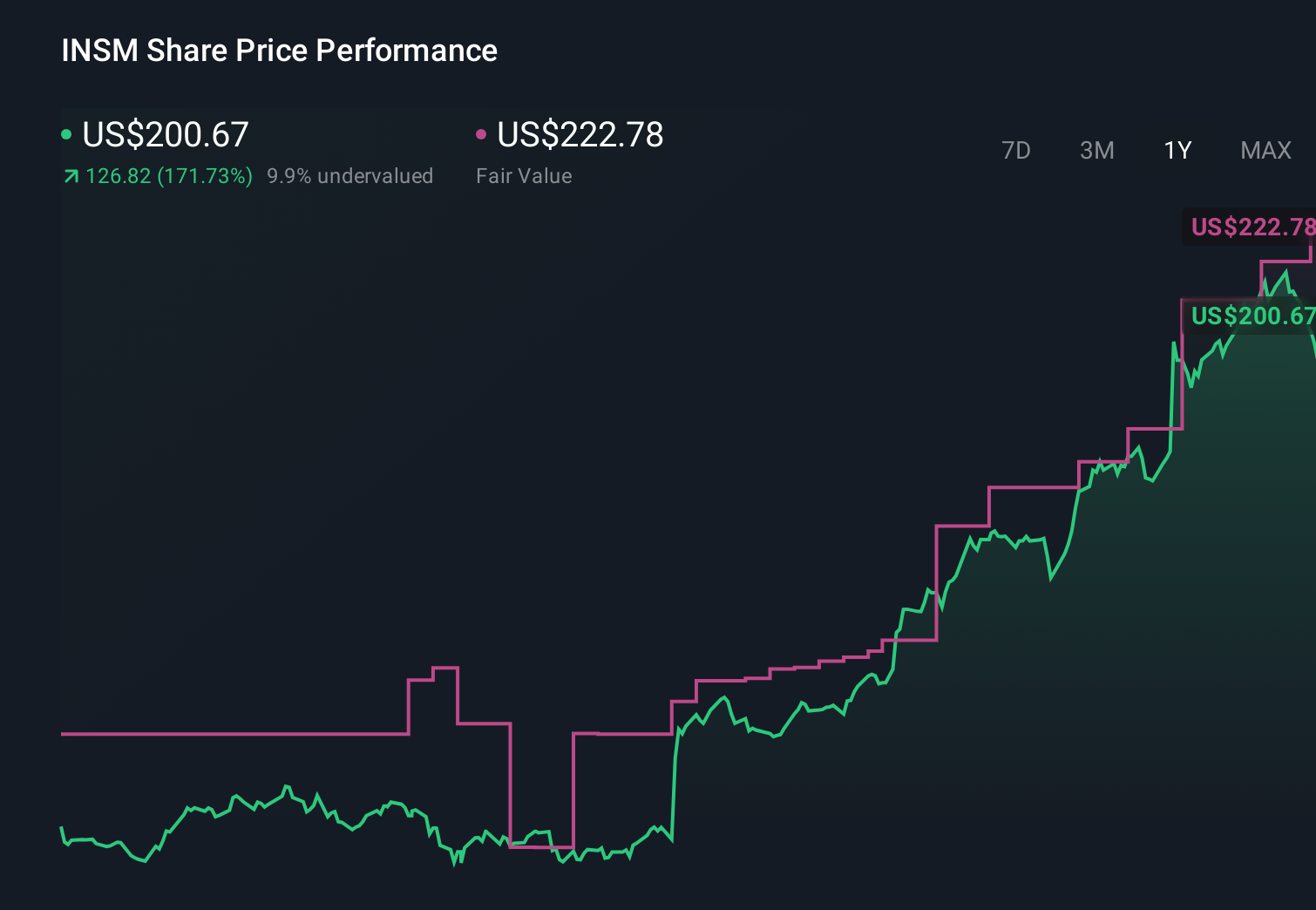
Compared with consensus, the most cautious analysts were already assuming about US$3.2 billion in 2029 revenue and only US$170.8 million in earnings, reflecting concern that TPIP’s crowded, long trial path could blunt its impact; the new TPIP results might soften or reinforce that view, so as a shareholder you may want to weigh how your own expectations line up with these very different scenarios.
Explore 3 other fair value estimates on Insmed - why the stock might be worth over 3x more than the current price!
Decide For Yourself
Disagree with existing narratives? Extraordinary investment returns rarely come from following the herd, so go with your instincts.
- A great starting point for your Insmed research is our analysis highlighting 3 key rewards and 1 important warning sign that could impact your investment decision.
- Our free Insmed research report provides a comprehensive fundamental analysis summarized in a single visual - the Snowflake - making it easy to evaluate Insmed's overall financial health at a glance.
Looking For Alternative Opportunities?
These stocks are moving-our analysis flagged them today. Act fast before the price catches up:
- The future of work is here. Discover the 34 top robotics and automation stocks leading the charge in AI-driven automation and industrial transformation.
- Find 49 companies with promising cash flow potential yet trading below their fair value.
- Uncover the next big thing with 21 elite penny stocks that balance risk and reward.
This article by Simply Wall St is general in nature. We provide commentary based on historical data and analyst forecasts only using an unbiased methodology and our articles are not intended to be financial advice. It does not constitute a recommendation to buy or sell any stock, and does not take account of your objectives, or your financial situation. We aim to bring you long-term focused analysis driven by fundamental data. Note that our analysis may not factor in the latest price-sensitive company announcements or qualitative material. Simply Wall St has no position in any stocks mentioned.