

What MongoDB (MDB)'s Interest‑Rate Tailwind From the Strait of Hormuz Peace Deal Means For Shareholders
MongoDB, Inc. Class A MDB | 0.00 |
- Earlier this week, the Trump administration announced a peace deal enabling the reopening of the Strait of Hormuz, which pushed long-term Treasury yields lower and improved the backdrop for rate‑sensitive assets such as high-growth software companies.
- This shift in bond markets matters for MongoDB because lower discount rates can increase the present value investors assign to its expected future cash flows, especially given its growth-focused business model.
- We’ll now examine how the drop in long-term interest rates, following the Strait of Hormuz peace deal, could influence MongoDB’s investment narrative.
Capitalize on the AI infrastructure supercycle with our selection of the 48 best 'picks and shovels' of the AI gold rush converting record-breaking demand into massive cash flow.
MongoDB Investment Narrative Recap
To own MongoDB, you need to believe that its Atlas cloud platform can keep converting rising data and AI demand into recurring revenue, while gradually improving profitability. The Strait of Hormuz peace deal and resulting drop in long term yields support sentiment for rate sensitive software names, but do not materially change MongoDB’s near term catalysts around Atlas adoption or its key risk of competition from cheaper, cloud provider native databases.
The most relevant recent update here is MongoDB’s raised FY2027 guidance to US$2.92 billion to US$2.96 billion in revenue and positive net income per share. That outlook reinforces the core catalyst of continued Atlas driven growth and improving operating discipline, which the recent move in bond yields may simply make easier for the market to value, rather than fundamentally altering the company’s underlying business trajectory.
Yet even with lower yields helping growth stocks today, investors should be aware of the risk that hyperscaler native databases could still...
MongoDB's narrative projects $4.3 billion revenue and $276.7 million earnings by 2029. This requires 18.4% yearly revenue growth and about a $305.8 million earnings increase from -$29.1 million today.
Uncover how MongoDB's forecasts yield a $395.77 fair value, a 12% upside to its current price.
Exploring Other Perspectives
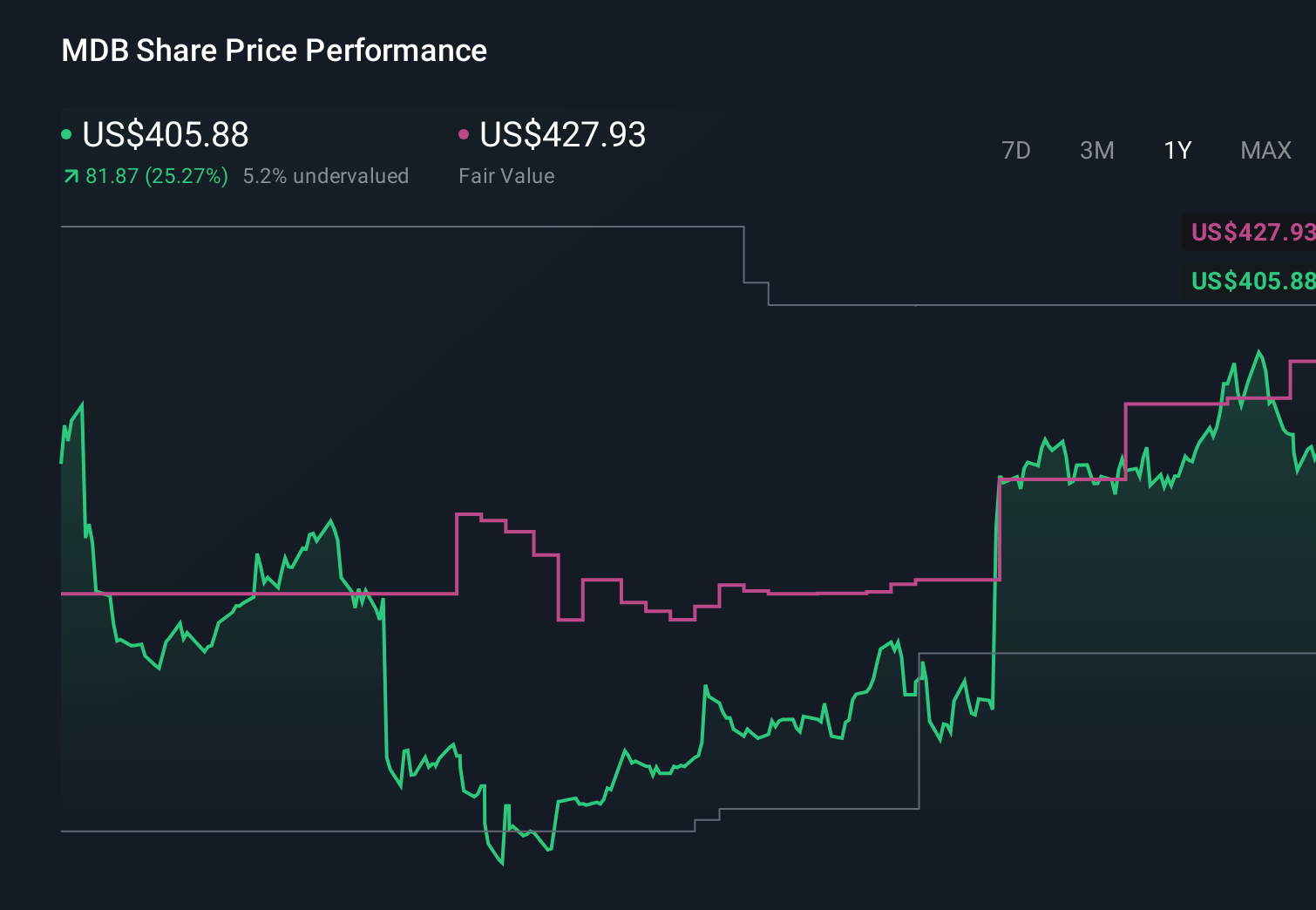
Some of the most optimistic analysts were already penciling in roughly US$4.8 billion of revenue and US$358.0 million of earnings by 2029, but the same backdrop that could support that outcome also increases the importance of the risk that sustained high R&D and sales spending might cap margin improvement, reminding you that views on MongoDB’s potential can differ sharply and may shift again as the impact of this rate move becomes clearer.
Explore 8 other fair value estimates on MongoDB - why the stock might be worth 20% less than the current price!
Reach Your Own Conclusion
Don't just follow the ticker - dig into the data and build a conviction that's truly your own.
- A great starting point for your MongoDB research is our analysis highlighting 2 key rewards and 1 important warning sign that could impact your investment decision.
- Our free MongoDB research report provides a comprehensive fundamental analysis summarized in a single visual - the Snowflake - making it easy to evaluate MongoDB's overall financial health at a glance.
Searching For A Fresh Perspective?
These stocks are moving-our analysis flagged them today. Act fast before the price catches up:
- Outshine the giants: these 14 early-stage AI stocks could fund your retirement.
- Invest in the nuclear renaissance through our list of 88 elite nuclear energy infrastructure plays powering the global AI revolution.
- AI is about to change healthcare. These 39 stocks are working on everything from early diagnostics to drug discovery. The best part - they are all under $10b in market cap - there's still time to get in early.
This article by Simply Wall St is general in nature. We provide commentary based on historical data and analyst forecasts only using an unbiased methodology and our articles are not intended to be financial advice. It does not constitute a recommendation to buy or sell any stock, and does not take account of your objectives, or your financial situation. We aim to bring you long-term focused analysis driven by fundamental data. Note that our analysis may not factor in the latest price-sensitive company announcements or qualitative material. Simply Wall St has no position in any stocks mentioned.