
What U.S. Physical Therapy (USPH)'s New Hospital Alliance, Dividend Hike, and CFO Change Means For Shareholders
U.S. Physical Therapy, Inc. USPH | 74.86 74.86 | +1.11% 0.00% Post |
- In February 2026, U.S. Physical Therapy reported fourth-quarter and full-year 2025 results showing higher revenue but lower quarterly net income, announced a 10-year alliance that will place ten subsidiary clinics into a local hospital system’s network, raised its quarterly dividend to US$0.46, and disclosed an upcoming CFO transition.
- Taken together, the new hospital partnership, dividend increase, and earnings mix highlight how U.S. Physical Therapy is balancing growth initiatives with evolving profitability and leadership changes.
- Next, we’ll examine how the new 10-year hospital alliance may influence U.S. Physical Therapy’s investment narrative and future business positioning.
Find 47 companies with promising cash flow potential yet trading below their fair value.
U.S. Physical Therapy Investment Narrative Recap
To own U.S. Physical Therapy, you need to be comfortable with a clinic-centric model that depends on steady patient volumes while managing reimbursement and labor pressures. The latest results show revenue growth but weaker quarterly earnings, so the key near term catalyst remains visit growth and cost efficiency, while margin pressure and leadership transition around the CFO role are the most immediate risks. Overall, this news does not materially change the core thesis, but it sharpens the focus on profitability.
The 10 year alliance that folds ten subsidiary clinics into a hospital system’s network is the clearest link to that volume based catalyst, because it could support patient throughput and payer access once all sites are operational. Against this, the recent dip in quarterly net income and tight labor conditions underline how any ramp in volumes still has to be balanced against staffing costs and operational execution.
Yet even with new hospital referrals and higher dividends, investors should be aware that reimbursement pressure and margin strain could still...
U.S. Physical Therapy's narrative projects $918.4 million revenue and $52.5 million earnings by 2028. This requires 8.3% yearly revenue growth and a $17.9 million earnings increase from $34.6 million today.
Uncover how U.S. Physical Therapy's forecasts yield a $106.83 fair value, a 29% upside to its current price.
Exploring Other Perspectives
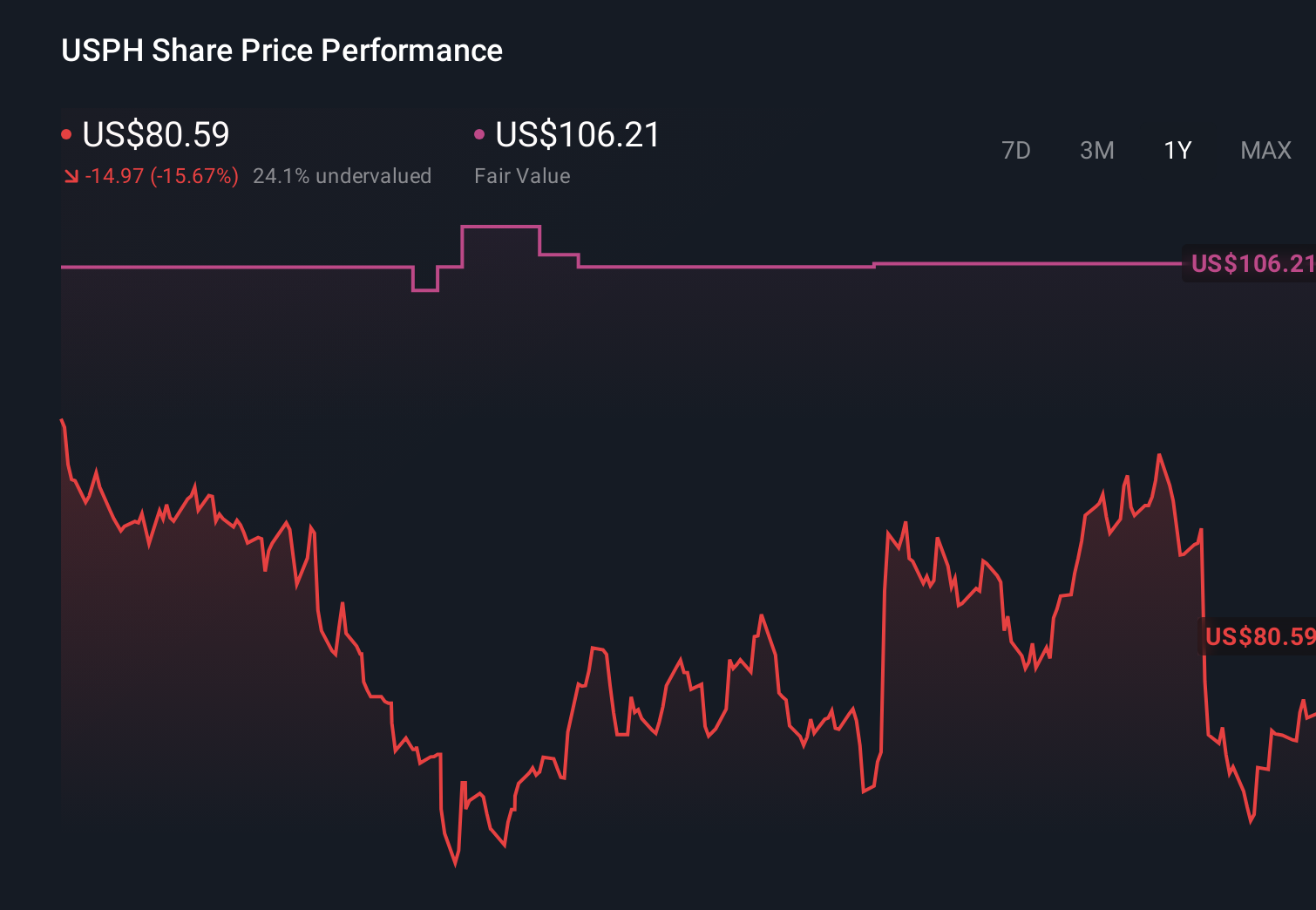
One member of the Simply Wall St Community currently pegs fair value at US$106.83, highlighting how individual estimates can diverge from market pricing. Against that backdrop, ongoing reimbursement pressure and recent margin compression could shape how you weigh those community views against the company’s ability to translate higher volumes into sustainable earnings.
Explore another fair value estimate on U.S. Physical Therapy - why the stock might be worth just $106.83!
Form Your Own Verdict
Disagree with existing narratives? Extraordinary investment returns rarely come from following the herd, so go with your instincts.
- A great starting point for your U.S. Physical Therapy research is our analysis highlighting 3 key rewards and 2 important warning signs that could impact your investment decision.
- Our free U.S. Physical Therapy research report provides a comprehensive fundamental analysis summarized in a single visual - the Snowflake - making it easy to evaluate U.S. Physical Therapy's overall financial health at a glance.
Interested In Other Possibilities?
These stocks are moving-our analysis flagged them today. Act fast before the price catches up:
- Rare earth metals are the new gold rush. Find out which 31 stocks are leading the charge.
- The future of work is here. Discover the 30 top robotics and automation stocks leading the charge in AI-driven automation and industrial transformation.
- Uncover the next big thing with 30 elite penny stocks that balance risk and reward.
This article by Simply Wall St is general in nature. We provide commentary based on historical data and analyst forecasts only using an unbiased methodology and our articles are not intended to be financial advice. It does not constitute a recommendation to buy or sell any stock, and does not take account of your objectives, or your financial situation. We aim to bring you long-term focused analysis driven by fundamental data. Note that our analysis may not factor in the latest price-sensitive company announcements or qualitative material. Simply Wall St has no position in any stocks mentioned.