

What Whirlpool (WHR)'s Leadership Change Amid Softer Appliance Demand Means For Shareholders
Whirlpool Corporation WHR | 0.00 |
- Whirlpool Corporation recently announced that Executive Vice President James Peters will resign effective March 30, 2026, following his earlier step-down as Chief Financial Officer and President, Whirlpool Asia as part of its talent planning process, while the major appliance sector is experiencing a 7% industrial production decline versus earlier expectations for flat to slightly lower levels.
- The combination of weaker-than-expected industry conditions and the departure of a senior leader who previously oversaw finance and Asia operations raises fresh questions about Whirlpool’s operational resilience and leadership bench strength.
- We’ll now examine how the softer appliance demand backdrop and Peters’ departure may influence Whirlpool’s investment narrative and risk profile.
Outshine the giants: these 22 early-stage AI stocks could fund your retirement.
Whirlpool Investment Narrative Recap
To own Whirlpool today, you need to believe it can restore earnings quality in a mature, cyclical industry while managing high competition and balance sheet pressure. The sharp 7% drop in major appliance production and the upcoming resignation of Executive Vice President James Peters primarily reinforce existing risks around demand softness and execution, but do not appear to alter the most important near term catalyst, which is Whirlpool’s ability to sustain margin improvement from cost actions and product mix.
The most relevant recent announcement here is the follow on equity offering completed in February 2026, which raised about US$475.0 million. That move, alongside earlier dividend cuts, highlights how Whirlpool is prioritizing financial flexibility as it works through weaker demand and restructuring. For investors watching Peters’ exit, this fresh capital may matter more to the near term risk reward balance than the individual leadership change itself.
Yet while some of these pressures may look temporary, investors should be aware that Whirlpool’s heavy exposure to mature North American and European markets leaves it vulnerable if...
Whirlpool’s narrative projects $15.8 billion revenue and $741.4 million earnings by 2028. This assumes a 0.6% yearly revenue decline and an earnings increase of about $887 million from -$146.0 million today.
Uncover how Whirlpool's forecasts yield a $86.44 fair value, a 52% upside to its current price.
Exploring Other Perspectives
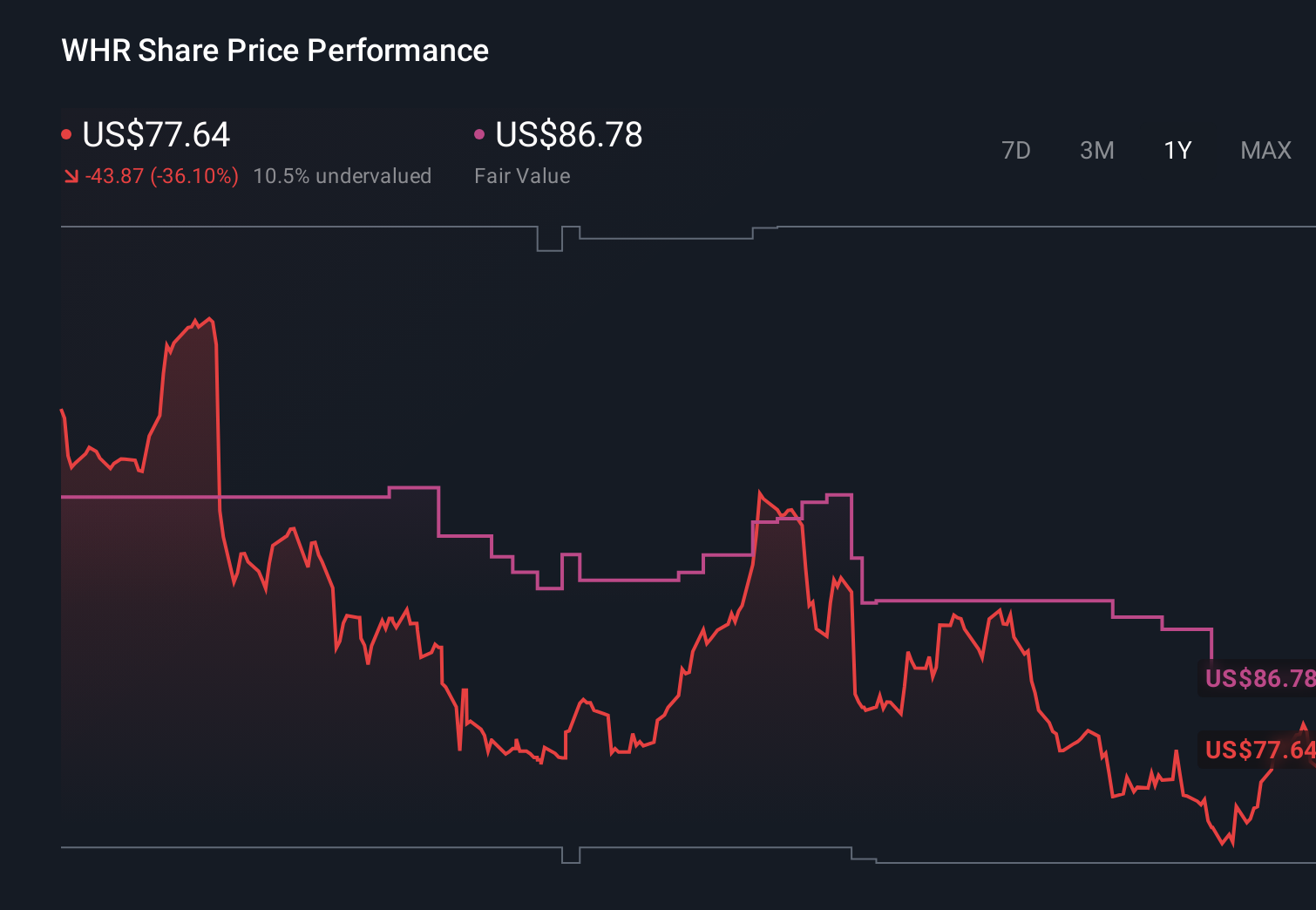
Some of the most optimistic analysts once expected Whirlpool to reach about US$16.6 billion in revenue and roughly US$614 million in earnings, yet the latest leadership shake up and softer industry data could challenge those assumptions, so you should weigh that bullish view against the risk that ongoing capital intensity and lagging innovation may keep free cash flow and returns under pressure.
Explore 4 other fair value estimates on Whirlpool - why the stock might be worth just $86.44!
Form Your Own Verdict
Don't just follow the ticker - dig into the data and build a conviction that's truly your own.
- A great starting point for your Whirlpool research is our analysis highlighting 4 key rewards and 4 important warning signs that could impact your investment decision.
- Our free Whirlpool research report provides a comprehensive fundamental analysis summarized in a single visual - the Snowflake - making it easy to evaluate Whirlpool's overall financial health at a glance.
Curious About Other Options?
Don't miss your shot at the next 10-bagger. Our latest stock picks just dropped:
- The future of work is here. Discover the 29 top robotics and automation stocks leading the charge in AI-driven automation and industrial transformation.
- Find 49 companies with promising cash flow potential yet trading below their fair value.
- We've uncovered the 15 dividend fortresses yielding 5%+ that don't just survive market storms, but thrive in them.
This article by Simply Wall St is general in nature. We provide commentary based on historical data and analyst forecasts only using an unbiased methodology and our articles are not intended to be financial advice. It does not constitute a recommendation to buy or sell any stock, and does not take account of your objectives, or your financial situation. We aim to bring you long-term focused analysis driven by fundamental data. Note that our analysis may not factor in the latest price-sensitive company announcements or qualitative material. Simply Wall St has no position in any stocks mentioned.