

When Tech Trembles and Coca-Cola Soars, How Do We Reclaim a Sense of Safety in Investing?
Coca-Cola Company KO | 0.00 | |
Cisco Systems, Inc. CSCO | 0.00 | |
Caterpillar Inc. CAT | 0.00 | |
Travelers Companies, Inc. TRV | 0.00 | |
Johnson & Johnson JNJ | 0.00 |
Subscribe to The Trend Catcher Topic / The Value Anchor Topic —unlock the full historical archive and never miss a weekly pick again.
The Setup
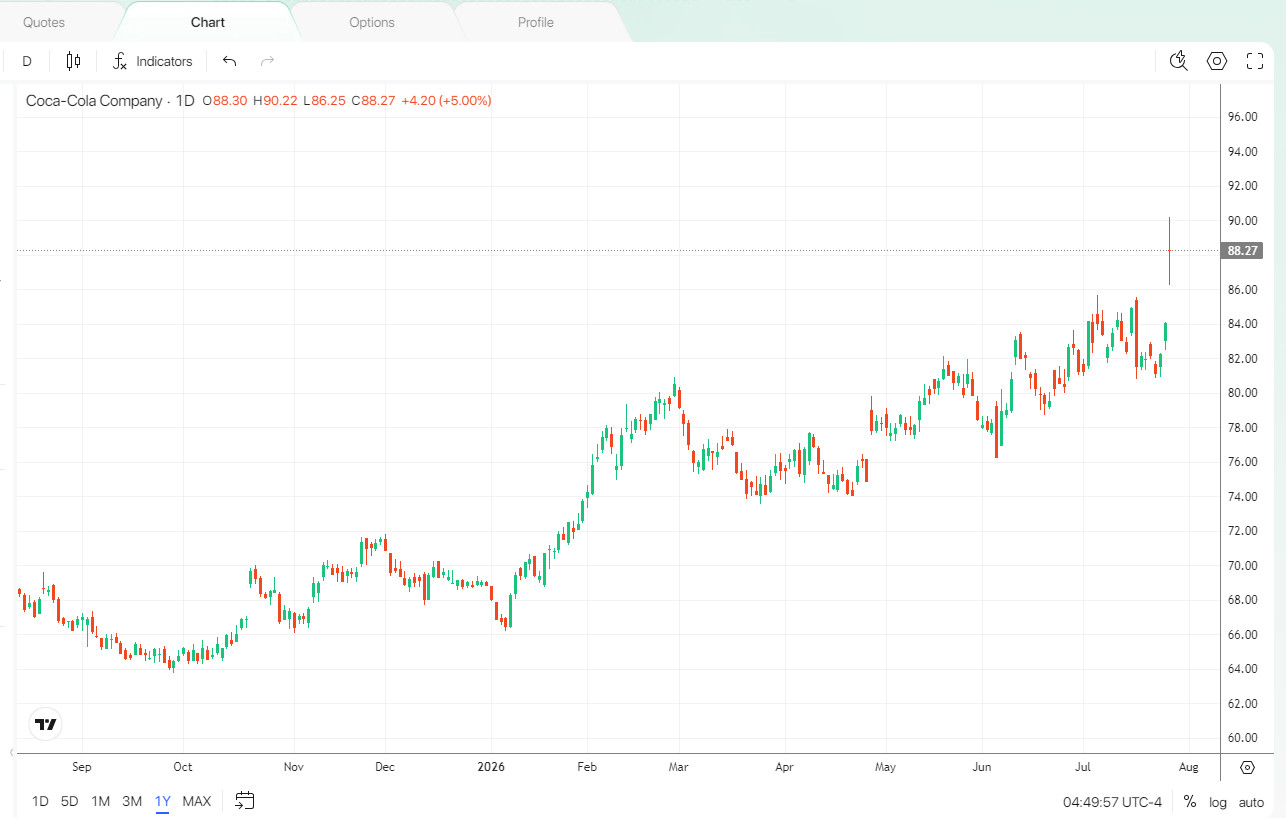
The latest bout of AI weakness—concentrated in memory and optical communications names—has done more than dent portfolios. It has exposed a broader shift in what the market is willing to reward. As speculative tech unwound overnight, capital didn't flee the market; it moved. Apple and Coca-Cola both printed fresh record highs, and the leadership board quietly filled with names that generate cash rather than promise it.
This isn't simply "risk-off." It's a repricing of certainty.
What Coca-Cola's Print Actually Tells Us
Coca-Cola Company(KO.US)'s second quarter is worth dwelling on, not because a beverage company is exciting, but because it illustrates the qualities the market is currently paying up for:
- Comparable revenue grew about 6% year-over-year to $13.37 billion
- EPS rose 16% to $1.03; adjusted EPS rose 11% to $0.97
- Management lifted full-year adjusted EPS growth guidance to 9%–10% from 8%–9%, and guided to roughly $12.4 billion in free cash flow
None of these figures are spectacular in isolation. What makes them powerful right now is their predictability. In an environment where investors are increasingly skeptical of long-dated growth stories, boring and bankable has become a premium asset class.
Breadth Was Never Just AI
A look at 2025's Dow leaders reinforces the point. Cisco Systems, Inc.(CSCO.US) is up 52% year-to-date, Caterpillar Inc.(CAT.US) 48%, and Travelers Companies, Inc.(TRV.US) 38%. Healthcare, energy, and consumer names— Johnson & Johnson(JNJ.US), Merck & Co., Inc.(MRK.US), Chevron Corporation(CVX.US), UnitedHealth Group Incorporated(UNH.US), Amgen Inc.(AMGN.US), Coca-Cola Company(KO.US)—have broadly gained more than 25%.
The market has been quietly diversifying its winners all year. The AI-only narrative was always a partial picture; the recent selloff simply made the rest of the market visible again.
The underlying logic is straightforward. Expanding tech multiples reflect a bid for possibility. Drawdowns reflect a return to fundamentals: current earnings power, cash flow stability, balance sheet strength, and whether today's price is defensible. Value is back not because it's fashionable, but because the questions have changed.
How to Position: A Framework, Not a Panic
Rather than treating this as an AI-versus-value binary, three principles matter more than any single trade.
First, survival before recovery. The instinct after a drawdown is to add leverage and chase a rebound. The math argues against it: a 20% loss needs a 25% gain to recover, a 30% loss needs 43%, and a 50% loss requires a full double. Leverage magnifies this asymmetry into forced-selling territory. The priority is de-risking—trimming margin, reducing single-name and single-supply-chain concentration, and holding cash as optionality rather than dry powder that never gets deployed.
Second, cheapness is not value. A stock down 30% whose forward earnings estimates also fell 30% has not actually gotten cheaper. The distinction that matters is why it fell—sentiment versus deteriorating orders, customer cutbacks, or a dependence on continuous financing. For AI specifically, the debate has moved past "is demand real" to "can this demand be monetized into cash." Worthwhile bottom-fishing waits for order stability, a self-funding balance sheet, and a genuine margin of safety—ideally scaled in over time rather than dropped in at a guessed low.
Third, value has valuation risk too. Chasing defensives at all-time highs means paying a premium for certainty. If growth merely decelerates, an expensive "safe" stock can still correct. The value names worth owning share concrete traits: pricing power, strong cash generation, manageable leverage, capital return capacity, and a valuation that matches realistic growth.
Subscribe to The Trend Catcher Topic / The Value Anchor Topic —unlock the full historical archive and never miss a weekly pick again.
Bottom Line
The long-term AI thesis doesn't die with one selloff. But elevated valuations raise the bar—"the industry is growing" is no longer sufficient; profits have to keep pace with prices. A resilient portfolio doesn't force a choice between growth and safety. It layers them: high-conviction AI leaders for upside, quality cyclical and defensive value to dampen volatility, and cash as the foundation for both stability and opportunity.
Bull markets make offense look like the whole game. Corrections remind us that long-term compounding starts with staying solvent, staying rational, and having capital left to deploy when valuation and earnings finally realign.