

Whirlpool (WHR) Stock Still Trades At A Discount After A 78% Slide
Whirlpool Corporation WHR | 0.00 |
Whirlpool stock is trading near US$36.91 after a steep multi year decline, and the valuation checks now point to a company that screens as undervalued on earnings multiples while its broader score suggests only a mixed picture rather than a clear bargain.
- Whirlpool has fallen about 78.5% over the past 5 years, which puts the current valuation in the context of a prolonged drawdown that long term holders will be acutely aware of.
- The announced Mexico plant closure, wider restructuring and debt refinancing can support future efficiency and balance sheet resilience, but also bring execution risk and higher interest costs that matter for what investors are willing to pay for the stock.
- With Whirlpool scoring 4 out of 6 on the broader valuation checks, the stock looks neither clearly cheap nor clearly expensive on this framework.
The issue now is whether Whirlpool's current share price already reflects the restructuring and refinancing risks, or if the market is still applying too steep a discount to the stock.
Is Whirlpool a Bargain on Earnings?
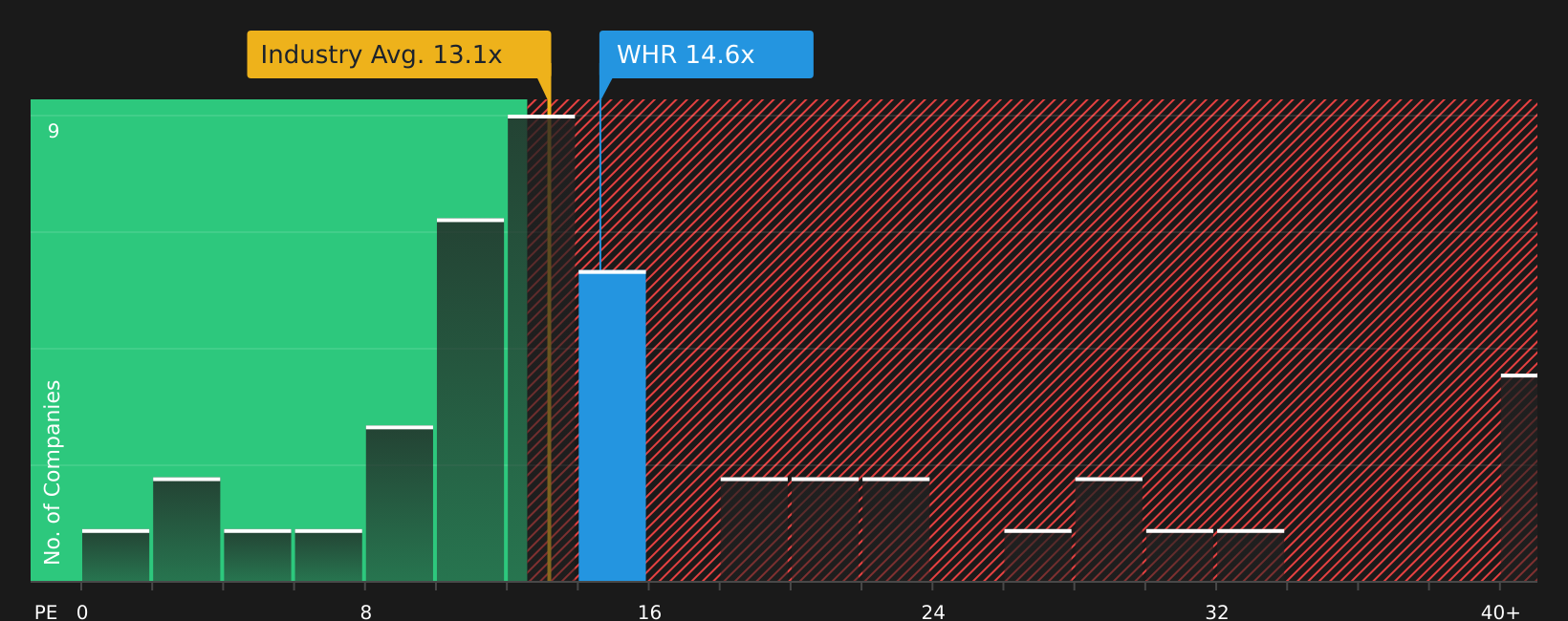
The P/E ratio is a useful way to look at Whirlpool because earnings are a central focus for how investors value the stock today. Whirlpool is trading on a P/E of about 14.8x, which is very close to the peer average of 15.0x and modestly above the Consumer Durables industry average of about 13.1x. On simple comparisons to sector and peers, Whirlpool does not stand out as either extremely cheap or extremely expensive.
The fair P/E ratio implied by the broader model is much higher at about 27.1x, which suggests the current 14.8x multiple is at a sizeable discount to what that framework would indicate given Whirlpool’s profile. Despite the recent restructuring and refinancing announcements, the P/E still sits well below this fair ratio, which points to a market that is pricing the stock cautiously.
On this earnings multiple, Whirlpool stock appears undervalued relative to the fair P/E suggested by the model.
The Whirlpool Narrative: What Would Justify Today's Price?
Simply Wall St Narratives pick up where Whirlpool's valuation puzzle leaves off by spelling out the earnings, margin and growth paths that would need to hold for the stock to be worth materially more or less than today, and they sit on the company’s Community page. Each narrative ties Whirlpool's potential catalysts and key risks to a specific fair value estimate, so you can track over time which version of the story appears to be unfolding.
Community views on Whirlpool are split, with one camp leaning into a recovery story and the other focused on refinancing and margin pressure.
Bull case: 67% undervalued
"The ongoing adoption of smart home and IoT technologies puts Whirlpool at the forefront of the high-margin, connected-appliance segment, enabling the company to drive premium pricing, cross-selling, and new recurring service revenues..."
Bear case: 23% overvalued
"Tightening climate regulation and increasing pressure for environmental sustainability are likely to require significant retooling of Whirlpool's production lines and substantial investment in research and development, which will weigh heavily on gross margins and constrain long-term profitability..."
Do you think there's more to the story for Whirlpool? Head over to our Community to see what others are saying!
The Bottom Line
Whirlpool screens as undervalued on its current earnings multiple, yet the wider checks point to a more mixed picture rather than a clear bargain. For you as an investor, the real question is whether that apparent discount is compensation for restructuring, refinancing and execution risks, or whether the market is being overly cautious. The crux of the Whirlpool debate now is whether management can deliver sustainable margins and cash generation that justify a higher P/E without those risks turning the current valuation into a value trap.
This article by Simply Wall St is general in nature. We provide commentary based on historical data and analyst forecasts only using an unbiased methodology and our articles are not intended to be financial advice. It does not constitute a recommendation to buy or sell any stock, and does not take account of your objectives, or your financial situation. We aim to bring you long-term focused analysis driven by fundamental data. Note that our analysis may not factor in the latest price-sensitive company announcements or qualitative material. Simply Wall St has no position in any stocks mentioned.