

Why American Express (AXP) Is Down 6.7% After Trump’s Proposed 10% Card Rate Cap And What's Next
American Express Company AXP | 331.69 | +1.82% |
- In early January 2026, former President Donald Trump called for a one-year cap of 10% on credit card interest rates starting January 20, triggering political and regulatory scrutiny of issuers such as American Express and its peers across the banking and payments sector.
- Beyond the immediate policy uncertainty, the proposal raises deeper questions about how a forced reset of lending economics could reshape card rewards, credit availability, and the balance of power between traditional card issuers and alternative payment providers.
- We’ll now examine how the proposed 10% interest cap and resulting regulatory uncertainty could alter American Express’s premium-focused investment narrative.
The end of cancer? These 29 emerging AI stocks are developing tech that will allow early identification of life changing diseases like cancer and Alzheimer's.
American Express Investment Narrative Recap
To own American Express today, you need to believe its premium, fee-heavy model and strong brand can stay attractive even as credit economics come under political pressure. Trump’s proposed 10% interest cap injects meaningful regulatory risk into the story, with the key short term catalyst now being management’s January 30 earnings call commentary on how a cap, or even partial action, might affect lending, rewards, and credit availability.
The most relevant recent announcement in this context is American Express’s reaffirmed and then raised 2025 guidance, targeting revenue of about US$65.3 billion and strong earnings while steadily investing in premium cards. That backdrop of record performance and ongoing buybacks now sits alongside a new policy overhang, and the upcoming earnings call will likely be the market’s first real chance to hear how management frames this regulatory threat against its longer term premium growth plans.
Yet beneath the strong 2025 guidance, one risk investors should be aware of is how a forced reset of lending economics could interact with already rising rewards costs and ...
American Express' narrative projects $85.7 billion revenue and $13.5 billion earnings by 2028. This requires 10.6% yearly revenue growth and a $3.5 billion earnings increase from $10.0 billion today.
Uncover how American Express' forecasts yield a $354.83 fair value, in line with its current price.
Exploring Other Perspectives
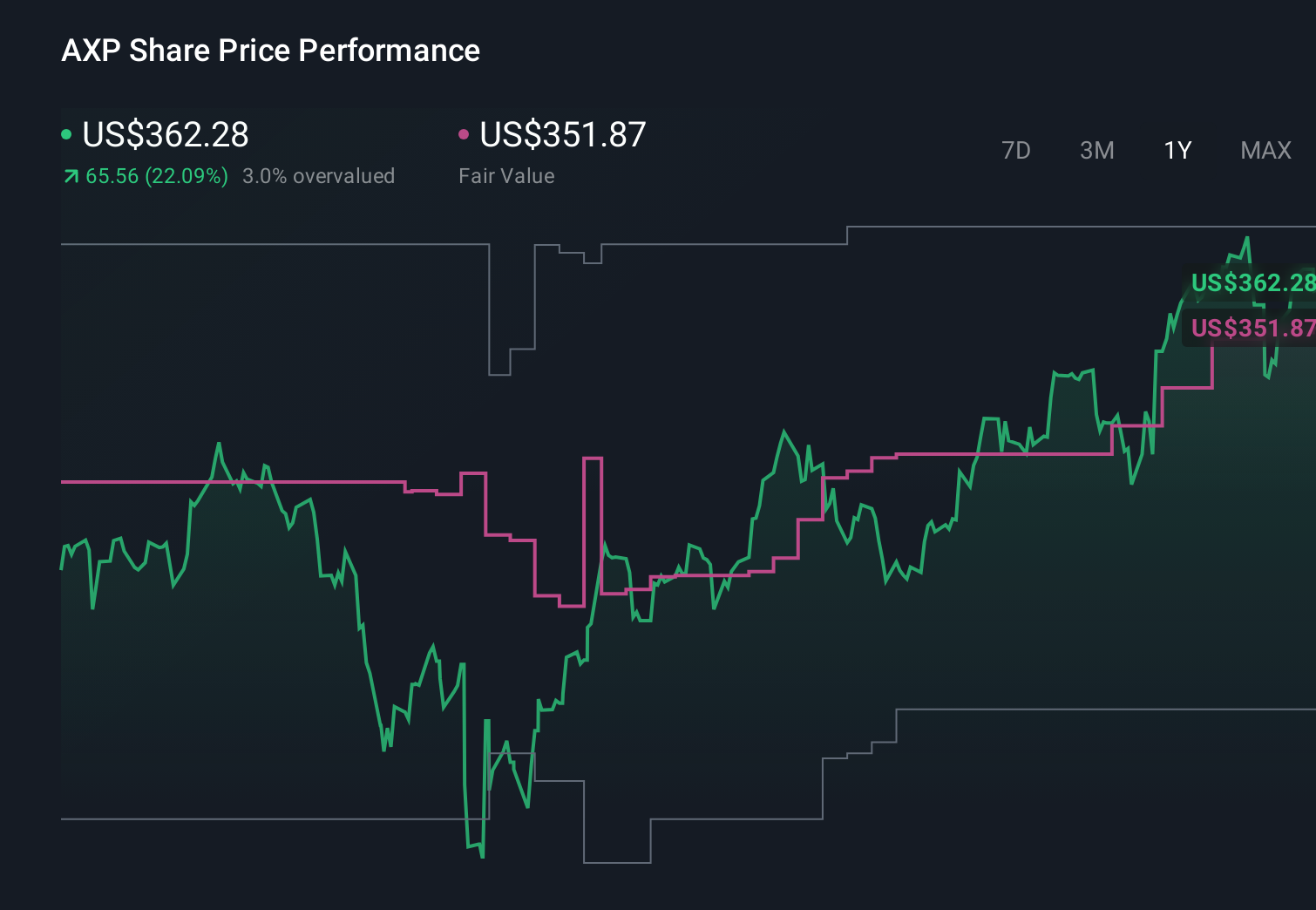
Some of the lowest analysts were already cautious, assuming revenue would grow only about 9% annually to roughly US$80.3 billion by 2028 and margins would narrow, and this new rate cap debate could push their already more pessimistic view on rewards costs and spending even further, which is worth weighing alongside more optimistic forecasts.
Explore 12 other fair value estimates on American Express - why the stock might be worth as much as 29% more than the current price!
Build Your Own American Express Narrative
Disagree with existing narratives? Create your own in under 3 minutes - extraordinary investment returns rarely come from following the herd.
- A great starting point for your American Express research is our analysis highlighting 3 key rewards and 1 important warning sign that could impact your investment decision.
- Our free American Express research report provides a comprehensive fundamental analysis summarized in a single visual - the Snowflake - making it easy to evaluate American Express' overall financial health at a glance.
Contemplating Other Strategies?
These stocks are moving-our analysis flagged them today. Act fast before the price catches up:
- This technology could replace computers: discover 29 stocks that are working to make quantum computing a reality.
- Rare earth metals are the new gold rush. Find out which 38 stocks are leading the charge.
- Find companies with promising cash flow potential yet trading below their fair value.
This article by Simply Wall St is general in nature. We provide commentary based on historical data and analyst forecasts only using an unbiased methodology and our articles are not intended to be financial advice. It does not constitute a recommendation to buy or sell any stock, and does not take account of your objectives, or your financial situation. We aim to bring you long-term focused analysis driven by fundamental data. Note that our analysis may not factor in the latest price-sensitive company announcements or qualitative material. Simply Wall St has no position in any stocks mentioned.