

Why Are Central Banks Buying So Much Gold? 90% Institutions Cite This Reason
Barrick Mining B | 0.00 | |
Newmont Corporation NEM | 0.00 | |
ALBILAD GOLD ETF 9405.SA | 0.00 | |
Gold Trust Ishares IAU | 0.00 | |
SPDR Gold GLD | 0.00 |
Central banks are increasingly turning to gold as protection against financial crises, inflation and geopolitical risks, according to a World Gold Council survey highlighted Tuesday by market commentator, The Kobeissi Letter.
Crisis Protection Drives Gold Demand
According to the survey of 69 central banks, 90% of respondents cited gold’s performance during periods of crisis as a primary reason for holding on to the precious metal.
The trend was even stronger among emerging market and developing economy central banks, where 92% identified crisis performance as a primary driver, compared with 81% of advanced economy central banks, The Kobeissi Letter said in a post on X.
Inflation Hedge, Diversification Remain Key
Beyond crisis protection, 84% of respondents cited gold’s role as a long-term store of value and hedge against inflation.
The survey also found that 85% of emerging market central banks viewed gold as a hedge against geopolitical risks, compared with 56% of advanced economy central banks.
Central Banks Continue To Accumulate Gold
Central banks have remained among the largest buyers of gold in recent years, helping support prices as countries diversify reserves amid geopolitical and economic uncertainty.
A separate World Gold Council survey published on June 16 found that central banks bought an average of 1,000 metric tons of gold annually over the past four years, double the previous decade’s pace, with 89% expecting global reserves to rise over the next 12 months.
Gold’s Next Big Catalyst
While analysts expect rising real interest rates to become the dominant driver of gold’s near-term performance, economist Mohamed El-Erian last week said renewed, consistent central bank buying could provide the next major catalyst for the precious metal.
Earlier this week, CMC Markets analyst Daniel Kostecki said higher real Treasury yields have increased the opportunity cost of holding non-yielding assets such as gold, making Federal Reserve policy a bigger influence on prices than geopolitical developments in the near term.
That could make upcoming Fed decisions a key focus for investors in SPDR Gold Shares (NYSE:GLD), iShares Gold Trust (NYSE:IAU) and gold miners such as Newmont Corp (NYSE:NEM) and Barrick Mining Corp (NYSE:B).
Gold was trading around $3,973 an ounce at publication time, hovering near an eight-month low as higher interest-rate expectations weighed on the metal.
Price Action: On Tuesday, GLD closed 0.05% lower at $368.38 and fell further by 0.24% in after-hours trading.
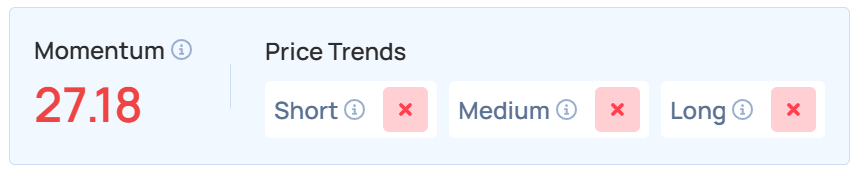
Benzinga edge rankings indicate GLD has a Momentum score in the 27th percentile, and a negative price trend across the short, medium and long term.
Disclaimer: This content was partially produced with the help of AI tools and was reviewed and published by Benzinga editors.
Photo Courtesy: Denis—S on Shutterstock.com