

Why Atlassian (TEAM) Is Up 8.8% After Profitability Jump And AI-Powered Code Context Launch
Atlassian TEAM | 0.00 |
- Atlassian recently reported past fourth-quarter and full-year 2026 results showing higher revenue of US$1,766.47 million and US$6,572.31 million respectively, alongside a quarterly move to net income of US$139.08 million, while also filing a US$1.29 billion shelf registration for approximately 7.96 million Class A shares related to its employee stock plans.
- A key development for Atlassian’s long-term product vision was the launch of Code Context, which connects large-scale codebases with organizational knowledge to power AI-enhanced development workflows securely across its ecosystem.
- We’ll now examine how Atlassian’s strong quarterly profitability improvement and AI-driven Code Context launch may influence its existing investment narrative.
Uncover the next big thing with 20 elite penny stocks that balance risk and reward.
Atlassian Investment Narrative Recap
To own Atlassian, you need to believe its cloud-first, AI-enhanced collaboration platform can keep deepening usage across developers and business teams. The sharp swing to quarterly profitability and launch of Code Context reinforce the AI investment catalyst, while the new US$1.29 billion shelf registration modestly tilts the near term focus toward dilution and execution on monetizing these AI capabilities. The biggest near term risk remains whether heavy AI and R&D spend translates into meaningful revenue and margin improvement.
Among the recent news, Code Context stands out as most directly tied to Atlassian’s AI-led growth catalyst. By linking large scale codebases with Jira, Confluence, Loom and Rovo, it aims to make AI agents and developers more effective across Atlassian’s ecosystem, which is central to the thesis that AI can drive higher engagement and premium upsell. This product launch sits alongside the improving profitability picture as a key proof point for the AI native development vision.
Yet, investors should be aware that if growing AI investment fails to translate into stronger pricing power and revenue per customer, the long term story could...
Atlassian's narrative projects $9.5 billion revenue and $569.4 million earnings by 2029. This requires 15.3% yearly revenue growth and approximately a $786.2 million earnings increase from -$216.8 million today.
Uncover how Atlassian's forecasts yield a $140.37 fair value, a 13% downside to its current price.
Exploring Other Perspectives
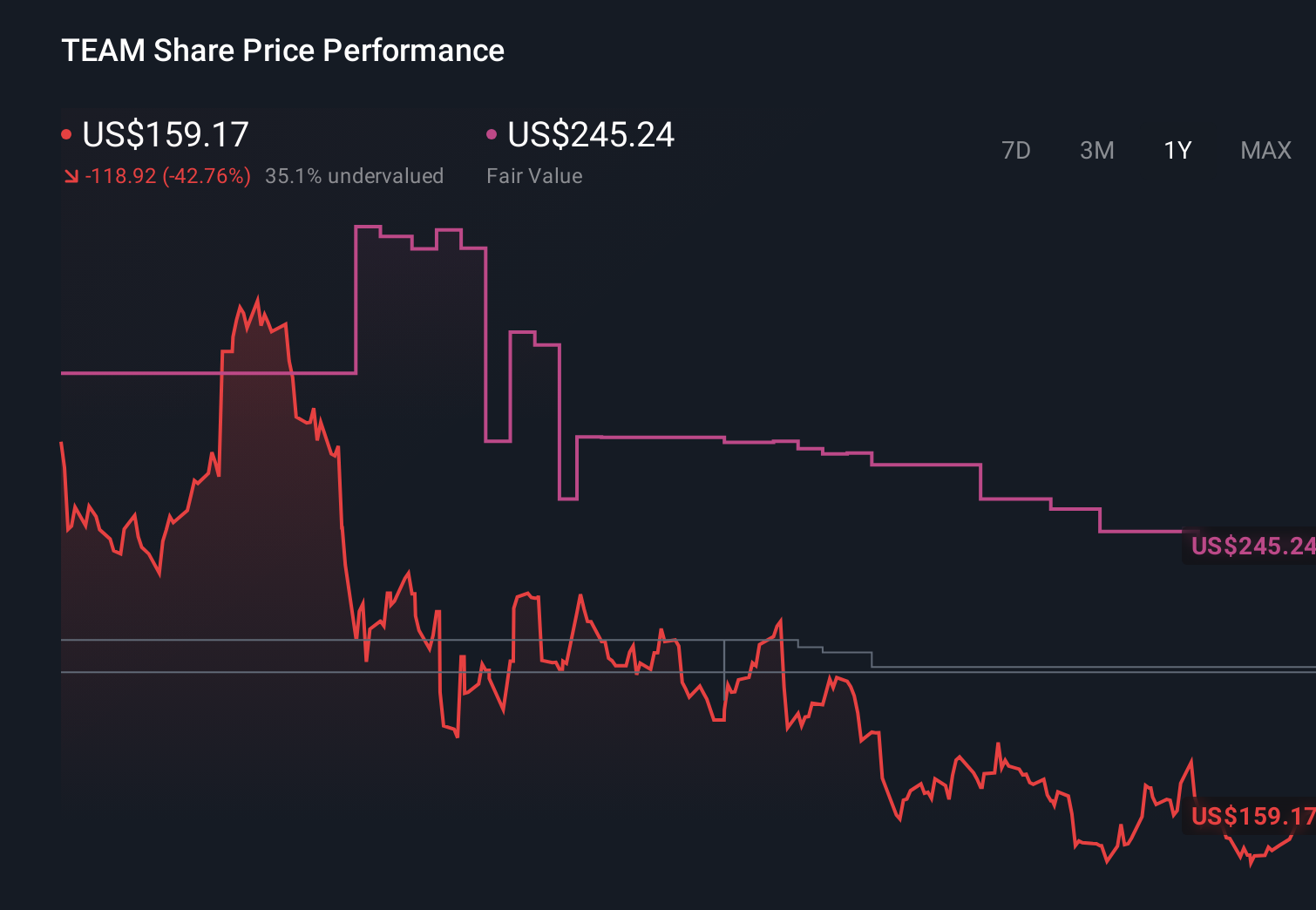
Some of the most optimistic analysts were already projecting revenue of about US$10.4 billion and earnings near US$715 million by 2029, so compared with the baseline focus on cloud migrations and AI monetization risk, they lean heavily on faster AI adoption and large enterprise rollouts to justify that outcome, which shows how far apart reasonable views can be and why revisiting both narratives after this quarter’s AI and capital markets moves may matter.
Explore 12 other fair value estimates on Atlassian - why the stock might be worth 49% less than the current price!
The Verdict Is Yours
Don't just follow the ticker - dig into the data and build a conviction that's truly your own.
- A great starting point for your Atlassian research is our analysis highlighting 3 key rewards and 1 important warning sign that could impact your investment decision.
- Our free Atlassian research report provides a comprehensive fundamental analysis summarized in a single visual - the Snowflake - making it easy to evaluate Atlassian's overall financial health at a glance.
No Opportunity In Atlassian?
Our daily scans reveal stocks with breakout potential. Don't miss this chance:
- We've uncovered the 10 dividend fortresses yielding 5%+ that don't just survive market storms, but thrive in them.
- Invest in the nuclear renaissance through our list of 92 elite nuclear energy infrastructure plays powering the global AI revolution.
- This technology could replace computers: discover 24 stocks that are working to make quantum computing a reality.
This article by Simply Wall St is general in nature. We provide commentary based on historical data and analyst forecasts only using an unbiased methodology and our articles are not intended to be financial advice. It does not constitute a recommendation to buy or sell any stock, and does not take account of your objectives, or your financial situation. We aim to bring you long-term focused analysis driven by fundamental data. Note that our analysis may not factor in the latest price-sensitive company announcements or qualitative material. Simply Wall St has no position in any stocks mentioned.