
Why Linde Stock May Be More Vulnerable Than It Appears
Linde plc LIN | 502.60 | +1.78% |
Linde (NASDAQ:LIN) is currently trading in Phase 9 of its 18-phase Adhishthana cycle on the weekly charts, and the setup suggests that risks may be starting to build beneath the surface. When viewed through the Adhishthana framework, the stock's recent behavior points toward rising downside pressure, making hedging an increasingly important consideration.
Let's break down Linde's structure and understand what may lie ahead.
Linde and Its Cakra Formation
Under the Adhishthana Principles, stocks typically form a Cakra structure between Phases 4 and 8. This arc-like formation usually carries bullish implications and prepares the stock for a breakout in Phase 9, which marks the start of the Himalayan Formation, a powerful bullish sequence.
In Linde's case, however, the weekly structure deviated from this ideal setup. While a Cakra did form, it lacked structural cleanliness. Throughout the formation, the stock attempted multiple premature breakouts, weakening the integrity of the pattern. More importantly, when Phase 9 arrived, where a clean breakout is expected, the stock instead broke down.
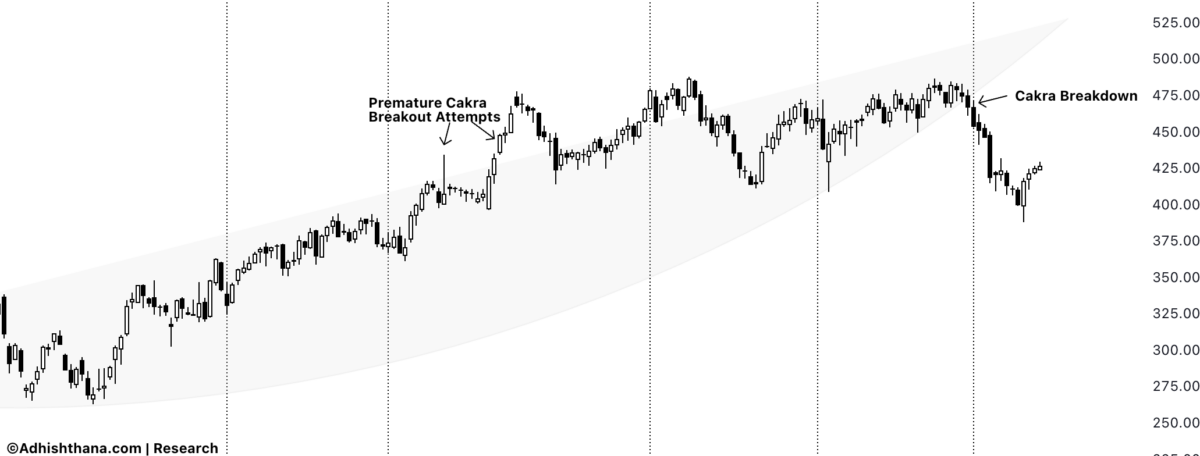
This type of failure triggers a highly bearish development under the framework, known as the Move of Pralaya.
As I outlined in Adhishthana: The Principles That Govern Wealth, Time & Tragedy:
"When the underlying breaks the Cakra on the flip side, consolidation typically extends into the Guna triads. The move that follows is highly significant, and selling pressure can be extremely strong. This is called the Move of Pralaya."
True to the principles, Linde broke its Cakra on October 6, and since then the stock has declined by more than 15%. Historically, such breakdowns tend to invite further weakness, often well before the deeper phases of the cycle start.
A Cakra breakdown also raises an important red flag: these events usually occur when inherent risks exist beneath the surface, even if they are not yet fully visible in fundamentals or headlines.
That raises an important question, does the monthly chart offer a more constructive picture?
The Curious Case of Linde on the Monthly Chart
On the monthly timeframe, Linde is currently in Phase 10. Unlike the weekly chart, the stock formed a well-defined Cakra on the monthly chart and broke out cleanly in Phase 9, exactly as the framework prescribes. That breakout triggered a powerful rally, with the stock gaining over 193% since.
The early part of Phase 10 continued to support bullish momentum. However, the recent pullback suggests something more structural may be unfolding.
Under Adhishthana, the Himalayan Formation that begins after a Cakra breakout is a three-legged move: ascent, peak, and descent. Phase 10 is a critical window where peak formation often occurs.
As stated in the principles:
"The 18th interval is expected to be the level of peak formation; if not, then the 23rd interval. If this phase concludes without forming the peak, it is anticipated to occur in the following phases."

In Linde's case, the stock marked its all-time high squarely within Phase 10 exactly during this window, raising the possibility that a structural peak may already be in place. When this is combined with a confirmed Cakra breakdown on the weekly chart, the odds tilt toward the descent leg beginning to unfold.
Investor Outlook
With a Cakra breakdown on the weekly charts and signs of a potential peak on the monthly timeframe, Linde's risk profile has shifted.
Investors holding the stock should actively hedge long exposure, as downside skew appears to be increasing. Those looking to initiate new positions may want to wait until Phase 10 on the monthly chart fully concludes, allowing clearer confirmation of whether a peak has indeed formed.
While Linde remains a structurally strong name over the long term, the current setup suggests that trouble may be brewing beneath the surface, and protecting capital should take priority as the cycle evolves.
Benzinga Disclaimer: This article is from an unpaid external contributor. It does not represent Benzinga’s reporting and has not been edited for content or accuracy.