

Why Palo Alto Networks (PANW) Is Up 5.7% After Deepening Its IBM–Red Hat Security Collaboration
Palo Alto Networks, Inc. PANW | 0.00 |
- Earlier this week, IBM and Red Hat announced a collaboration with Palo Alto Networks to link Project Lightwell and Palo Alto’s Virtual Patching, aiming to deliver rapid, dual-layer protection and remediation for vulnerabilities across open source software, commercial applications, OT and healthcare systems.
- The tie-up effectively blends IBM and Red Hat’s US$5.00 billion open source security commitment with Palo Alto Networks’ threat intelligence and network protections, creating a coordinated ecosystem for faster vulnerability discovery, patching and real-world exploitation telemetry.
- We’ll now look at how this expanded virtual patching and remediation ecosystem could influence Palo Alto Networks’ broader investment narrative.
Uncover the next big thing with 21 elite penny stocks that balance risk and reward.
Palo Alto Networks Investment Narrative Recap
To own Palo Alto Networks, you need to believe that enterprises will keep consolidating security spend onto integrated, AI-enhanced platforms where the company already has strong traction. The IBM and Red Hat collaboration reinforces this platform story, but its near term impact on the key catalyst of winning large “platformization” deals and the major risk of integration complexity around CyberArk and other acquisitions looks incremental rather than transformative for now.
Among recent developments, the rapid adoption of Palo Alto’s XSIAM platform, with annual recurring revenue now above US$600 million, feels most relevant. XSIAM’s focus on automated threat detection and response pairs naturally with the new virtual patching alliance, which also targets faster detection and remediation. Together, they speak directly to the same catalyst: customers looking to simplify operations while closing exposure windows more quickly across increasingly complex environments.
Yet against this promise, investors still need to consider how rising competition and open source security tools could pressure pricing and margins over time...
Palo Alto Networks’ narrative projects $17.6 billion revenue and $2.6 billion earnings by 2029. This requires 18.4% yearly revenue growth and an earnings increase of about $1.8 billion from $842.9 million today.
Uncover how Palo Alto Networks' forecasts yield a $310.32 fair value, in line with its current price.
Exploring Other Perspectives
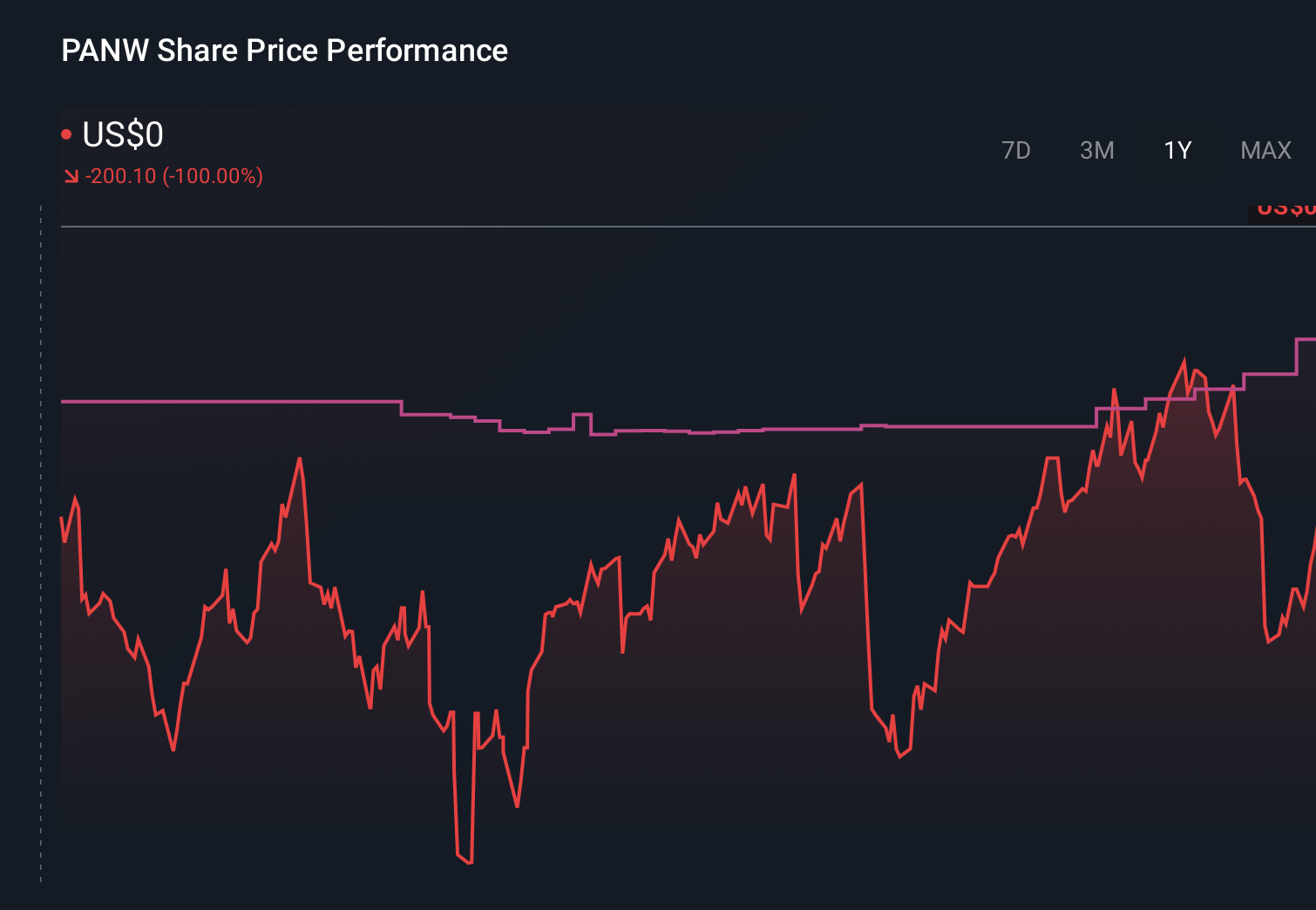
While the consensus view is more measured, the most optimistic analysts were already assuming about US$17.3 billion of revenue and US$3.5 billion of earnings by 2029, which could look either more achievable or more stretched depending on how effectively this IBM and Red Hat collaboration scales in practice.
Explore 19 other fair value estimates on Palo Alto Networks - why the stock might be worth as much as $310.32!
Form Your Own Verdict
Don't just follow the ticker - dig into the data and build a conviction that's truly your own.
- A great starting point for your Palo Alto Networks research is our analysis highlighting 1 key reward and 3 important warning signs that could impact your investment decision.
- Our free Palo Alto Networks research report provides a comprehensive fundamental analysis summarized in a single visual - the Snowflake - making it easy to evaluate Palo Alto Networks' overall financial health at a glance.
Curious About Other Options?
Right now could be the best entry point. These picks are fresh from our daily scans. Don't delay:
- AI is about to change healthcare. These 39 stocks are working on everything from early diagnostics to drug discovery. The best part - they are all under $10b in market cap - there's still time to get in early.
- Capitalize on the AI infrastructure supercycle with our selection of the 51 best 'picks and shovels' of the AI gold rush converting record-breaking demand into massive cash flow.
- We've uncovered the 8 dividend fortresses yielding 5%+ that don't just survive market storms, but thrive in them.
This article by Simply Wall St is general in nature. We provide commentary based on historical data and analyst forecasts only using an unbiased methodology and our articles are not intended to be financial advice. It does not constitute a recommendation to buy or sell any stock, and does not take account of your objectives, or your financial situation. We aim to bring you long-term focused analysis driven by fundamental data. Note that our analysis may not factor in the latest price-sensitive company announcements or qualitative material. Simply Wall St has no position in any stocks mentioned.