

Why RingCentral (RNG) Is Down 6.0% After Soft Billings And Inefficient Customer Acquisition Spend - And What's Next
RingCentral, Inc. Class A RNG | 0.00 |
- Recently, RingCentral reported solid quarterly results, but weaker billings and softer demand indicators have raised fresh questions about the strength of its underlying growth engine.
- An unusual red flag is the negative customer acquisition cost payback period, suggesting current sales and marketing spending may not be efficiently converting into profitable, long-term customers.
- Next, we'll explore how concerns over weak billings and soft demand could reshape RingCentral's existing investment narrative and future expectations.
Capitalize on the AI infrastructure supercycle with our selection of the 35 best 'picks and shovels' of the AI gold rush converting record-breaking demand into massive cash flow.
RingCentral Investment Narrative Recap
To be a shareholder in RingCentral, you need to believe its AI infused UCaaS and CCaaS platform can stay relevant despite bundled competitors and slower top line expectations. The latest weak billings and soft demand directly challenge that belief, because they put more weight on whether AI products and partnerships can offset any slowdown. In the near term, the key catalyst is execution on AI and partner led growth, while the biggest risk is that high customer acquisition costs fail to translate into durable revenue.
Among recent announcements, the expanded Charter Communications partnership for Spectrum UCX with RingCentral stands out. It connects directly to the demand questions raised by softer billings, because it should test whether channel partnerships can still drive efficient customer acquisition and usage growth. If this expanded distribution does not translate into healthier billings over time, it could reinforce concerns that RingCentral’s growth engine is becoming more expensive and less productive.
Yet beneath the AI story, investors also need to weigh how rising customer acquisition costs and pricing pressure could quietly reshape RingCentral’s long term earnings power...
RingCentral's narrative projects $2.9 billion revenue and $315.6 million earnings by 2029.
Uncover how RingCentral's forecasts yield a $35.70 fair value, in line with its current price.
Exploring Other Perspectives
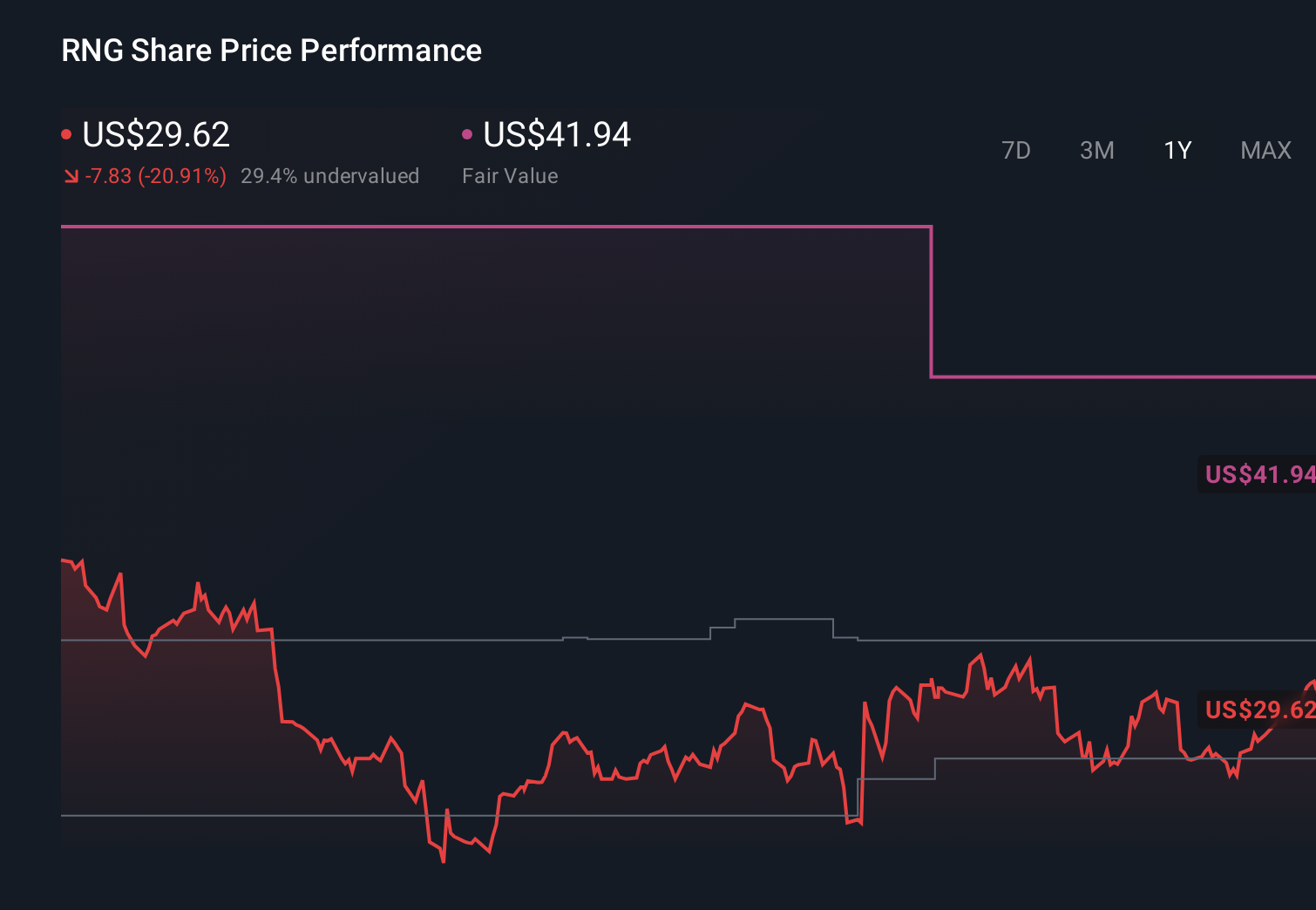
The most bearish analysts were already assuming only about 4.2 percent annual revenue growth to roughly US$2.8 billion by 2029, so when you compare that with the latest weak billings and rising acquisition costs, you can see how their more pessimistic view on future pricing and margins could gain traction and why it is worth weighing these alternative expectations alongside more optimistic scenarios.
Explore 3 other fair value estimates on RingCentral - why the stock might be worth just $35.70!
Reach Your Own Conclusion
Disagree with existing narratives? Extraordinary investment returns rarely come from following the herd, so go with your instincts.
- A great starting point for your RingCentral research is our analysis highlighting 3 key rewards and 4 important warning signs that could impact your investment decision.
- Our free RingCentral research report provides a comprehensive fundamental analysis summarized in a single visual - the Snowflake - making it easy to evaluate RingCentral's overall financial health at a glance.
Curious About Other Options?
Don't miss your shot at the next 10-bagger. Our latest stock picks just dropped:
- We've uncovered the 12 dividend fortresses yielding 5%+ that don't just survive market storms, but thrive in them.
- Outshine the giants: these 21 early-stage AI stocks could fund your retirement.
- AI is about to change healthcare. These 34 stocks are working on everything from early diagnostics to drug discovery. The best part - they are all under $10b in market cap - there's still time to get in early.
This article by Simply Wall St is general in nature. We provide commentary based on historical data and analyst forecasts only using an unbiased methodology and our articles are not intended to be financial advice. It does not constitute a recommendation to buy or sell any stock, and does not take account of your objectives, or your financial situation. We aim to bring you long-term focused analysis driven by fundamental data. Note that our analysis may not factor in the latest price-sensitive company announcements or qualitative material. Simply Wall St has no position in any stocks mentioned.