

Wiley (WLY) Stock May Be 44% Undervalued Despite New Spectral Analysis APIs
John Wiley & Sons, Inc. Class A WLY | 0.00 |
John Wiley & Sons stock has delivered a 76.2% return year to date, yet current valuation checks and an intrinsic value estimate based on a Discounted Cash Flow (DCF) approach indicate that the shares may still trade below that intrinsic value by a wide margin.
- The 76.2% year to date return suggests investors have rapidly repriced John Wiley & Sons. The key issue now is whether the fundamentals justify that move.
- Recent launches in its spectral analysis APIs and updated mass spectral library can support expectations for data driven revenue streams. Any slowdown in adoption of these tools may limit how much value investors are willing to ascribe to those cash flows.
- John Wiley & Sons screens as undervalued on most checks, with a high value score of 5 out of 6, and the DCF estimate currently points to the shares trading at about a 44.5% discount to intrinsic value.
The stock's next move may depend on whether that apparent discount to intrinsic value holds up against more detailed assumptions about future cash flows and risks.
Does John Wiley & Sons Look Undervalued on Cash Flow?
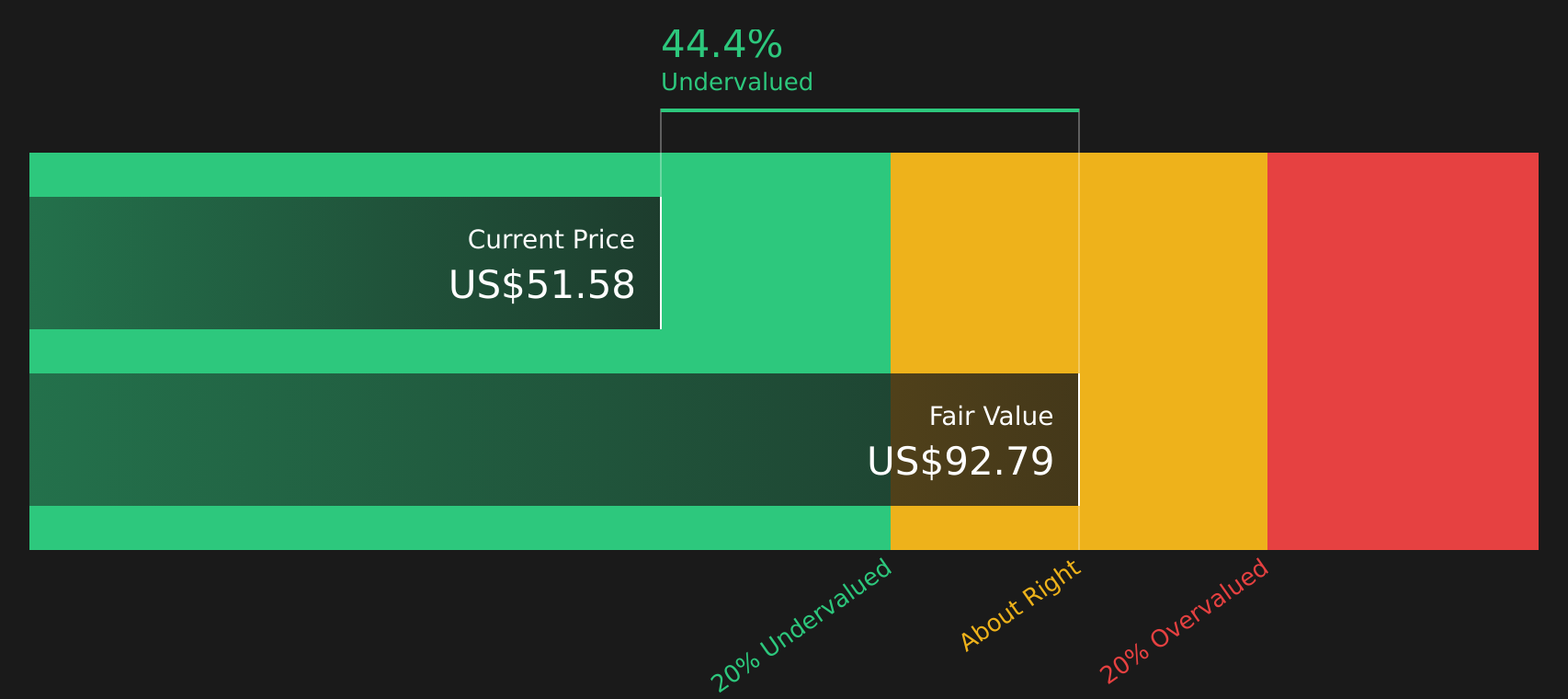
The Discounted Cash Flow (DCF) model values John Wiley & Sons by projecting future free cash flows and discounting them back to today. On this basis, the latest twelve month free cash flow of about $174.4 million is assumed to grow over time rather than shrink, which supports a two stage free cash flow to equity framework. This approach produces an estimated intrinsic value of about $93.59 per share.
That figure compares with a current share price that embeds roughly a 44.5% discount to the DCF estimate, which indicates that the market may be treating John Wiley & Sons as riskier or lower growth than the cash flow assumptions imply. The recent launches of the spectral analysis API portfolio and the 2026 edition of the combined Wiley Registry/NIST Mass Spectral Library are expected to provide a clearer path for data driven cash flows. However, the share price remains well below the modelled value.
On these cash flow assumptions, the stock currently appears undervalued relative to its DCF based intrinsic value.
Our Discounted Cash Flow (DCF) analysis suggests John Wiley & Sons is undervalued by 44.5%. Track this in your watchlist or portfolio, or discover 52 more high quality undervalued stocks.
Is John Wiley & Sons Fairly Priced on Earnings?
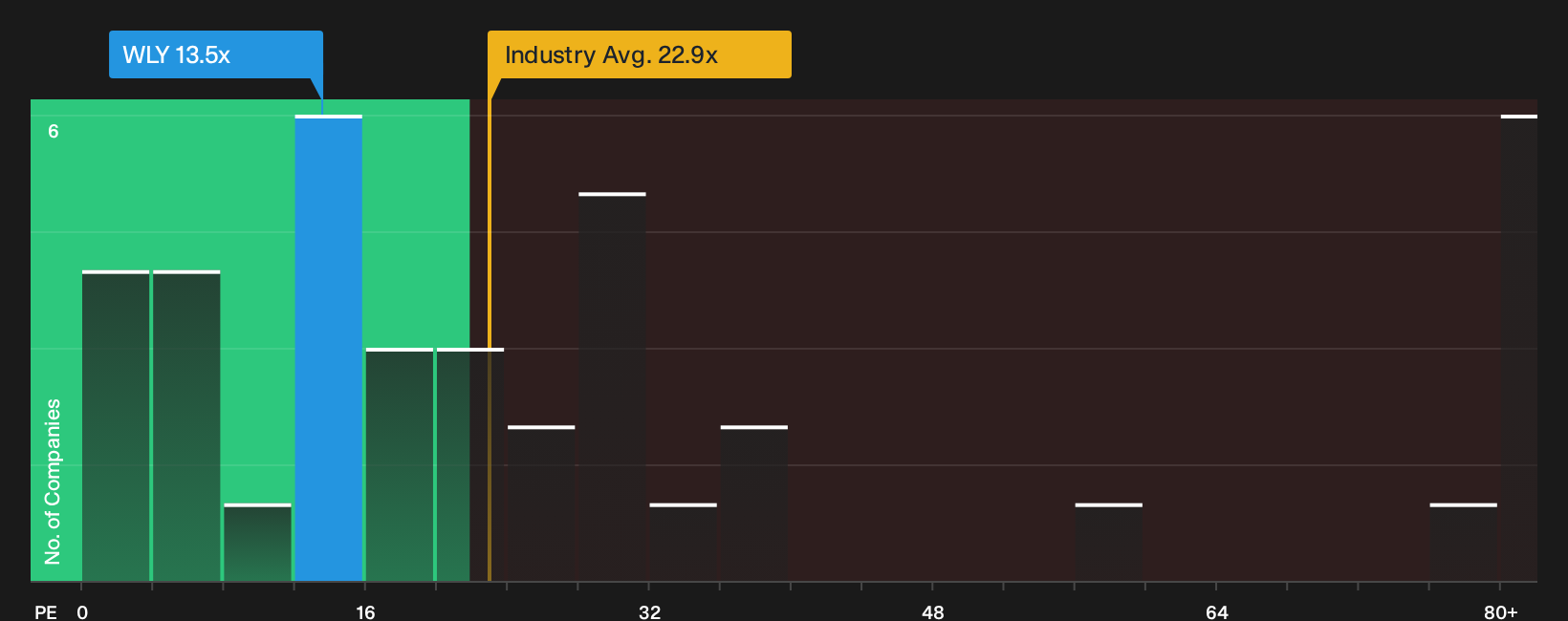
The P/E ratio is a useful way to quickly compare how the market prices John Wiley & Sons earnings against peers in the media space.
John Wiley & Sons currently trades on a P/E of about 11.9x. That is below the media industry average of around 21.4x and also below the peer average of about 50.0x. A fair P/E for the stock, based on its profile rather than simple averages, is estimated at about 13.1x. This points to only a modest gap between where the shares trade and where they might sit if priced in line with those fundamentals.
The current P/E therefore suggests John Wiley & Sons is not priced aggressively relative to sector benchmarks, but it also does not flag a large discount once the tailored fair multiple is considered.
On balance, the P/E multiple indicates John Wiley & Sons stock is trading at roughly a fair valuation.
The John Wiley & Sons Narrative: What Would Justify Today's Price?
Simply Wall St Narratives for John Wiley & Sons link the earlier valuation gap to clear assumptions about future growth, margins and earnings, and they sit on the company’s Community page. Each one ties a fair value estimate to a specific storyline about John Wiley & Sons' potential catalysts and risks, so you can track over time which version of events appears to be playing out.
Share a Narrative on John Wiley & Sons' stock to add your voice to the Simply Wall St community and put a clear, number driven case on the table. It is a chance to set out your view on whether the new spectral analysis APIs and updated mass spectral library translate into the kind of fundamentals that could support today's valuation.
Do you think there's more to the story for John Wiley & Sons? Head over to our Community to see what others are saying!
The Bottom Line
For John Wiley & Sons, the Discounted Cash Flow (DCF) work still points to meaningful intrinsic value upside, while the P/E multiple suggests the stock is closer to being priced about right than clearly mispriced. The broader valuation checks remain supportive, so the key question is whether cash flows from newer data focused products can develop in line with the forecasts that underpin that intrinsic value estimate. The crux for investors is whether the current discount reflects an opportunity or a sensible cushion for execution and adoption risk around those products.
This article by Simply Wall St is general in nature. We provide commentary based on historical data and analyst forecasts only using an unbiased methodology and our articles are not intended to be financial advice. It does not constitute a recommendation to buy or sell any stock, and does not take account of your objectives, or your financial situation. We aim to bring you long-term focused analysis driven by fundamental data. Note that our analysis may not factor in the latest price-sensitive company announcements or qualitative material. Simply Wall St has no position in any stocks mentioned.