

Will BKV’s (BKV) Profit Rebound and Low‑Carbon Push Redefine Its Integrated Energy Narrative?
BKV Corporation BKV | 0.00 |
- BKV Corporation has reported first-quarter 2026 results, with revenue of US$432.85 million versus US$176.07 million a year earlier and net income of US$44.08 million, compared with a net loss of US$81.98 million, alongside a successful equity raise of US$186.2 million.
- The company’s return to profitability, combined with progress in its power and carbon capture projects and increased ownership in its BKV-BPP Power joint venture, underpins a broader shift toward integrated low‑carbon energy solutions.
- We’ll now examine how BKV’s jump back to profitability and accelerating power and CCUS expansion influence its broader investment narrative.
The future of work is here. Discover the 31 top robotics and automation stocks leading the charge in AI-driven automation and industrial transformation.
BKV Investment Narrative Recap
BKV’s story asks you to believe in its integrated gas, power and carbon capture model, especially around ERCOT power demand and CCUS ramp‑up. The immediate catalyst is execution on new power capacity and long term PPAs, while a key risk is whether CCUS projects reach meaningful injection volumes and earn attractive fees. The latest quarter’s return to profitability and strong revenue do not remove that risk, but they give the company more financial room to pursue it.
The most relevant recent development here is the underwritten equity offering that raised about US$261.7 million, followed by an additional US$186.2 million in net proceeds this quarter. That fresh equity supports BKV’s push to expand its power business and progress CCUS, including first injection at the Cotton Cove project. For investors focused on near term catalysts, this extra capital can matter as BKV advances turbine reservations and works toward long duration PPAs in ERCOT.
Yet while the current numbers look encouraging, investors should be aware that the biggest risk may still be whether CCUS volumes and economics ultimately...
BKV's narrative projects $2.0 billion revenue and $371.8 million earnings by 2028. This requires 35.4% yearly revenue growth and about a $327.3 million earnings increase from $44.5 million today.
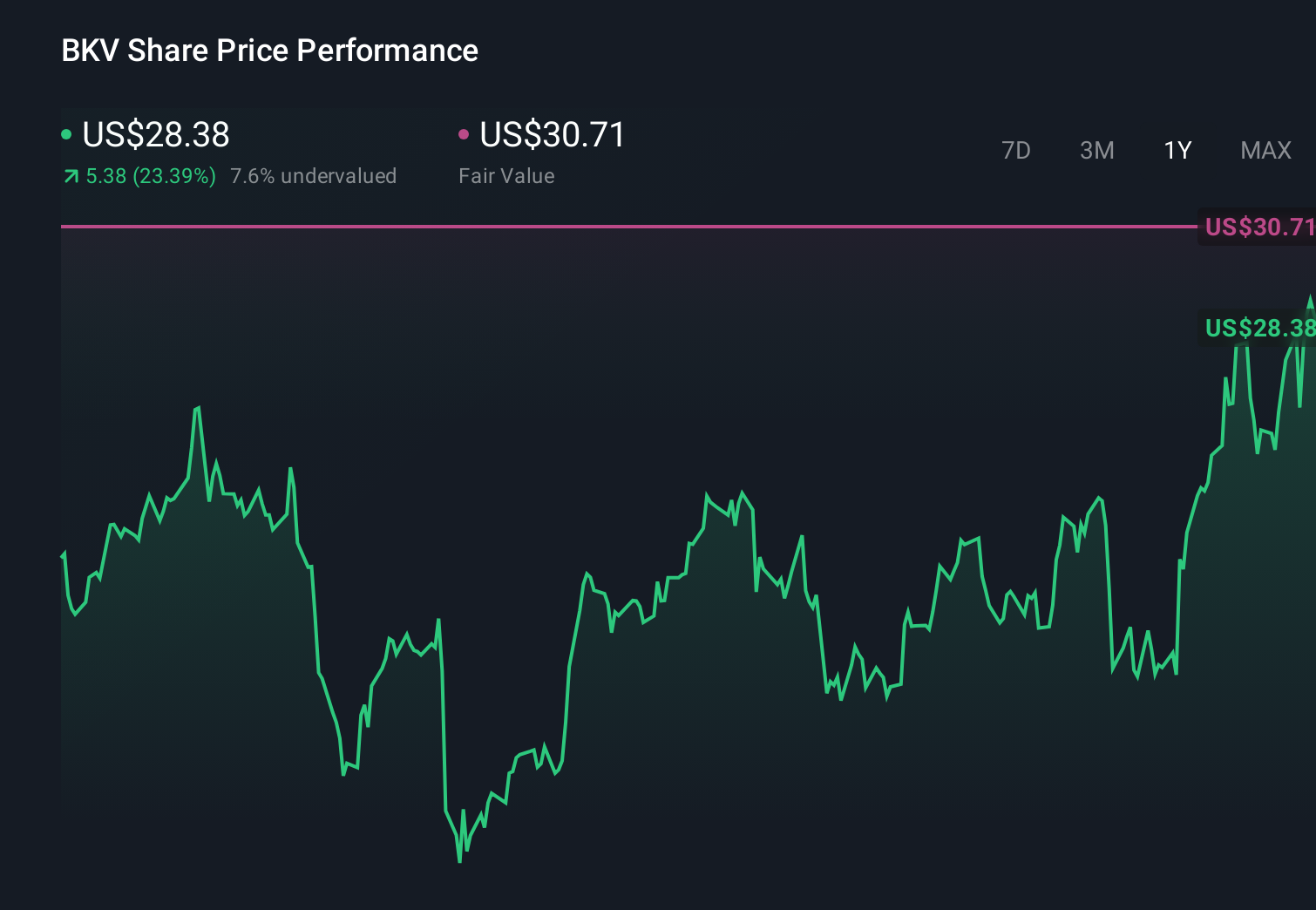
Uncover how BKV's forecasts yield a $30.71 fair value, a 3% upside to its current price.
Exploring Other Perspectives
Before this quarter, the most bearish analysts were only penciling in about US$1.7 billion of 2029 revenue and US$199 million of earnings, so compared with the catalyst risk around securing Temple PPAs on acceptable terms, their view of BKV’s earnings power was already much more cautious; this new profit and revenue step up could eventually push both narratives in different directions, and you should weigh how far your own expectations sit between them.
Explore 3 other fair value estimates on BKV - why the stock might be worth just $30.71!
Reach Your Own Conclusion
Don't just follow the ticker - dig into the data and build a conviction that's truly your own.
- A great starting point for your BKV research is our analysis highlighting 3 key rewards and 2 important warning signs that could impact your investment decision.
- Our free BKV research report provides a comprehensive fundamental analysis summarized in a single visual - the Snowflake - making it easy to evaluate BKV's overall financial health at a glance.
Seeking Other Investments?
Our daily scans reveal stocks with breakout potential. Don't miss this chance:
- Uncover the next big thing with 24 elite penny stocks that balance risk and reward.
- The best AI stocks today may lie beyond giants like Nvidia and Microsoft. Find the next big opportunity with these 18 smaller AI-focused companies with strong growth potential through early-stage innovation in machine learning, automation, and data intelligence that could fund your retirement.
- Invest in the nuclear renaissance through our list of 91 elite nuclear energy infrastructure plays powering the global AI revolution.
This article by Simply Wall St is general in nature. We provide commentary based on historical data and analyst forecasts only using an unbiased methodology and our articles are not intended to be financial advice. It does not constitute a recommendation to buy or sell any stock, and does not take account of your objectives, or your financial situation. We aim to bring you long-term focused analysis driven by fundamental data. Note that our analysis may not factor in the latest price-sensitive company announcements or qualitative material. Simply Wall St has no position in any stocks mentioned.