

Will Embedding Virtual Cards Into @ Work and Travel Workflows Change American Express' (AXP) Narrative
American Express Company AXP | 0.00 |
- Earlier this month, American Express expanded its U.S. commercial offering by integrating Virtual Card issuance and management into its @ Work platform and extending mobile Virtual Card capabilities for Business Travel Account customers through Conferma.
- This move deepens American Express’s role inside corporate finance and travel workflows by tying its Virtual Cards directly into ERP, expense tools, and controlled, policy-based spending for employees and non-cardholders.
- Next, we’ll examine how embedding Virtual Cards into @ Work and travel workflows could influence American Express’s premium-focused investment narrative.
The best AI stocks today may lie beyond giants like Nvidia and Microsoft. Find the next big opportunity with these 17 smaller AI-focused companies with strong growth potential through early-stage innovation in machine learning, automation, and data intelligence that could fund your retirement.
American Express Investment Narrative Recap
To own American Express, you generally need to believe in the durability of its premium brand, its ability to deepen relationships with high-spending consumers and businesses, and disciplined risk management. The virtual card expansion modestly supports near term revenue and engagement catalysts by embedding Amex more tightly into corporate systems and travel, but it does not materially change the biggest current risk: rising competitive pressure and rewards costs in premium payments.
Among recent announcements, the expanded virtual card capabilities in @ Work and via Conferma are most directly relevant. They sit alongside Amex’s broader push to reinforce its premium value proposition through partnerships in travel, dining, and experiences, all aimed at keeping spend and loyalty high even as analysts debate how sustainable growth in travel, entertainment, and small business spending will be.
Yet beneath the premium brand story, investors should also be aware of rising rewards and customer engagement costs that could eventually...
American Express' narrative projects $95.1 billion revenue and $14.8 billion earnings by 2029. This requires 11.4% yearly revenue growth and about a $3.7 billion earnings increase from $11.1 billion today.
Uncover how American Express' forecasts yield a $374.94 fair value, a 10% upside to its current price.
Exploring Other Perspectives
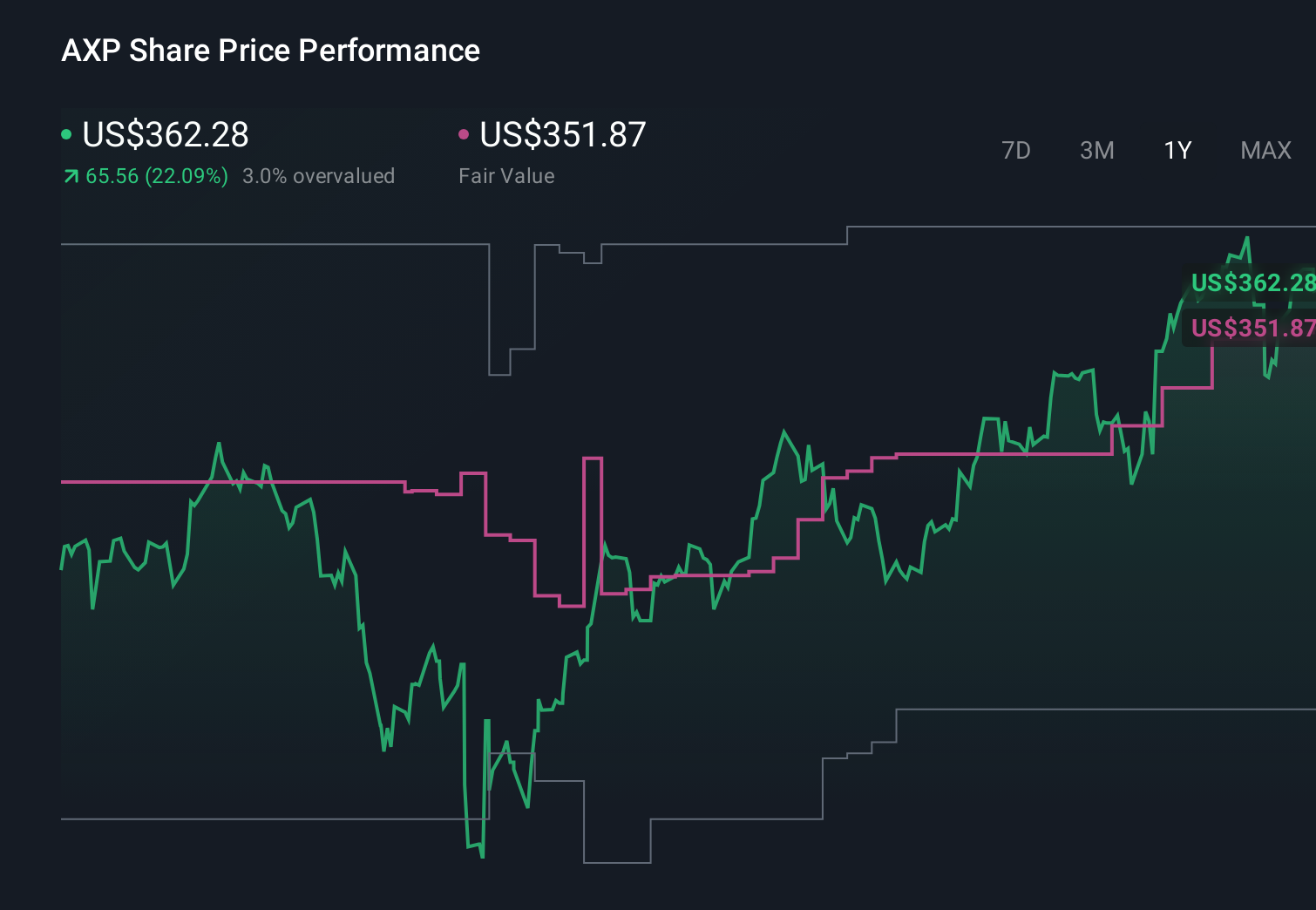
While consensus focuses on steady growth, the most pessimistic analysts expect revenue of about US$96.8 billion and earnings of US$14.2 billion by 2029, reminding you that views on risks like slowing travel spend and higher rewards costs can differ sharply and may shift again as new virtual card initiatives are absorbed into fresh forecasts.
Explore 7 other fair value estimates on American Express - why the stock might be worth 8% less than the current price!
Form Your Own Verdict
Don't just follow the ticker - dig into the data and build a conviction that's truly your own.
- A great starting point for your American Express research is our analysis highlighting 3 key rewards and 1 important warning sign that could impact your investment decision.
- Our free American Express research report provides a comprehensive fundamental analysis summarized in a single visual - the Snowflake - making it easy to evaluate American Express' overall financial health at a glance.
Contemplating Other Strategies?
Early movers are already taking notice. See the stocks they're targeting before they've flown the coop:
- Uncover the next big thing with 21 elite penny stocks that balance risk and reward.
- Invest in the nuclear renaissance through our list of 92 elite nuclear energy infrastructure plays powering the global AI revolution.
- This technology could replace computers: discover 24 stocks that are working to make quantum computing a reality.
This article by Simply Wall St is general in nature. We provide commentary based on historical data and analyst forecasts only using an unbiased methodology and our articles are not intended to be financial advice. It does not constitute a recommendation to buy or sell any stock, and does not take account of your objectives, or your financial situation. We aim to bring you long-term focused analysis driven by fundamental data. Note that our analysis may not factor in the latest price-sensitive company announcements or qualitative material. Simply Wall St has no position in any stocks mentioned.