

Will Korea’s Gigawatt-Scale AI Factories Deal Redefine NVIDIA’s (NVDA) Infrastructure Narrative?
NVIDIA Corporation NVDA | 0.00 |
- Recently, SK Group and NVIDIA agreed a more than US$500.00 billion AI infrastructure partnership anchored by a planned 2-gigawatt Vera Rubin DSX AI factory, while NAVER, Brookfield and NVIDIA outlined a US$10.00 billion expansion of Korea’s sovereign AI factory footprint and NVIDIA deepened research and packaging ties with KAIST and Amkor.
- Together, these moves show NVIDIA extending its full-stack AI platform into sovereign and hyperscale “AI factory” builds while simultaneously shoring up talent, memory, and advanced packaging foundations that could influence how resilient and diversified its future AI infrastructure business becomes.
- We’ll now examine how NVIDIA’s push into gigawatt-scale AI factories in Korea may inform and stress-test its existing investment narrative.
Uncover the next big thing with 21 elite penny stocks that balance risk and reward.
NVIDIA Investment Narrative Recap
To own NVIDIA today, you need to believe that AI “factories” become a core layer of global infrastructure and that NVIDIA’s full stack stays central to that buildout. The Korea announcements deepen that case by tying Vera Rubin, DSX software, and HBM4 memory into multi-gigawatt deployments. The biggest near term catalyst remains hyperscaler and sovereign AI capex, while key risks include export controls, customer concentration, and whether AI data centers hit power or regulatory limits.
Among the recent moves, the US$500.00 billion plus partnership with SK Group, anchored by SK Telecom’s planned 2 gigawatt Vera Rubin DSX AI factory, looks most relevant. It underlines how quickly NVIDIA is scaling into utility sized compute, in a way that could amplify both its upside from global AI infrastructure demand and its exposure to any slowdown in large customer spending or constraints on advanced memory and manufacturing capacity.
Yet even with these mega deals, investors should be aware that power, regulation and customer concentration could still...
NVIDIA's narrative projects $676.2 billion revenue and $363.6 billion earnings by 2029. This requires 38.7% yearly revenue growth and an earnings increase of about $204.0 billion from $159.6 billion today.
Uncover how NVIDIA's forecasts yield a $296.81 fair value, a 43% upside to its current price.
Exploring Other Perspectives
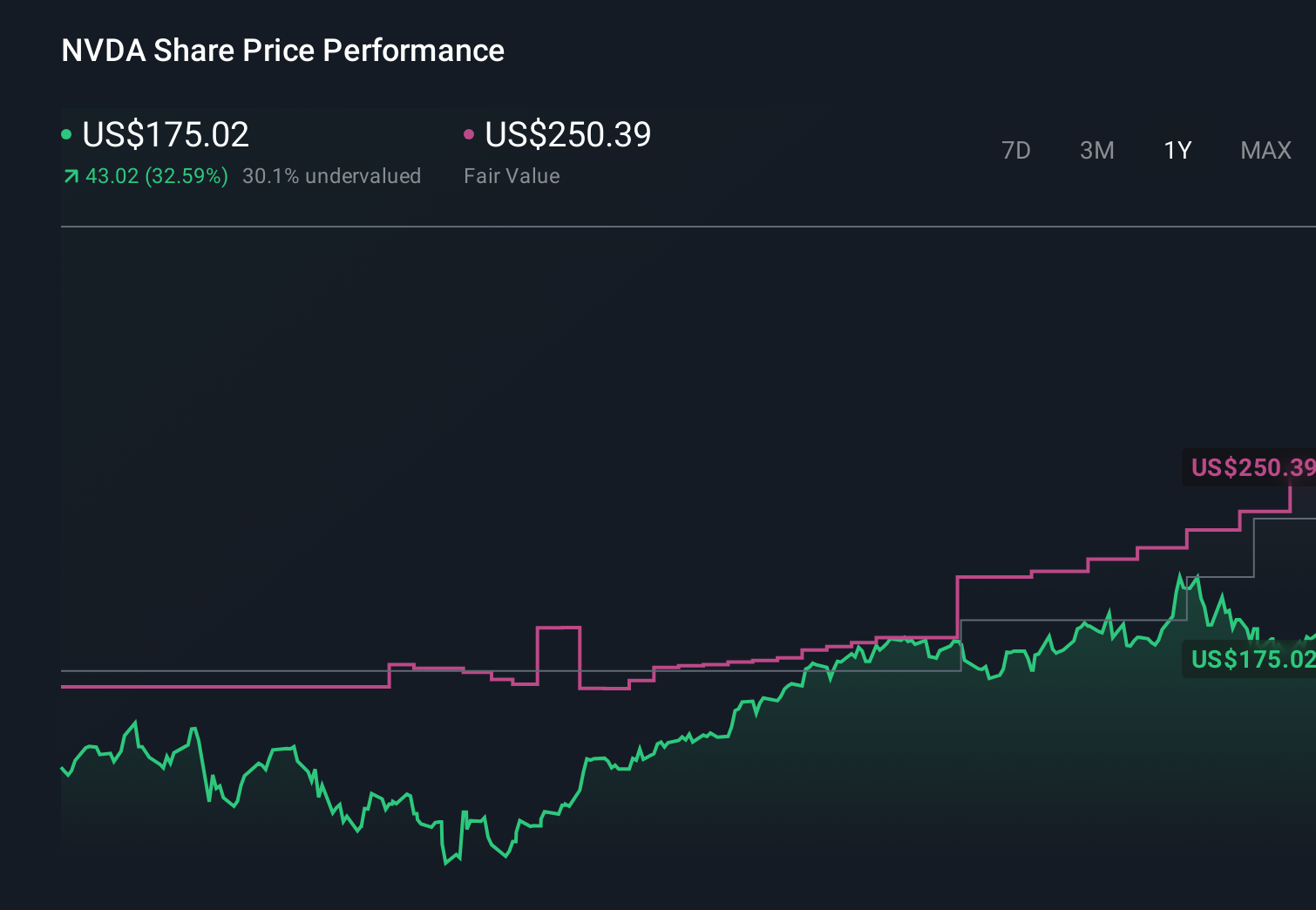
Some of the lowest estimate analysts were already assuming earnings of about US$352.5 billion by 2029, yet still worried that export limits and hyperscaler in house chips could blunt upside, reminding you that reasonable views on NVIDIA’s future can differ a lot and may shift again as these Korea AI factory plans play through.
Explore 184 other fair value estimates on NVIDIA - why the stock might be worth 17% less than the current price!
Reach Your Own Conclusion
Disagree with existing narratives? Extraordinary investment returns rarely come from following the herd, so go with your instincts.
- A great starting point for your NVIDIA research is our analysis highlighting 4 key rewards and 2 important warning signs that could impact your investment decision.
- Our free NVIDIA research report provides a comprehensive fundamental analysis summarized in a single visual - the Snowflake - making it easy to evaluate NVIDIA's overall financial health at a glance.
Interested In Other Possibilities?
Markets shift fast. These stocks won't stay hidden for long. Get the list while it matters:
- Find 49 companies with promising cash flow potential yet trading below their fair value.
- Invest in the nuclear renaissance through our list of 90 elite nuclear energy infrastructure plays powering the global AI revolution.
- The latest GPUs need a type of rare earth metal called Terbium and there are only 29 companies in the world exploring or producing it. Find the list for free.
This article by Simply Wall St is general in nature. We provide commentary based on historical data and analyst forecasts only using an unbiased methodology and our articles are not intended to be financial advice. It does not constitute a recommendation to buy or sell any stock, and does not take account of your objectives, or your financial situation. We aim to bring you long-term focused analysis driven by fundamental data. Note that our analysis may not factor in the latest price-sensitive company announcements or qualitative material. Simply Wall St has no position in any stocks mentioned.