

Will Lockheed’s Index Shift and THAAD Megadeal Recast Lockheed Martin’s (LMT) Defense Investment Narrative?
Lockheed Martin Corporation LMT | 0.00 |
- In late June 2026, Lockheed Martin was removed from several Russell value indices but added to the Russell 1000 Dynamic Index, following a new seven-year, up to US$35.00 billion undefinitized contract action to significantly expand production of Terminal High Altitude Area Defense interceptors and broader munitions capacity investments across multiple U.S. sites.
- This index reclassification and multibillion-dollar missile defense framework highlight how Lockheed Martin’s growing role in high-priority defense programs is reshaping how equity benchmarks and investors categorize the company’s business profile.
- We’ll now examine how Lockheed Martin’s shift into the Russell 1000 Dynamic Index reframes its investment narrative around expanding missile capacity.
Find 43 companies with promising cash flow potential yet trading below their fair value.
Lockheed Martin Investment Narrative Recap
To own Lockheed Martin, you need to believe its core franchises in air, missile defense, and space can convert a large, long-duration backlog into steady cash generation despite program complexity and high leverage. The new Russell index moves do not appear to change the near term fundamentals; the key near term catalyst remains execution on growing munitions contracts, while the biggest current risk is further cost overruns or charges on large, technically demanding legacy and classified programs.
The seven year, up to US$35.00 billion THAAD and munitions capacity contract is the clearest tie to this index shift, because it reinforces Lockheed Martin’s positioning in high priority missile defense. This contract sits squarely against the central catalyst of sustained demand for PAC 3, THAAD, and related systems, while also underscoring the risk that any production, supply chain, or pricing issues on such large fixed price efforts could put additional pressure on margins.
Yet against this, investors should also weigh how concentrated exposure to a few mega programs can quietly magnify execution and budget risks that shareholders need to understand...
Lockheed Martin's narrative projects $88.0 billion revenue and $8.0 billion earnings by 2029. This requires 5.4% yearly revenue growth and a $3.2 billion earnings increase from $4.8 billion today.
Uncover how Lockheed Martin's forecasts yield a $625.16 fair value, a 23% upside to its current price.
Exploring Other Perspectives
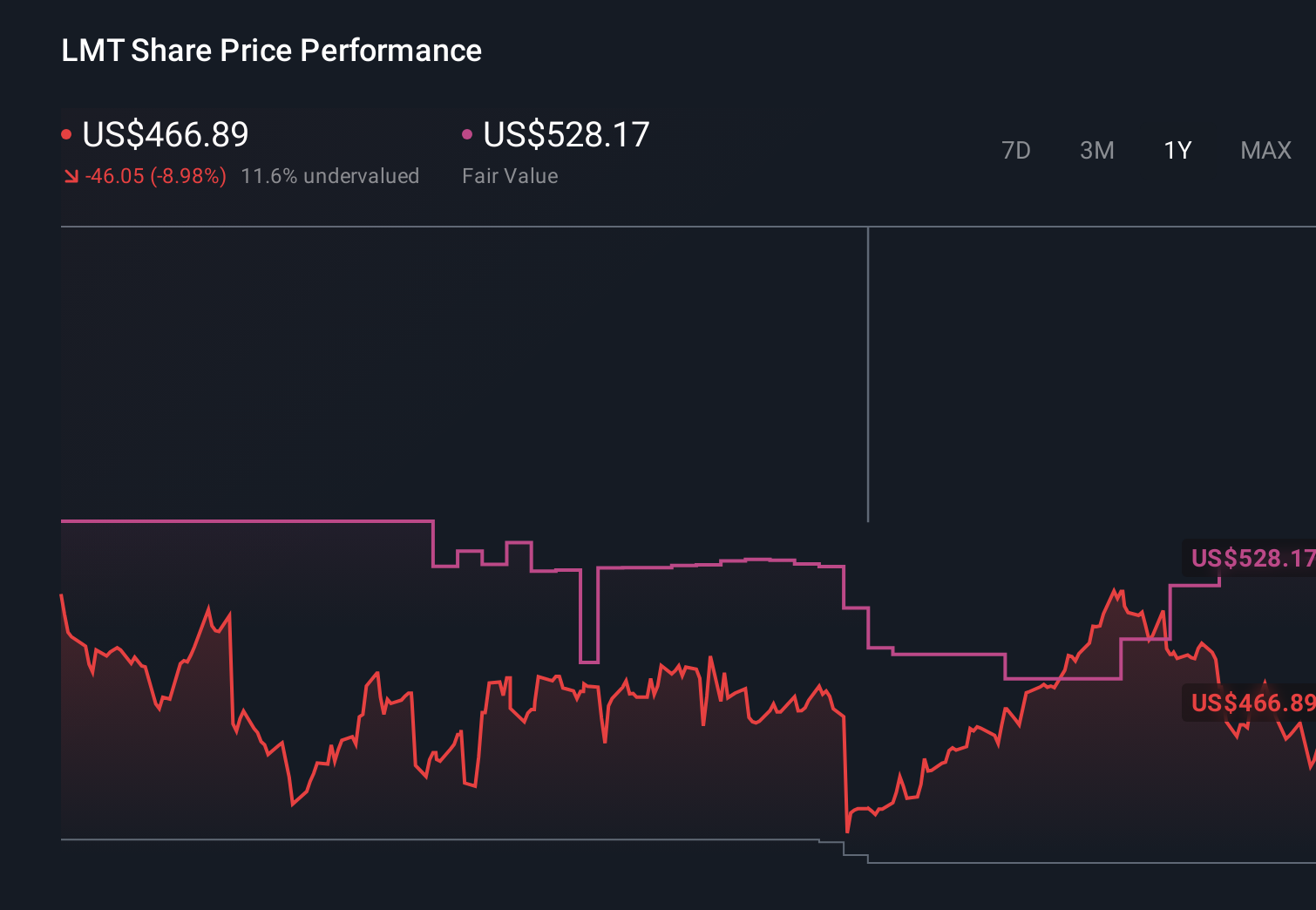
Some of the most optimistic analysts already saw room for annual revenue near US$93.5 billion and earnings around US$8.7 billion by 2029, so if you only focus on backlog strength or missile demand, you might miss how differently others weigh execution, budget, or ESG risks and why these new munitions contracts and index changes could prompt both sides to rethink their stories.
Explore 7 other fair value estimates on Lockheed Martin - why the stock might be worth just $566.77!
Reach Your Own Conclusion
Disagree with existing narratives? Extraordinary investment returns rarely come from following the herd, so go with your instincts.
- A great starting point for your Lockheed Martin research is our analysis highlighting 5 key rewards and 1 important warning sign that could impact your investment decision.
- Our free Lockheed Martin research report provides a comprehensive fundamental analysis summarized in a single visual - the Snowflake - making it easy to evaluate Lockheed Martin's overall financial health at a glance.
Contemplating Other Strategies?
These stocks are moving-our analysis flagged them today. Act fast before the price catches up:
- Uncover the next big thing with 22 elite penny stocks that balance risk and reward.
- We've uncovered the 10 dividend fortresses yielding 5%+ that don't just survive market storms, but thrive in them.
- AI is about to change healthcare. These 40 stocks are working on everything from early diagnostics to drug discovery. The best part - they are all under $10b in market cap - there's still time to get in early.
This article by Simply Wall St is general in nature. We provide commentary based on historical data and analyst forecasts only using an unbiased methodology and our articles are not intended to be financial advice. It does not constitute a recommendation to buy or sell any stock, and does not take account of your objectives, or your financial situation. We aim to bring you long-term focused analysis driven by fundamental data. Note that our analysis may not factor in the latest price-sensitive company announcements or qualitative material. Simply Wall St has no position in any stocks mentioned.