

Will New DashPass and MileagePlus Perks Change Lyft's (LYFT) Partnership-Driven Platform Narrative?
Lyft LYFT | 0.00 |
- In late April 2026, DoorDash and Lyft expanded their partnership into Canada to give DashPass members automatic discounts on eligible Lyft rides, while Lyft and United Airlines introduced a new feature allowing MileagePlus members to pay for rides with miles directly in the Lyft app.
- Together, these partnerships extend Lyft’s reach into Canadian cities and integrate its service more tightly with everyday food delivery and air travel loyalty programs.
- Next, we’ll examine how deeper integrations with DashPass and United’s MileagePlus program could influence Lyft’s partnership-driven investment narrative.
Invest in the nuclear renaissance through our list of 91 elite nuclear energy infrastructure plays powering the global AI revolution.
Lyft Investment Narrative Recap
To own Lyft, you need to believe its core ride-hailing platform can keep converting product improvements and partnerships into sustainable, high quality profits, despite rising competition and regulatory scrutiny. In the near term, a key catalyst is whether Lyft can translate its strong recent earnings into steadier rider growth, while its heavy dependence on external partners remains a central risk. The new DashPass and MileagePlus integrations support the partnership story but do not, on their own, alter those core drivers in a material way.
Of the recent developments, the United MileagePlus “pay with miles” feature looks especially relevant, because it deepens an existing relationship that already tied ride volume to airline travel. By letting users redeem miles inside the Lyft app for both airport and everyday trips, it potentially strengthens Lyft’s role in trip planning and loyalty ecosystems, which sits squarely inside the current catalyst of partnership driven usage and monetization.
Yet while these integrations look helpful on the surface, investors should also be aware that growing reliance on partners could magnify the risk if incentives shift...
Lyft's narrative projects $8.8 billion revenue and $458.2 million earnings by 2029. This requires 11.5% yearly revenue growth and an earnings decrease of about $2.3 billion from $2.8 billion today.
Uncover how Lyft's forecasts yield a $19.28 fair value, a 34% upside to its current price.
Exploring Other Perspectives
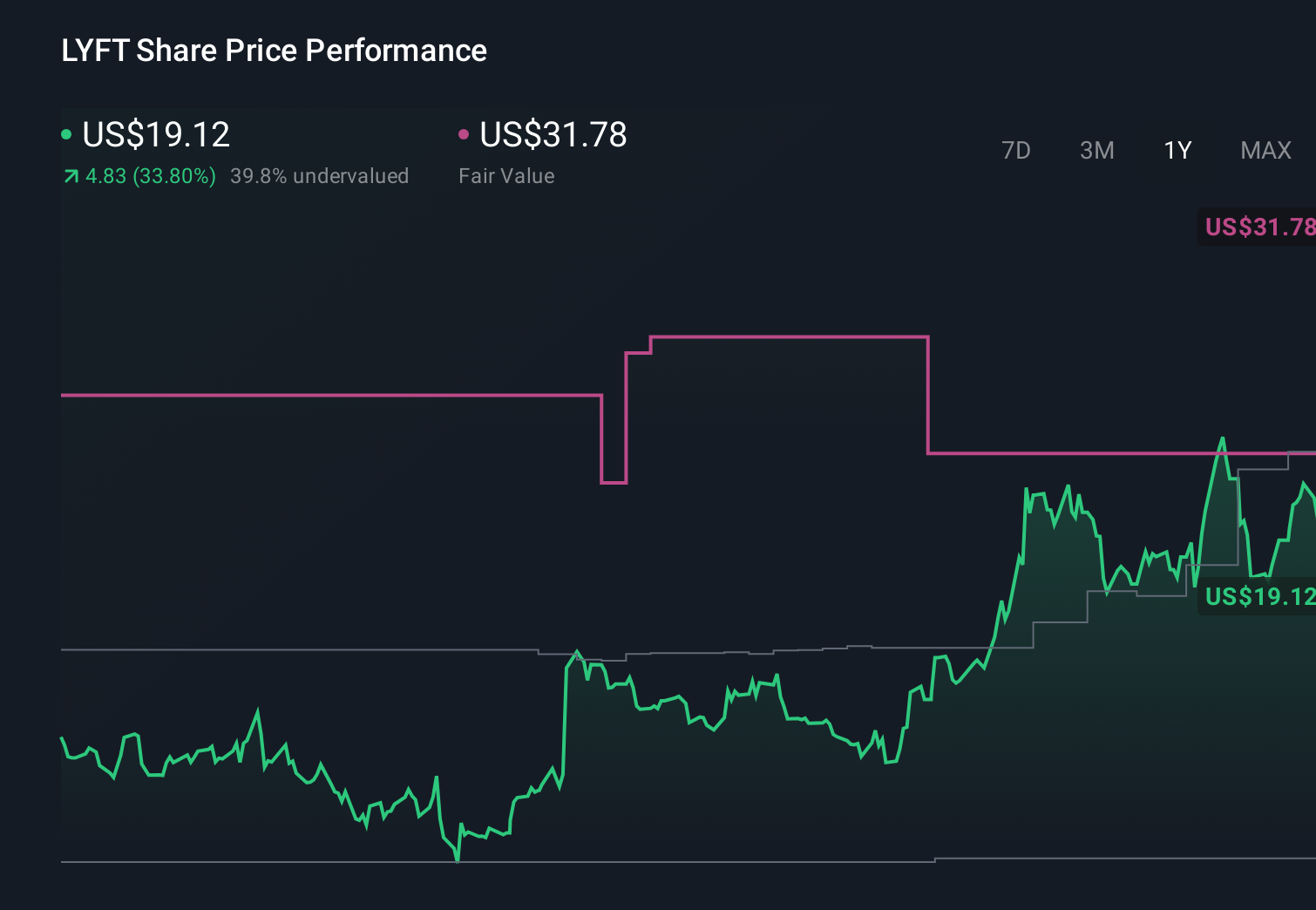
Some of the lowest estimate analysts took a far gloomier view, assuming earnings might fall to about US$173.7 million, even as they saw partnerships and AV bets as key offsets to those pressures. For you, that creates room to compare how much weight to put on today’s partnership news versus that cautious path for future profits and consider how your expectations might differ.
Explore 8 other fair value estimates on Lyft - why the stock might be worth over 4x more than the current price!
Decide For Yourself
Disagree with existing narratives? Extraordinary investment returns rarely come from following the herd, so go with your instincts.
- A great starting point for your Lyft research is our analysis highlighting 3 key rewards and 2 important warning signs that could impact your investment decision.
- Our free Lyft research report provides a comprehensive fundamental analysis summarized in a single visual - the Snowflake - making it easy to evaluate Lyft's overall financial health at a glance.
Curious About Other Options?
The market won't wait. These fast-moving stocks are hot now. Grab the list before they run:
- Explore 26 top quantum computing companies leading the revolution in next-gen technology and shaping the future with breakthroughs in quantum algorithms, superconducting qubits, and cutting-edge research.
- We've uncovered the 13 dividend fortresses yielding 5%+ that don't just survive market storms, but thrive in them.
- The future of work is here. Discover the 33 top robotics and automation stocks leading the charge in AI-driven automation and industrial transformation.
This article by Simply Wall St is general in nature. We provide commentary based on historical data and analyst forecasts only using an unbiased methodology and our articles are not intended to be financial advice. It does not constitute a recommendation to buy or sell any stock, and does not take account of your objectives, or your financial situation. We aim to bring you long-term focused analysis driven by fundamental data. Note that our analysis may not factor in the latest price-sensitive company announcements or qualitative material. Simply Wall St has no position in any stocks mentioned.