

Will Rising Revenue, Squeezed Profits and a New Disney+ Asia Chief Reshape Disney's (DIS) Narrative?
Walt Disney Company DIS | 0.00 |
- The Walt Disney Company recently reported fiscal third-quarter 2026 results, with revenue rising to US$25,248 million while net income fell to US$2,638 million, and also appointed former HBO Max architect Andy Shu as director and head of commerce for Disney+ Asia Pacific, relocating him to Tokyo.
- This combination of higher revenue but lower profitability, alongside Shu’s streaming-commerce expertise, highlights Disney’s focus on tightening digital monetization while Experiences and direct-to-consumer businesses evolve together.
- Next, we’ll examine how Andy Shu’s Disney+ Asia Pacific commerce role could reshape Disney’s investment narrative around Experiences and streaming monetization.
Find 50 companies with promising cash flow potential yet trading below their fair value.
Walt Disney Investment Narrative Recap
To own Disney today, you generally need to believe its Experiences, streaming and IP engines can work together to turn a vast fan base into steadier earnings, even as near term margins remain under pressure. The latest quarter’s higher revenue but lower net income, combined with Andy Shu’s hire for Disney+ Asia Pacific, does not materially change the biggest near term swing factor: whether Disney can improve direct to consumer profitability without denting subscriber engagement, while managing content and Experiences cost inflation.
Among recent announcements, Disney’s fiscal third quarter 2026 result, with revenue at US$25,248 million and net income at US$2,638 million, is most relevant here because it frames Shu’s appointment against a backdrop of rising sales but compressed earnings. Together, that earnings pressure and the push to deepen Disney+ commerce in Asia Pacific sit right beside a key risk for shareholders: that higher spending on premium sports rights, content and Experiences expansion could further weigh on margins if revenue growth does not keep pace.
Yet investors should also be aware that heavier spending on sports rights and park expansions could still...
Walt Disney's narrative projects $112.8 billion revenue and $13.1 billion earnings by 2029. This requires 5.1% yearly revenue growth and about a $1.9 billion earnings increase from $11.2 billion today.
Uncover how Walt Disney's forecasts yield a $126.74 fair value, a 19% upside to its current price.
Exploring Other Perspectives
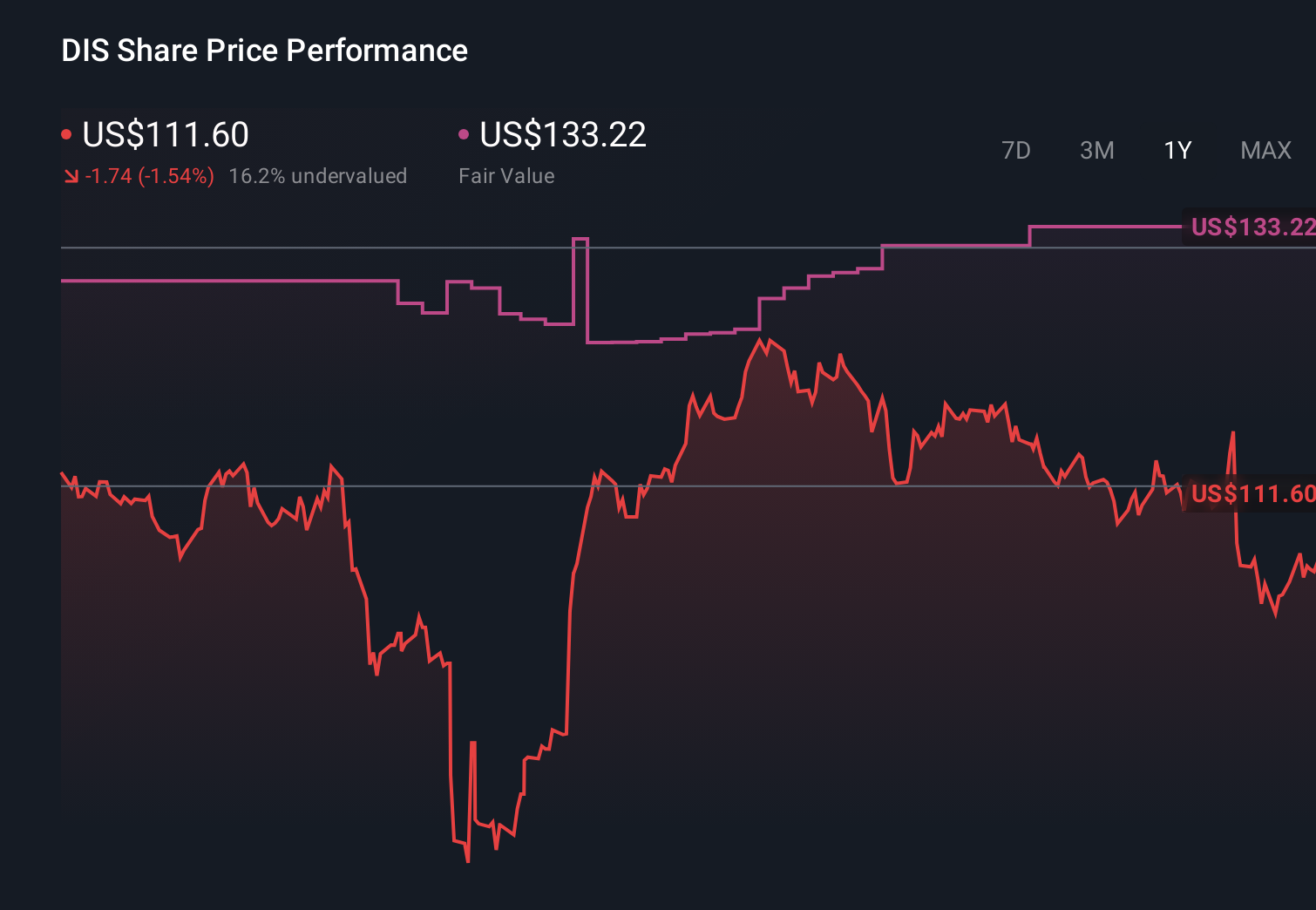
Six members of the Simply Wall St Community currently see Disney’s fair value between US$109.44 and US$134.63, reflecting a wide spread of individual expectations. Against that backdrop, the risk that rising sports rights and Experiences capital spending compresses margins gives you a clear reason to compare several of these views before deciding how Disney fits into your portfolio.
Explore 6 other fair value estimates on Walt Disney - why the stock might be worth as much as 26% more than the current price!
Form Your Own Verdict
Disagree with existing narratives? Extraordinary investment returns rarely come from following the herd, so go with your instincts.
- A great starting point for your Walt Disney research is our analysis highlighting 2 key rewards and 1 important warning sign that could impact your investment decision.
- Our free Walt Disney research report provides a comprehensive fundamental analysis summarized in a single visual - the Snowflake - making it easy to evaluate Walt Disney's overall financial health at a glance.
Seeking Other Investments?
Our daily scans reveal stocks with breakout potential. Don't miss this chance:
- Uncover the next big thing with 18 elite penny stocks that balance risk and reward.
- We've uncovered the 10 dividend fortresses yielding 5%+ that don't just survive market storms, but thrive in them.
- Rare earth metals are the new gold rush. Find out which 28 stocks are leading the charge.
This article by Simply Wall St is general in nature. We provide commentary based on historical data and analyst forecasts only using an unbiased methodology and our articles are not intended to be financial advice. It does not constitute a recommendation to buy or sell any stock, and does not take account of your objectives, or your financial situation. We aim to bring you long-term focused analysis driven by fundamental data. Note that our analysis may not factor in the latest price-sensitive company announcements or qualitative material. Simply Wall St has no position in any stocks mentioned.