

Will Strong Q2 Results and Ongoing Buybacks Reshape Halliburton’s (HAL) Capital Allocation Narrative?
Halliburton Company HAL | 0.00 |
- In July 2026, Halliburton Company reported that its second-quarter sales rose to US$3,202 million and revenue to US$5,714 million, with net income increasing to US$534 million and diluted earnings per share from continuing operations reaching US$0.64, all higher than a year earlier.
- Over the same period, Halliburton also continued its long-running capital return program, repurchasing about 5.04 million shares for US$200.57 million and bringing total buybacks since 2006 to roughly 333.23 million shares for US$12.38 billion, materially shrinking its share count over time.
- Against this backdrop of higher earnings and ongoing buybacks, we’ll now examine how Halliburton’s capital allocation choices influence its investment narrative.
AI is about to change healthcare. These 41 stocks are working on everything from early diagnostics to drug discovery. The best part - they are all under $10b in market cap - there's still time to get in early.
Halliburton Investment Narrative Recap
To own Halliburton, you need to believe oil and gas spending remains robust enough for its global services, digital tools, and capital returns to matter. The latest results show higher revenue and earnings, but do not fundamentally change the near term tension between international growth opportunities and the key risk of long term decarbonization pressure on fossil fuel activity.
The continued share buybacks, including about 5.04 million shares repurchased in the quarter, are the most relevant recent development here, because they directly shape how rising earnings translate into per share results. When viewed alongside steady dividends, this capital allocation profile is central to how investors frame Halliburton’s catalysts around global project wins and its biggest risk of structurally weaker demand for traditional oilfield services.
Yet while buybacks and earnings are improving today, investors should be aware that growing regulatory and decarbonization pressures could still materially affect...
Halliburton's narrative projects $24.7 billion revenue and $2.6 billion earnings by 2029.
Uncover how Halliburton's forecasts yield a $44.24 fair value, a 37% upside to its current price.
Exploring Other Perspectives
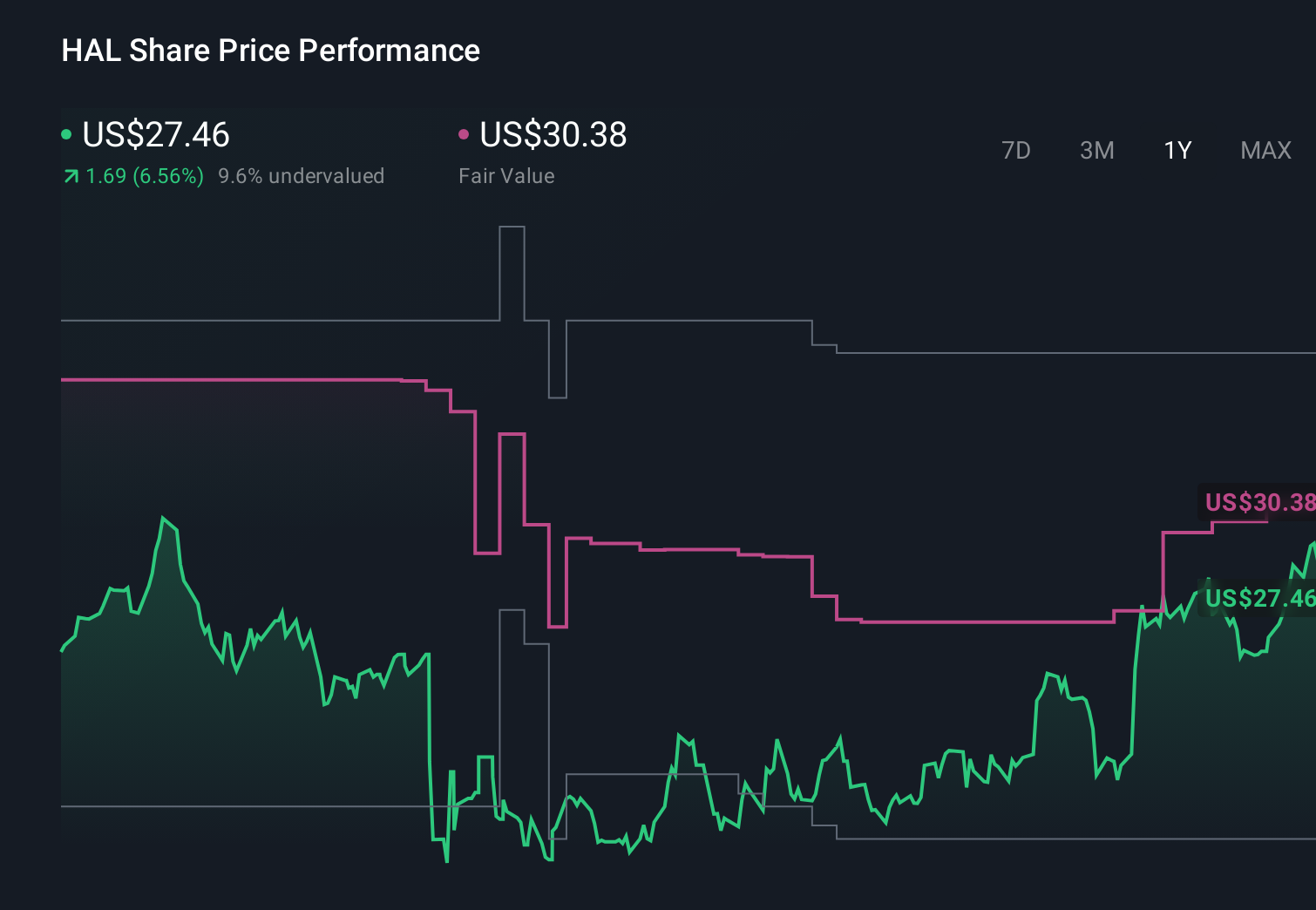
Some of the most optimistic analysts were already assuming Halliburton could reach about US$26.7 billion in revenue and US$3.3 billion in earnings, so if you see recent contract wins and automation progress as evidence for that stronger scenario, you may view the consensus worries about decarbonization and pricing differently and want to compare how your expectations stack up against both views.
Explore 5 other fair value estimates on Halliburton - why the stock might be worth over 2x more than the current price!
The Verdict Is Yours
Don't just follow the ticker - dig into the data and build a conviction that's truly your own.
- A great starting point for your Halliburton research is our analysis highlighting 4 key rewards and 2 important warning signs that could impact your investment decision.
- Our free Halliburton research report provides a comprehensive fundamental analysis summarized in a single visual - the Snowflake - making it easy to evaluate Halliburton's overall financial health at a glance.
Ready For A Different Approach?
These stocks are moving-our analysis flagged them today. Act fast before the price catches up:
- Find 55 companies with promising cash flow potential yet trading below their fair value.
- Capitalize on the AI infrastructure supercycle with our selection of the 55 best 'picks and shovels' of the AI gold rush converting record-breaking demand into massive cash flow.
- The best AI stocks today may lie beyond giants like Nvidia and Microsoft. Find the next big opportunity with these 16 smaller AI-focused companies with strong growth potential through early-stage innovation in machine learning, automation, and data intelligence that could fund your retirement.
This article by Simply Wall St is general in nature. We provide commentary based on historical data and analyst forecasts only using an unbiased methodology and our articles are not intended to be financial advice. It does not constitute a recommendation to buy or sell any stock, and does not take account of your objectives, or your financial situation. We aim to bring you long-term focused analysis driven by fundamental data. Note that our analysis may not factor in the latest price-sensitive company announcements or qualitative material. Simply Wall St has no position in any stocks mentioned.