

13F Insights: PIF Trims U.S. Stock Portfolio to $12 Billion, Uber (UBER) Remains Top Holding, Exits Allurion (ALURW)
Allurion Technologies, Inc. ALURW | 0.00 | |
Uber Technologies,Inc. UBER | 0.00 | |
Electronic Arts Inc. EA | 0.00 | |
Lucid LCID | 0.00 | |
Clarivate PLC CLVT | 0.00 |
Ready to invest like the pros? Subscribe to The Trend Catcher Topic to catch the latest trends and unlock the US stock 'smart money' dynamics!
Saudi Arabia’s Public Investment Fund is tightening its grip on its U.S. portfolio, drastically narrowing its focus while shifting capital into safer, liquid assets.
According to its latest 13F filing with the Securities and Exchange Commission, the Saudi sovereign wealth fund reduced the value of its U.S. equity holdings to $12 billion in the first quarter of 2026, down from $12.95 billion at the end of 2025. The fund's U.S. portfolio is now hyper-concentrated, consisting of just four main companies.
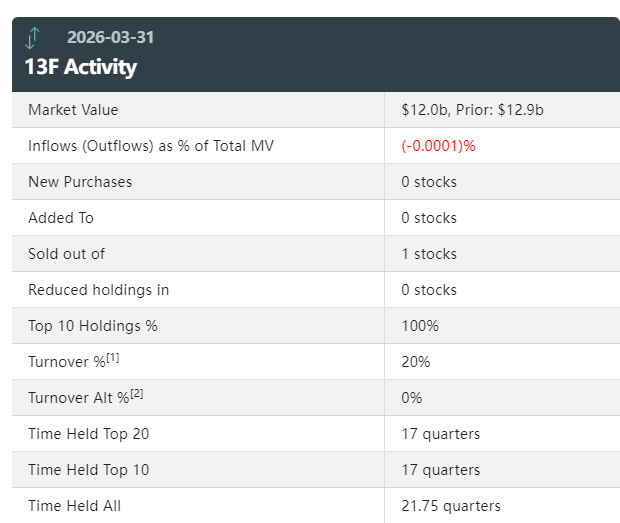
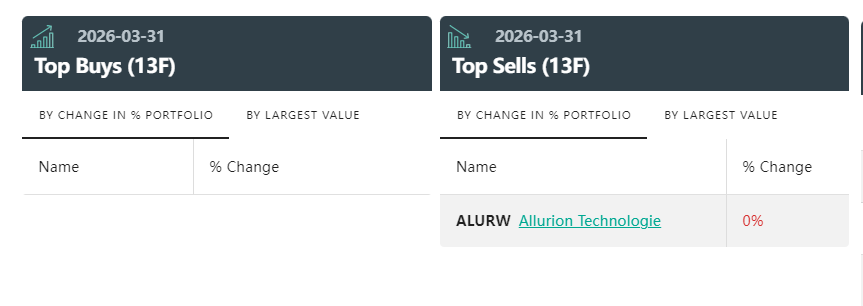
The PIF made no new stock purchases during the quarter. Instead, it completely liquidated its stake in Allurion Technologies, Inc.(ALURW.US), divesting 1.1 million shares. $alur
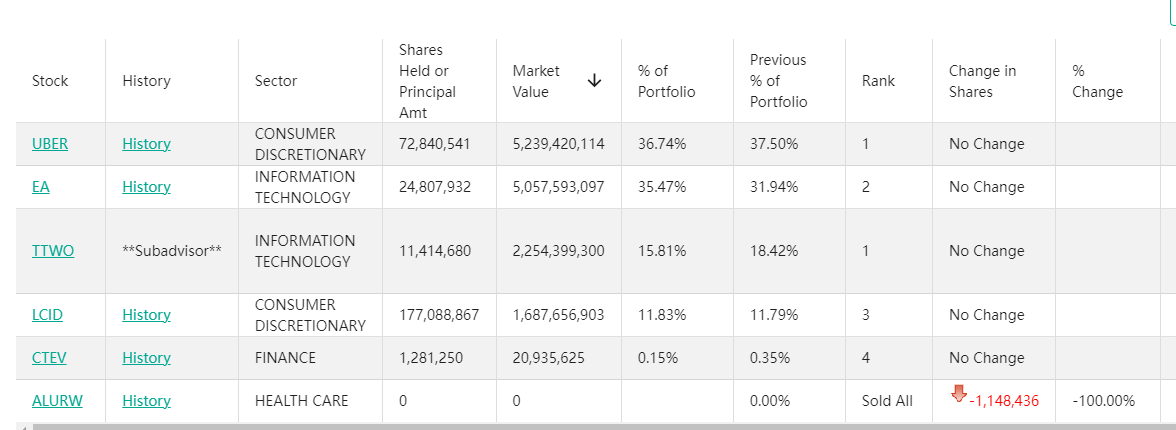
The fund maintained its positions in its four remaining U.S.-listed names, though the market value of those stakes saw fluctuations:
- Uber Technologies,Inc.(UBER.US): Remains PIF’s largest holding. The fund held onto its 72.8 million shares, though the position's value fell to $5.23 billion from $5.95 billion in the previous quarter.
- Electronic Arts Inc.(EA.US): Position maintained at 24.8 million shares, valued at roughly $5.05 billion.
- Lucid(LCID.US): Position held steady at 177.1 million shares, with the value dropping to $1.68 billion from $1.87 billion.
- Clarivate PLC(CLVT.US): Maintained at 1.3 million shares, with the value sliding to $20.9 million from $54.8 million.
A Pivot to Liquidity and Vision 2030
Market watchers and analysts are closely tracking the reshuffle, but experts say the sell-off should not be viewed as a bearish signal on the U.S. market. Rather, it reflects a broader strategic shift as Saudi Arabia accelerates its "Vision 2030" initiative to diversify its economy away from oil.
Simultaneous to trimming its equity exposure, Saudi Arabia has significantly ramped up its purchases of U.S. government debt. Recent Treasury International Capital data showed the Kingdom’s U.S. Treasury holdings jumped 19% in February to a multi-year high of $160.4 billion, driven heavily by short-term securities.
"PIF’s reduction in US equity holdings should not necessarily be viewed as a retreat from US markets, but rather as part of a broader portfolio recalibration and capital allocation strategy," said Tony Hallside, CEO of STP Partners. He noted that as Saudi Arabia undergoes a massive domestic transformation, the fund is naturally becoming more selective in its international deployments.
Ahmed Azzam, head of market research at Equiti Group, echoed this sentiment, calling the move a "classic liquidity-first positioning" meant to earn yield and maintain flexibility amid shifting global market conditions and funding costs.
"That looks less like a wholesale retreat from US equities and more like portfolio discipline, fewer names, cleaner exposure, and less capital tied up in positions that no longer fit the strategic direction," Azzam noted. Under the PIF’s 2026–2030 roadmap, U.S. equities are transitioning from a flagship allocation to a more "adjustable sleeve" that can be scaled without disrupting core domestic missions like clean energy, logistics, and technology.
Despite the slimmer U.S. stock portfolio, the PIF remains an absolute powerhouse in global markets. According to research firm Global SWF, the Saudi fund committed approximately $36.2 billion to investments in 2025, the most of any sovereign wealth fund globally.