

$1B Bitcoin Short Squeeze: COIN +9.55%, CRCL +9.56%—Can the Rally Last?
Coinbase COIN | 0.00 | |
BTC Digital Ltd. BTCT | 0.00 | |
Circle CRCL | 0.00 | |
Strategy MSTR | 0.00 | |
MARA Holdings MARA | 0.00 |
Bitcoin has suddenly reclaimed $70,000 level, but the most important part of Wednesday’s move was not the round-number breakout itself.
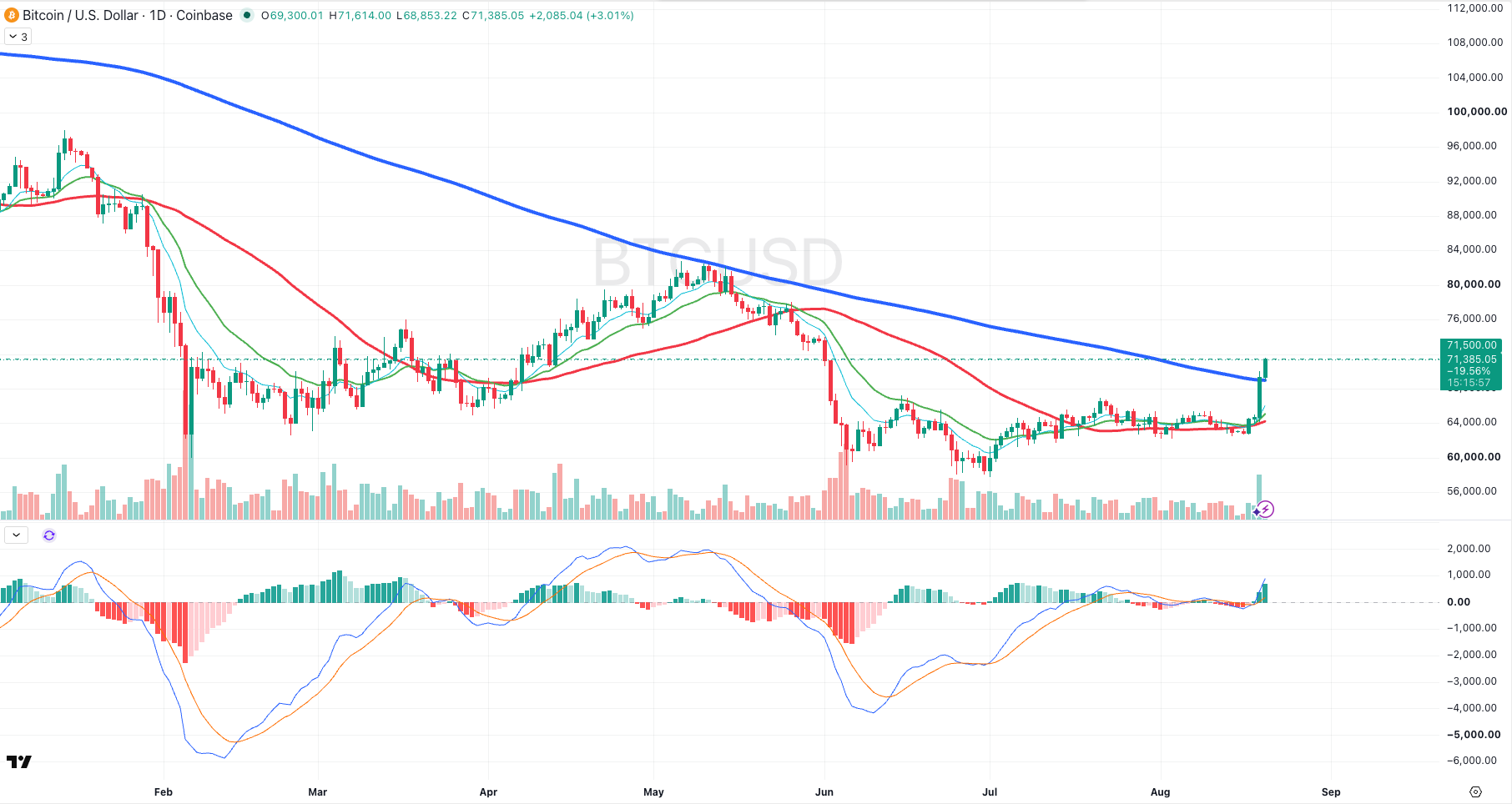
Three forces converged at once: the U.S. Treasury unexpectedly stepped up support for the long-end bond market, Washington delivered fresh crypto-friendly regulatory signals, and heavily crowded Bitcoin shorts were forced to unwind.
That combination turned an initial macro rally into a much larger squeeze—and sent crypto-linked stocks sharply higher.
The Primary Driver: Lower Yields Started It, Leverage Amplified It
The U.S. Treasury said it will double liquidity-support buybacks for 10- to 30-year Treasuries from $2 billion to at least $4 billion per operation, effective from September 9 through November 4. The announcement came after the 30-year Treasury yield had touched roughly 5.34%, its highest since 2007. Yields subsequently fell by nearly 10 basis points, while the dollar weakened.
For Bitcoin, the transmission mechanism was straightforward:
Treasury support → lower long-term yields + weaker dollar → improved risk appetite → Bitcoin breakout → forced short covering.
This is the number that matters most: according to Coinglass data, more than $1 billion of Bitcoin short positions were liquidated in roughly one hour as prices accelerated higher.
That matters because forced liquidation creates mechanical buying. A short seller exiting a position must buy back the asset, which pushes the price higher and can trigger the next layer of stops.
In other words, policy helped light the match, but positioning supplied much of the fuel.
Bitcoin once traded as high as $71,998 today, its highest level since early June.
Why the Treasury Move Matters—but Should Not Be Mistaken for QE
The Treasury intervention also deserves some investor education.
These are primarily liquidity-support buybacks of older, less-liquid Treasury securities. The Treasury is not eliminating the government’s financing requirement, and the operation does not directly solve the fiscal deficit or the large supply of bonds still coming to market.
If the purchases are ultimately offset by greater bill or other Treasury issuance, the policy is better understood as maturity management with an Operation Twist-like effect: reducing some long-duration supply while funding the government elsewhere on the curve.
That distinction matters.
Evercore ISI argued that the surprise could attract buyers and trigger short covering, but stressed that the underlying financing requirements remain largely unchanged. Reuters similarly noted that the extra $2 billion per operation is small relative to the roughly $32 trillion Treasury market.
So the bullish implication for Bitcoin is conditional: if long yields resume climbing and the dollar rebounds, part of Wednesday’s macro tailwind could quickly reverse.
Washington Added a Second Catalyst
Crypto-specific policy developments reinforced the move.
President Donald Trump hosted crypto-industry executives at the White House and called for Congress to advance the CLARITY Act, while the SEC separately proposed a framework that would exempt certain crypto companies and token offerings from traditional securities-registration requirements.
For investors, these developments affect different crypto stocks in different ways.
Coinbase(COIN.US) is particularly sensitive to trading activity, asset prices and regulatory clarity because higher market participation can support transaction and related revenue.
Circle(CRCL.US) is more closely tied to stablecoin adoption and regulatory normalization than to Bitcoin itself.
Strategy(MSTR.US) remains a high-beta Bitcoin treasury proxy, while MARA Holdings(MARA.US) adds mining economics—Bitcoin prices matter, but so do network difficulty, power costs and mining efficiency.
Crypto Stocks: Wednesday’s Surge Is Extending Into Premarket
The market snapshot shows another round of gains in Thursday premarket trading after Wednesday’s strong closes.
| Stock | Wednesday Gains | Thursday Premarket Move (4:30am ET) | Average Analyst Target |
|---|---|---|---|
| Circle(CRCL.US) | 9.56% | +6.10% | $101.00 |
| Coinbase(COIN.US) | 9.55% | +6.80% | $203.14 |
| Strategy(MSTR.US) | 12.68% | +8.04% | $257.75 |
| MARA Holdings(MARA.US) | 7.7% | +4.46% | $15.50 |
Note: Average target prices are market analyst consensus figures and may change as analysts update estimates.
The follow-through is notable because these stocks had already rallied strongly during Wednesday’s regular session: Strategy gained 12.68%, Coinbase 9.55%, and Circle 9.56%.
Analyst targets should not be read as guaranteed upside. In fast-moving crypto equities, both the share price and analyst assumptions can change much faster than consensus databases update.
The Rally Is Broader Than COIN and MSTR
Market snapshot shows that speculative appetite spread deep into the crypto-equity universe.
Among the largest moves were BTC Digital Ltd.(BTCT.US) +79.97%, Cypherpunk Technologies Inc. Ordinary Shares(CYPH.US) +32.85%, Hyperliquid Strategies, Inc(PURR.US) +30.42%, Nakamoto Inc.(NAKA.US) +20.96%, BTCS(BTCS.US) +16.67%, BitGo Holdings, Inc. Class A(BTGO.US) +15.96%, and Strive(ASST.US) +15.08%, BitMine Immersion Technologies(BMNR.US) +10.72%.
That breadth is constructive for sentiment, but it also signals how powerful the leverage and positioning component has become. Smaller crypto-linked equities typically carry substantially more company-specific, liquidity and volatility risk than Bitcoin and Ethereum themself.
Gold Is Giving Investors a Cross-Asset Confirmation Signal
Bitcoin was not the only asset responding.
As Treasury yields and the dollar fell Wednesday, spot gold jumped more than 4% to around $4,520 an ounce, while Bitcoin and Ether also advanced sharply.
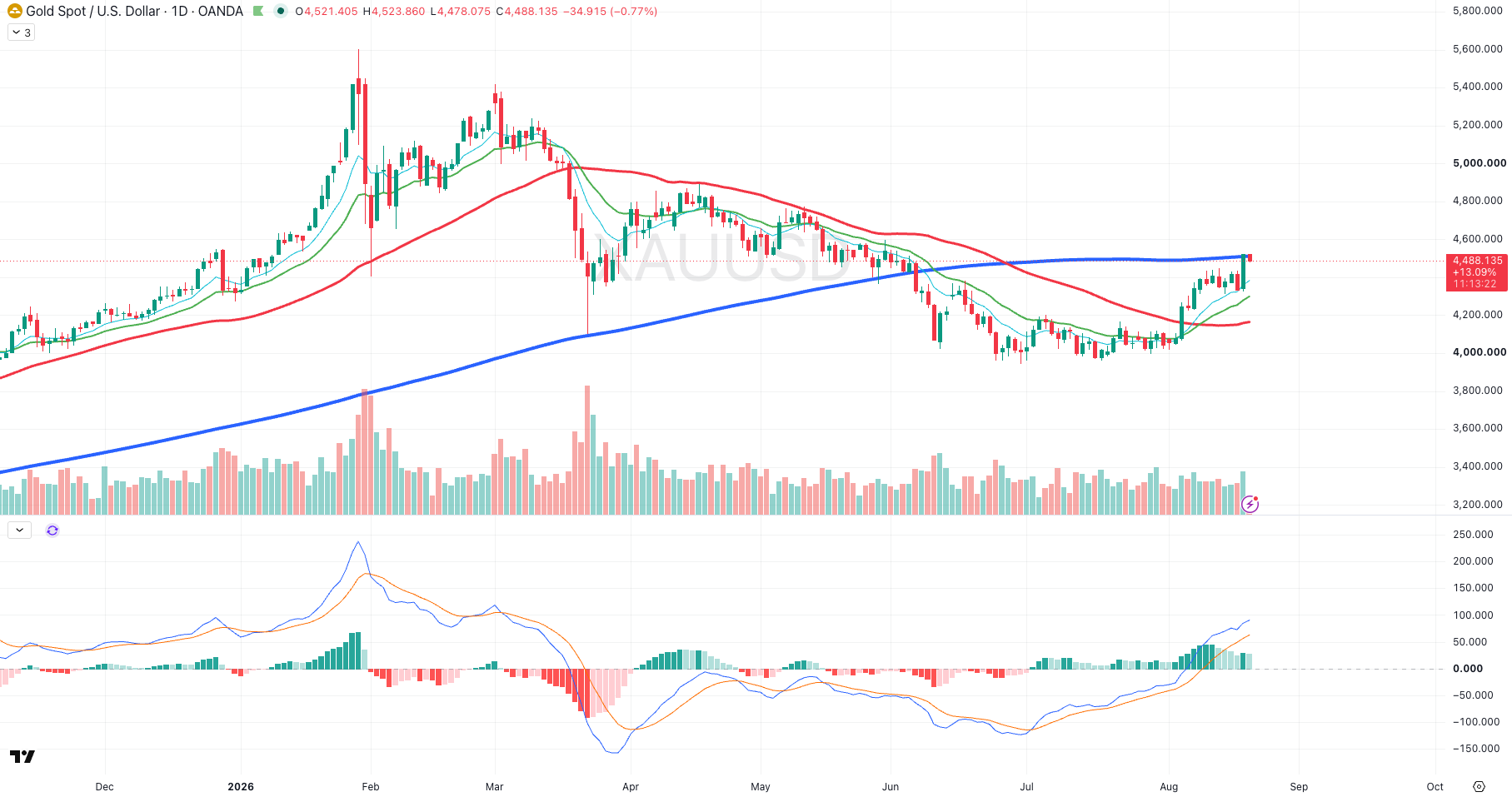
That makes gold an important cross-check on the crypto narrative.
If both Bitcoin and gold rise while the dollar and long-term yields fall, the market may be trading something broader than crypto regulation: a repricing of dollar liquidity, sovereign-debt risk and the value of scarce or non-sovereign assets.
A Citi Japan FX view cited in the supplied research similarly argues that recent U.S. currency and Treasury policies strengthen the case for gold as a non-sovereign reserve asset.
For Bitcoin investors, this is useful because sustained strength in gold alongside a weaker dollar would support the macro component of the thesis. If gold fades while yields and the dollar reverse higher, it would weaken that confirmation.
The Next Test: Can Forced Buying Become Real Demand?
The immediate question is whether buyers remain after the short squeeze has run its course.
Technically, the supplied research notes that Bitcoin has recovered both its 100-day and 200-day moving averages. The next major upside area highlighted by IG technical analyst Axel Rudolph is around $75,000.
That creates a simple framework.
A sustained hold around $70,000, improving spot demand and continued participation after leverage normalizes would strengthen the case that the move is evolving from a squeeze into a broader trend.
A rapid fall back below the breakout area—particularly alongside rebounding Treasury yields and a stronger dollar—would suggest that Wednesday’s move was driven more by positioning than a durable change in demand.
Stocks & ETFs to Watch
| Ticker | Exposure | Why It Matters | What to Watch |
|---|---|---|---|
| Coinbase(COIN.US) | Core crypto infrastructure | Exchange activity benefits from higher crypto prices, volumes and regulatory clarity | Trading volumes and CLARITY Act progress |
| Strategy(MSTR.US) | Bitcoin treasury proxy | Highly sensitive to Bitcoin price and capital-market conditions | BTC holding above the breakout and MSTR valuation vs. BTC holdings |
| Circle(CRCL.US) | Stablecoin / payments | More directly exposed to stablecoin adoption and regulation | USDC growth and final U.S. crypto rules |
| MARA Holdings(MARA.US) | Bitcoin mining | Higher BTC prices can improve mining economics | BTC price, network difficulty and energy costs |
| Shares Bitcoin Trust(IBIT.US) | Spot Bitcoin ETF | Provides direct exchange-traded exposure to Bitcoin price | ETF flows and whether spot buying replaces short covering |
| VANECK VECTORS DIGITAL TRANSFORMATION ETF(DAPP.US) | Crypto-equity ETF | Diversified exposure to exchanges, miners and digital-asset infrastructure | Whether the rally broadens beyond a handful of high-beta names |
| 20+ Year Trsy Bond Ishares(TLT.US) | Macro signal | Tracks long-duration Treasuries and helps monitor the yield channel behind the rally | Whether long-bond prices hold Wednesday’s rebound |
| SPDR Gold(GLD.US) | Cross-asset proxy | Gold can confirm the weaker-dollar / sovereign-risk component of the trade | Dollar direction and long-term Treasury yields |
The Shares Bitcoin Trust(IBIT.US) is designed to reflect Bitcoin’s price, while the VANECK VECTORS DIGITAL TRANSFORMATION ETF(DAPP.US) provides broader exposure to companies participating in the digital-asset economy. The 20+ Year Trsy Bond Ishares(TLT.US) offers a direct read on long-duration Treasury prices, and SPDR Gold(GLD.US) tracks gold bullion.
Near-term catalyst: whether Bitcoin can convert ~$70,000 level from resistance into support, whether Treasury yields remain contained, and whether Washington provides concrete follow-through on crypto regulation.
Medium-term thesis: a durable crypto re-rating requires more than short covering. Investors may want to monitor spot demand, ETF flows, stablecoin adoption, trading activity and regulatory implementation.
Structural risk: Treasury buybacks do not remove the U.S. deficit, inflation risks or long-term bond supply. If those pressures push yields higher again, the liquidity backdrop that helped drive Wednesday’s rally could reverse.
Disclaimer: This article is for informational purposes only and does not constitute investment advice or a recommendation to buy or sell any securities.