

5 ETFs to Play 2026's Top-Performing Markets
WisdomTree Japan Hedged Equity Fund DXJ | 0.00 | |
iShares MSCI Norway ETF ENOR | 0.00 | |
Ishares Msci Australia Index Fund EWA | 0.00 | |
iShares MSCI Sweden ETF EWD | 0.00 | |
iShares MSCI South Korea ETF EWY | 0.00 |
The S&P 500 is off to a dismal start in 2026, lagging most developed-market indexes as investors pull back from U.S. tech stocks with elevated valuations.
International diversification has been a winning strategy for investors over the last two years, and it appears to be gaining strength in 2026. But picking international stocks is hard, and accessing shares can be difficult (and expensive).
It's often more efficient to gain international exposure through ETFs.
Franklin FTSE South Korea ETF
South Korea is still technically considered an emerging market, but that designation is quickly becoming outdated thanks to its surging stock market and pro-growth government policies. The South Korean KOSPI index is up more than 30% to start 2026, and one of the best ways to play it is through the Franklin FTSE South Korea ETF (NYSE:FLKR). FLKR has a smaller market cap and fewer shares traded daily than the iShares MSCI South Korea ETF (NYSE:EWY), but its 0.09% expense ratio is hard to beat, and it pays a 2.9% dividend yield. It's a tech-heavy fund, with more than 40% of its assets allocated to shares of Samsung Electronics and SK Hynix alone.
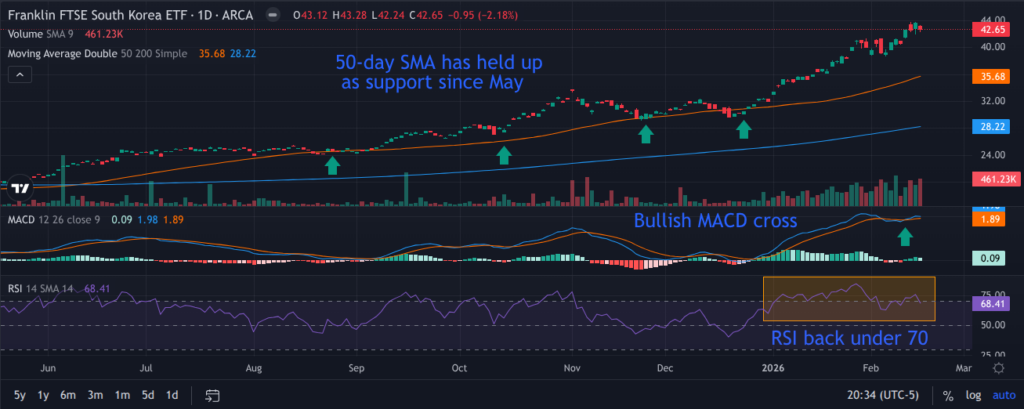
South Korea's government is incentivizing buybacks and dividends, which could narrow the ‘Korea Discount’ and re-rate some historically undervalued businesses. In addition to low expenses and a solid dividend, FLKR is in a strong uptrend, supported by the 50-day simple moving average (SMA). A bullish cross on the Moving Average Convergence Divergence (MACD) indicator confirms the uptrend, and the Relative Strength Index (RSI) is now back under the overbought threshold of 70.
White-Knuckled Enough Yet? Stop Predicting the Market – Start ‘Counter-Punching'
While everyone white-knuckled through last year’s chaos, a little-known protocol was quietly spotting winning stocks all 2025 long. Like First Majestic Silver in September before it soared as high as 181% the next five months. The secret? It doesn’t predict. It waits for the market to tip its hand – then strikes back with one of two proven ‘counter-punches.' Want to know which it's throwing for February? See the Stocks It’s Targeting Now
WisdomTree Japan Hedged Equity Fund
Japanese stocks are also breaking out to historic highs, with the Nikkei 225 up more than 11% so far this year. While it hasn't produced parabolic gains like South Korea's KOSPI, the new Prime Minister, Sanae Takaichi, has also proposed a number of pro-corporate policies, including investments in domestic energy. Currency concerns often give investors pause about Japanese equities, as Yen volatility can weigh on returns.
That's where the WisdomTree Japan Hedged Equity Fund (NYSE:DXJ) comes in. DXJ is a $6.5 billion fund with a 0.48% expense ratio, focusing on export-oriented dividend payers that avoid currency drag. By hedging Yen exposure, DXJ provides broad access to Japanese equities such as Toyota Motor, Mitsubishi UFJ, and Mizuho Financial without the risk of a strengthening dollar eroding returns. ‘Sell the dollar’ has been a good trade over the last 12 months, but if it gains against the Yen in 2026, this fund will neutralize it.

DXJ shares are up more than 14% so far this year, and technical tailwinds suggest further upside ahead. Like FLKR, the fund has strong support at the 50-day SMA and a bullish MACD. The latter hinted at some excessive exuberance as the MACD and signal lines began to separate, but a recent four-day losing streak has put the indicator back into a consolidation pattern. The overall trend remains bullish, and Japanese stocks have plenty of fundamental tailwinds to go along with it.
Global X MSCI Norway ETF
Norway is quietly one of Europe’s energy powerhouses, with its vast array of natural resources and its crucial role as one of the bloc's primary gas suppliers. The Norwegian OBX Index is off to a hot start this year, gaining more than 10% in just over six weeks. The Global X MSCI Norway ETF (NYSE:NORW) has outperformed this pace (14.8%) while charging a 0.51% expense ratio, which is lower than the iShares MSCI Norway ETF’s (BATS:ENOR) 0.53% expense ratio. NORW has a small asset base of $70 million, which limits liquidity, but it also offers a 3.02% dividend yield. The fund holds leading financial and energy firms such as Equinor and DNB Bank, with a blend of large-, mid-, and small-cap stocks amongst its 57 holdings.

NORW began breaking out last year when the share price soared above the 50-day and 200-day SMAs just as the MACD began a bullish crossover. The MACD has carried the trend higher ever since, and avoided a momentum reversal last week when the MACD and signal lines nearly crossed back over. Since only 12,000 shares trade daily on average, NORW can be a volatile ETF, but upward momentum remains strong.
iShares MSCI Australian Index Fund ETF
Australia is another commodity-rich continent, and its major market index, the ASX 200, is up 9.5% year to date. But it’s surprisingly difficult to trade on U.S. exchanges now that the Vanguard Australian index fund is no longer available. Today, investors' best bet for Australia exposure is the iShares MSCI Australian Index Fund (NYSE:EWA), which has $1.4 billion in assets and a 0.50% expense ratio. While the Franklin FTSE Australia ETF (NYSE:FLAU) is cheaper to own, its minimal asset base and high trading spreads offset some of those fees.

Despite its energy-rich reputation, EWA has more than 45% of its holdings in the financial sector, with another 27% in minerals. Shares of the fund had been trading in a tight range since November, but the signs of a breakout had been brewing before the recent uptrend. The MACD had been slowly gaining momentum over the winter months, and 50-day and 200-day SMAs remain in a bullish position while the RSI recedes under 70, a very good technical setup.
iShares MSCI Sweden ETF
Sweden's benchmark OMXS30 index is up more than 8% to start 2026, and the best way to play this market remains the iShares MSCI Sweden ETF (NYSE:EWD), which celebrates three decades of trading later this year. In its 30 years, the fund has amassed $350 million in assets and owns some of Sweden's largest and most important companies, like Spotify, Volvo, and Atlas Copco. The fund charges a 0.51% expense ratio and pays a 3.02% annual dividend yield.

Sweden has a high-trust society with a robust labor force and strong governance, which often bodes well for long-term growth prospects. EWD shares have been volatile over the last six months, but the trend continues to point upward, with strong support at the 50-day SMA and a calm RSI. If shares dip back to the 50-day SMA, it would likely represent a good entry point for new investors.