

AI and Defense in One Name: Can Palantir Carry the Software Narrative? Three Options Strategies to Watch
Palantir PLTR | 0.00 | |
Alphabet Inc. Class A GOOGL | 0.00 | |
PowerShares QQQ Trust,Series 1 QQQ | 0.00 | |
Leverage Shares 2X Long PLTR Daily ETF PLTG | 0.00 | |
NASDAQ IXIC | 0.00 |
Subscribe to The Trend Catcher Topic / The Value Anchor Topic —unlock the full historical archive and never miss a weekly pick again.
Few names capture the market's AI obsession like Palantir(PLTR.US)—part AI play, part defense contractor. The data-analytics firm reports fiscal Q2 results after the bell on August 3, 2026, and the stakes run well beyond a single print. Having become a proxy for the entire AI software complex, Palantir's quarter is less about clearing the bar than about what it signals for a sector caught in a jittery tech tape. Here's where expectations sit, what actually matters in the numbers, and what the options market is quietly telling us.
The Setup
The bar is high. The Street wants roughly $1.81 billion in revenue (+80% YoY) and GAAP EPS near $0.32—bulls say $0.35—more than double a year ago. That follows last quarter's $0.34 beat versus a $0.28 estimate on revenue up nearly 85%. String enough beats together, and they stop counting as surprises, which is the real risk for a stock priced for perfection.
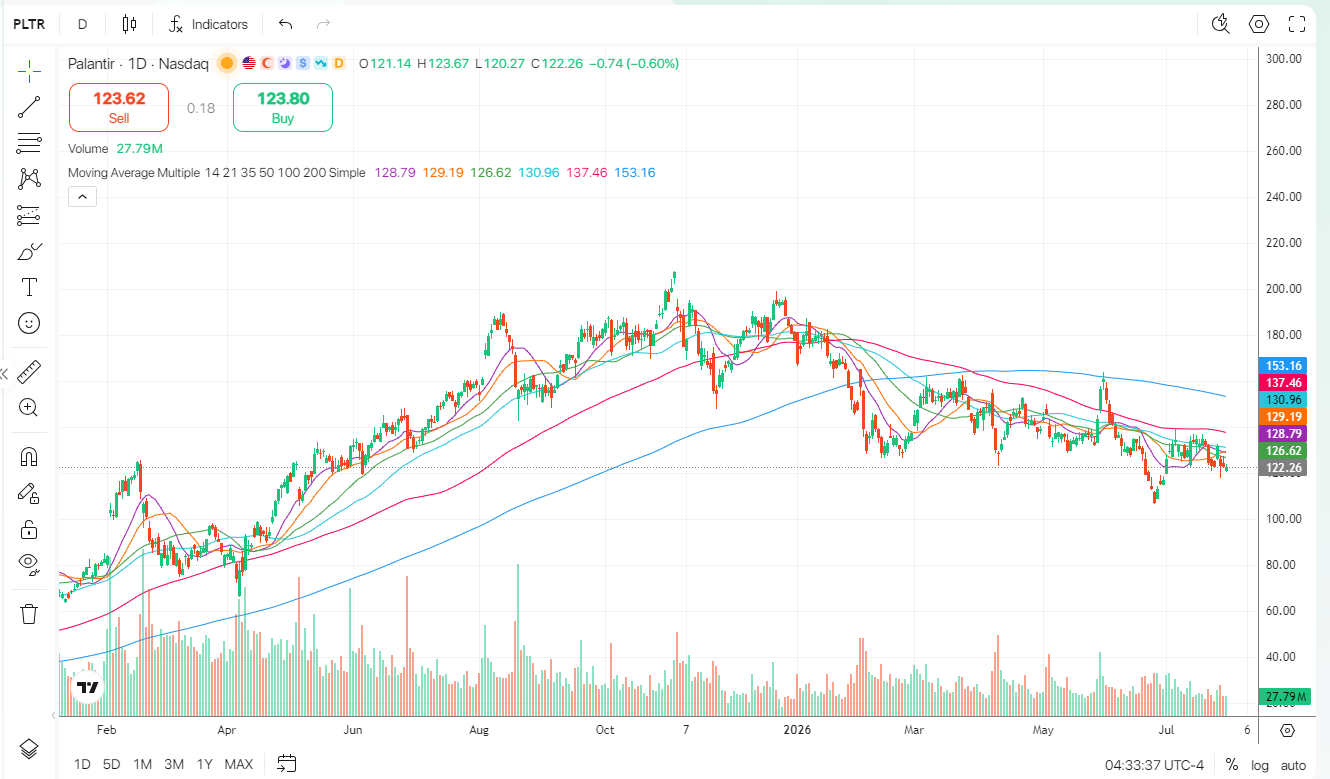
Valuation, at least, has cooled. The trailing multiple has compressed from a peak above 600x to about 137x—still rich, but only around the 40th percentile of its three-year range, and arguably defensible for a company set to more than double profits. On forward earnings it's closer to 79x, and with three straight years of GAAP profitability and roughly $2.3 billion in cash, the premium is finally starting to rhyme with the fundamentals.
What Actually Matters
Two growth engines, both firing.
Government remains the backbone. Palantir's edge here is structural—top-tier clearances, entrenched relationships across defense and intelligence, and switching costs that verge on prohibitive. Its Gotham platform sits at the center of critical military AI programs and drew particular attention during this year's U.S.–Iran flare-up. Federal momentum only accelerated in Q1, with government revenue hitting $687 million (+84%). A recent win in a procurement dispute at the Defense Intelligence Agency—which forced the agency to pull its solicitation—only tightens Palantir's hold on the space.
The commercial story is murkier but improving. Bears worry that model providers like OpenAI and Anthropic will creep down the stack and eat Palantir's lunch. Bulls counter that orchestrating messy enterprise workflows inside locked-down, high-security environments is exactly where Palantir's moat lives. June's AIP developer event added a proof point: a multi-layered tie-up with Alphabet Inc. Class A(GOOGL.US) that federates data both ways and plugs Gemini into AIP across varying security tiers.
Watch the backlog, not just the beat.
The more telling numbers may be Remaining Deal Value (RDV) and Total Contract Value (TCV)—the truest read on how sticky demand really is. Q1 showed U.S. commercial RDV surging 112% to $4.92 billion and TCV up 45% to $1.18 billion, with 206 seven-figure deals closed. With full-year adjusted free cash flow guidance now lifted to $4.2–4.4 billion, another quarter of that pace would go a long way toward validating the long-term cash-flow story.
The hardware-to-software handoff.
Here's the bigger picture. For most of 2026, the trade was simple: buy the picks and shovels. Chips (via the SOX) ran; software (via IGV) lagged as cheaper foundation models pressured the group. But July flipped the script—hardware started rolling over, and money began drifting back toward software. Palantir, which has traded in lockstep with the software group since topping out last November, is the cleanest test of whether AI value is finally migrating from silicon to applications. Prove the pricing power and adoption are real, and it could help lead that rotation.
Subscribe to The Trend Catcher Topic / The Value Anchor Topic —unlock the full historical archive and never miss a weekly pick again.
Reading the Options Tape
The market is bracing for a move of roughly ±11.8% on the print—middling by Palantir's own standards. Positioning leans bullish: a put/call ratio of 0.52 says traders are loading up on calls into the event. Implied volatility, meanwhile, has done its usual pre-earnings ramp, with an IV rank of ~72 and an IV percentile of 92—about as stretched as it gets.
The catch is what comes after. That elevated IV is prone to collapse the moment results drop, and outright long calls or puts need both the right direction and a big enough move to earn back a fat premium. In this kind of setup, spreads and premium-selling strategies deserve a harder look.
Bull call spread — for the measured optimist. If you think Palantir beats again and nudges guidance higher but don't want to overpay for a naked call, buy an at-the-money call and sell a higher strike against it. You cut your cost, blunt some of the post-earnings IV crush, and cap your upside in return.
Bear put spread — for the valuation skeptic. If ~138x still looks like too much, and you're braced for a "good news, no reaction" fade, buy an ATM (or slightly in-the-money) put and finance it by selling a lower strike. You trim the premium, soften the IV hit, and pull in your breakeven—giving up only the tail scenario where shares crater below your short strike.
Cash-secured put — for the patient buyer. Long-term believer in the AI-plus-defense thesis but think 137x is a touch full? Sell an out-of-the-money put and set aside the cash to take 100 shares if assigned. Pick a strike where you'd genuinely want to own it—historically, something in the -10% to -15% zone near support. With IV elevated, the premium is generous. If shares hold above the strike, you simply keep it. If they don't, you get put the stock at an effective discount—provided you have the conviction and the capital to hold through any deeper drawdown.
A Word of Caution
None of this is a recommendation. Estimates can miss, past beats guarantee nothing, and every options strategy here carries real risk—especially around a catalyst this binary. Size positions to your own tolerance and do your own work before acting.