

Amazon (AMZN) Stock May Trade At A Discount To Fair Value
Amazon.com, Inc. AMZN | 0.00 |
Amazon.com stock has delivered a very strong 3 year run, yet current valuation checks suggest the market price may still sit below what its fundamentals imply. Both an intrinsic value estimate using a Discounted Cash Flow (DCF) approach and the earnings multiple view point in the same direction rather than signaling a clear stretch in pricing.
- Amazon.com has returned 103.0% over the past 3 years, which puts extra focus on whether recent gains already reflect its cash flow potential or still leave some room relative to intrinsic value estimates.
- Heavy spending on artificial intelligence, cloud and new projects like Zoox robotaxis can support expectations for future cash generation, while ongoing regulatory and legal scrutiny may weigh on how much investors are willing to pay for those future cash flows.
- Amazon.com scores 4 out of 6 on the broader valuation checks at https://www.simplywall.st/stocks/us/retail/nasdaq-amzn/amazoncom/valuation, which points to a mixed picture rather than a clear bargain or clear overvaluation.
For investors, the debate is whether Amazon.com's recent share price strength already reflects the value indicated by the Discounted Cash Flow (DCF) and multiples, or if the current US$284.02 level still sits at a discount that could close over time.
Is Amazon.com a Bargain on Cash Flow?
The Discounted Cash Flow (DCF) method estimates what Amazon.com is worth today based on the cash it is expected to generate in the future. For Amazon.com, the model uses latest twelve month free cash flow of about $32.6b and assumes those cash flows keep growing rather than staying flat or declining. On that basis, the DCF calculation produces an estimated intrinsic value of around $429 per share.
That compares to the current share price of about $284. On this set of cash flow assumptions, the stock screens as roughly 33.9% below that estimated intrinsic value. News such as Zoox receiving approval to deploy driverless robotaxis commercially in the US helps explain why the model applies a growth path that extends beyond the core retail and cloud businesses.
On this Discounted Cash Flow view, Amazon.com stock currently appears undervalued relative to its estimated intrinsic worth.
Our Discounted Cash Flow (DCF) analysis suggests Amazon.com is undervalued by 33.9%. Track this in your watchlist or portfolio, or discover 53 more high quality undervalued stocks.

Is Amazon.com Still Cheap on Earnings?
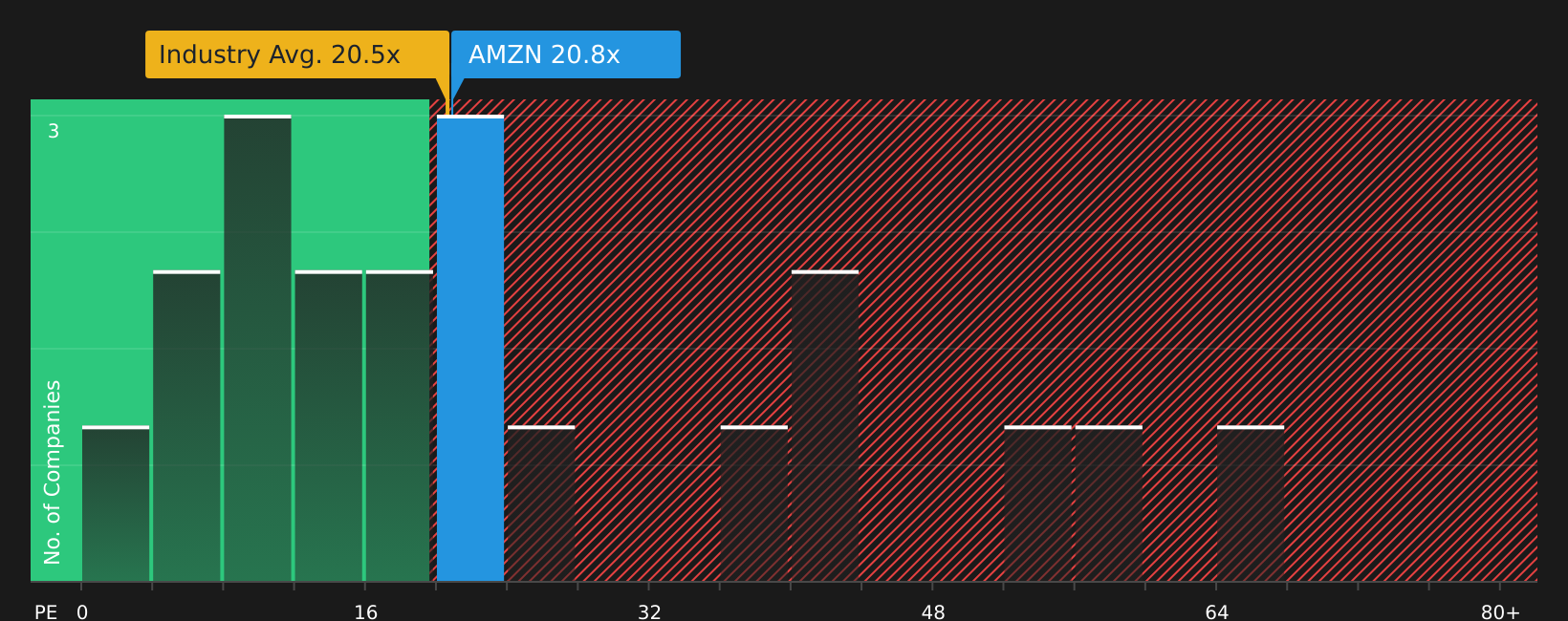
The P/E ratio fits Amazon.com well because earnings have become a key focus alongside revenue and cash flow. On this metric, Amazon.com trades on about 22.6x earnings, which sits below both the broader multiline retail industry average of roughly 19.9x and the peer group average of about 30.0x. That places the stock between more traditional retailers and higher rated large cap peers.
The Fair P/E Ratio model, which factors in Amazon.com size, margins and risk profile, points to a P/E of around 37.6x as a more appropriate level. Set against the current 22.6x, that suggests the stock trades at a discount compared with what this framework indicates investors might usually pay for its earnings profile. On this basis, the earnings multiple view aligns with the DCF work and indicates the market is not paying a premium price for each dollar of Amazon.com earnings.
Taken together, Amazon.com appears undervalued on its P/E multiple relative to the fair ratio implied by its fundamentals.
The Amazon.com Narrative: What Would Justify Today's Price?
Simply Wall St Narratives pick up where this valuation puzzle for Amazon.com leaves off. They spell out the specific assumptions on growth, margins and earnings that would need to hold for the stock to be worth meaningfully more or less than today, and sit on Simply Wall St's Community page. Each Narrative ties a fair value to a clear story about Amazon.com's potential catalysts and risks, allowing you to track which scenario is gradually taking shape.
The community sits on very different sides of the fence on Amazon.com, with one camp seeing meaningful upside and the other seeing limited value at current levels.
Bull case: 37% undervalued
"Amazon is sacrificing short-term margins to secure long-duration dominance in AI infrastructure, advertising, and automated commerce..."
Bear case: 21% overvalued
"The only two negatives I took from it was AWS not growing to revenue expectations and then also during the Q and A they were asked about AI innovation and so on, and they never really never answered the questions and were just very vague..."
Do you think there's more to the story for Amazon.com? Head over to our Community to see what others are saying!
The Bottom Line
Amazon.com screens as undervalued on both the Discounted Cash Flow (DCF) intrinsic value estimate and the earnings multiple, with neither pointing to an extreme disconnect. The broader checks still flag a mixed picture, so the current discount may reflect real concerns around regulation, legal risks and the cost of big projects like AI and Zoox rather than a clear mispricing. The key issue for investors is whether Amazon.com can convert its heavy investment into durable cash generation without regulatory setbacks that keep the stock trading on a lower multiple.
This article by Simply Wall St is general in nature. We provide commentary based on historical data and analyst forecasts only using an unbiased methodology and our articles are not intended to be financial advice. It does not constitute a recommendation to buy or sell any stock, and does not take account of your objectives, or your financial situation. We aim to bring you long-term focused analysis driven by fundamental data. Note that our analysis may not factor in the latest price-sensitive company announcements or qualitative material. Simply Wall St has no position in any stocks mentioned.