

Assessing KKR (KKR) After Recent Share Price Weakness And Private Markets Headwinds
KKR & Co KKR | 0.00 |
- Wondering whether KKR at around US$94.76 is starting to look attractively priced, or if the recent weakness is a warning sign for your portfolio?
- The stock is down 4.8% over the past week, 9.3% over the past month, 26.5% year to date and 19.3% over the past year. The 3 year and 5 year returns stand at 90.9% and 77.5% respectively.
- Recent coverage around private markets, fundraising conditions and deal activity has kept attention on global alternative asset managers such as KKR. This backdrop, along with shifting sentiment on interest rates and risk appetite, provides important context for the share price moves you are seeing.
- KKR currently has a value score of 3 out of 6. The rest of this article will walk through how different valuation methods line up for the stock and point to an even more useful way to think about valuation by the end.
Approach 1: KKR Excess Returns Analysis
The Excess Returns model looks at how much profit a company can generate above the return that equity investors require, then capitalises those surplus profits into an estimated value per share.
For KKR, the model uses a Book Value of $31.43 per share and a Stable EPS of $8.71 per share, based on weighted future Return on Equity estimates from 5 analysts. The Average Return on Equity is 12.46%, compared with a Cost of Equity of $6.40 per share. That spread translates into an Excess Return of $2.32 per share, which is the core engine of this valuation.
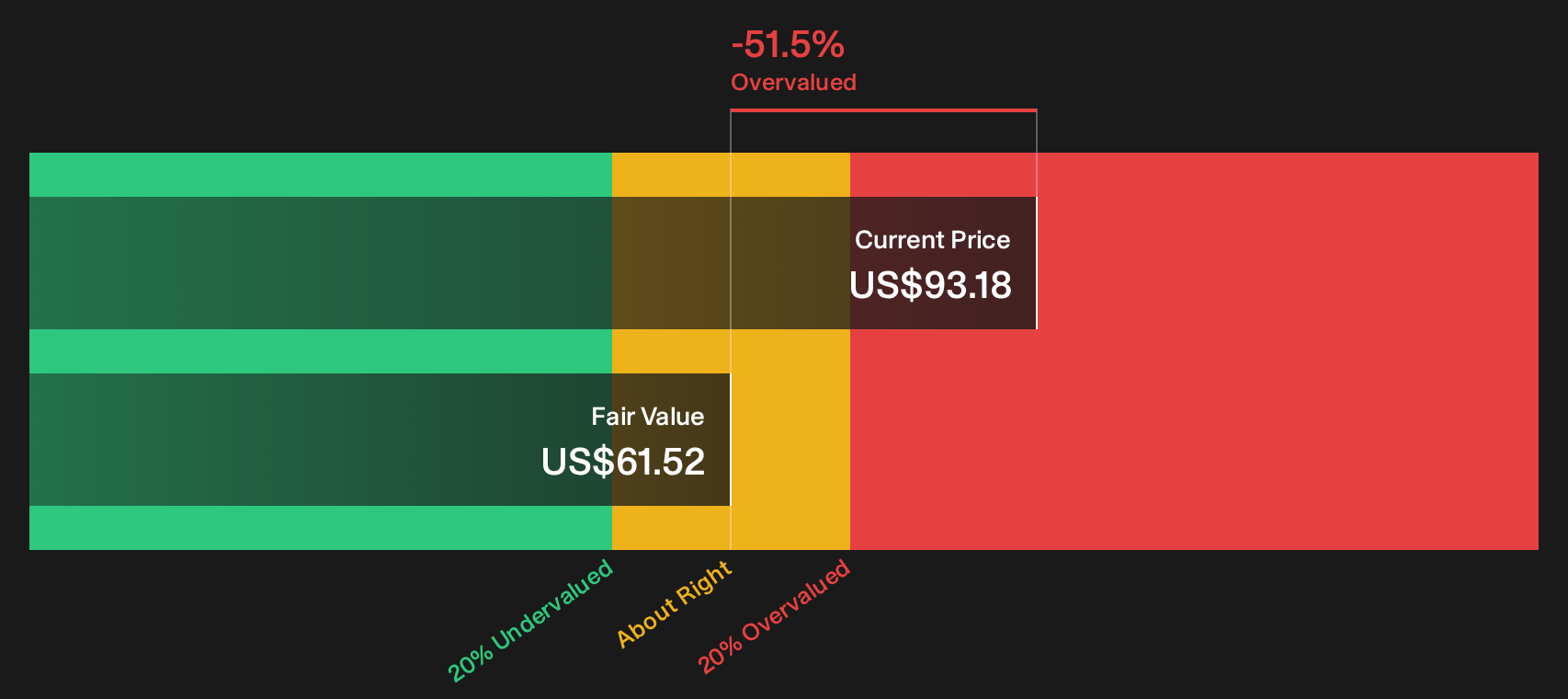
The analysis also assumes a Stable Book Value of $69.92 per share, sourced from weighted future Book Value estimates from 4 analysts. Combining these inputs, the Excess Returns model points to an intrinsic value of about $111.23 per share, compared with the recent share price around $94.76. On this framework, the stock appears 14.8% undervalued.
Result: UNDERVALUED
Our Excess Returns analysis suggests KKR is undervalued by 14.8%. Track this in your watchlist or portfolio, or discover 53 more high quality undervalued stocks.
Approach 2: KKR Price vs Earnings
For a profitable company, the P/E ratio is a straightforward way to link what you pay today with the earnings the business is currently generating. It tells you how many dollars investors are paying for each dollar of earnings.
What counts as a "normal" P/E will usually reflect how the market views a company’s growth outlook and risk profile. Higher expected growth or lower perceived risk can justify a higher multiple, while slower growth or higher risk typically points to a lower multiple.
KKR trades on a P/E of 30.36x, compared with the Capital Markets industry average of about 40.12x and a peer group average of 29.36x. This places the stock below the broader industry level but slightly above its peers.
Simply Wall St also calculates a proprietary “Fair Ratio”, which is the P/E multiple that would be expected for KKR given factors such as its earnings growth, industry, profit margin, market cap and key risks. This can be more useful than a simple peer or industry comparison because it adjusts for the specific characteristics of the business rather than assuming all companies deserve similar multiples.
Because a Fair Ratio is not available here, it is not possible to reach a clear conclusion on whether the current P/E suggests KKR is overvalued, undervalued or about right.
Result: ABOUT RIGHT

P/E ratios tell one story, but what if the real opportunity lies elsewhere? Start investing in legacies, not executives. Discover our 20 top founder-led companies.
Upgrade Your Decision Making: Choose your KKR Narrative
Earlier it was mentioned that there is an even better way to understand valuation, so Narratives put your view of KKR into a simple story that links assumptions about future revenue, earnings, margins and fair value to a clear comparison with today’s share price. This all happens inside the Simply Wall St Community page, where Narratives update automatically when new results or news arrive. There you can see, for example, one investor building a cautious KKR Narrative around a fair value near US$84 per share, while another leans on a more optimistic fair value near US$176. This gives you two concrete stories you can compare with your own before deciding whether the gap between your fair value and the current US$94.76 price feels wide enough to act on.
For KKR however, we will make it really easy for you with previews of two leading KKR Narratives:
These sit on opposite sides of the valuation debate, so you can quickly see which storyline feels closer to your own view of the stock at around US$94.76.
Fair value: about US$140.24 per share
Gap to fair value: trading roughly 32.4% below this narrative fair value
Revenue growth assumption: revenue declining at about 17.85% a year
- Frames KKR as a future fee powerhouse, with data center deals, IPO candidates and a broad private markets platform feeding long term fee and carry potential.
- Leans on accelerating fundraising, expanding credit and asset based finance, and a large pool of unrealized carried interest to support higher future earnings and margins.
- Flags risks around private credit, competition, regulation and potential fee pressure, but concludes that analysts’ consensus fair value still sits well above the recent share price on the assumptions used.
Fair value: about US$84.45 per share
Gap to fair value: trading roughly 12.2% above this narrative fair value
Revenue growth assumption: revenue growing at about 7% a year
- Treats KKR as a solid but complex permanent capital platform where the stock already reflects much of the quality and growth in fee related and insurance earnings.
- Uses a conservative Buffett style owner earnings approach, stress tests private credit and AUM, and still finds that intrinsic value clusters in the US$105 to US$120 range under base assumptions, but falls meaningfully under harsher credit shocks.
- Argues that compared with peers like Blackstone and Apollo, KKR sits in the middle on both risk and potential reward, so the stock looks reasonable rather than clearly cheap when credit risk is front of mind.
If you want to see how other investors are building out their own versions of these stories for KKR, it is worth reviewing the full narrative range on the Community page before making any portfolio decisions.
Do you think there's more to the story for KKR? Head over to our Community to see what others are saying!

This article by Simply Wall St is general in nature. We provide commentary based on historical data and analyst forecasts only using an unbiased methodology and our articles are not intended to be financial advice. It does not constitute a recommendation to buy or sell any stock, and does not take account of your objectives, or your financial situation. We aim to bring you long-term focused analysis driven by fundamental data. Note that our analysis may not factor in the latest price-sensitive company announcements or qualitative material. Simply Wall St has no position in any stocks mentioned.